.svg)

.png)
- 10 Best Influencer CRM Software Tools for Brands in 2026
- Quick Comparison: The Best Influencer CRM Software at a Glance
- The Best Influencer CRM Software for 2026
- 1. Afluencer
- 2. Influencer Hero
- 3. Amplify
- 4. Influencity
- 5. Modash
- 6. GRIN
- 7. Upfluence
- 8. Aspire
- 9. Traackr
- 10. CreatorIQ
- How to Choose the Right Influencer CRM in 2026
- Start Managing Creators the Easy Way
10 Best Influencer CRM Software Tools for Brands in 2026
Managing creators in a spreadsheet stops working the moment your program gets real. Once you're juggling outreach, contracts, product send-outs, payments, and performance across dozens of partners, you need a system, not a Google Sheet that one person understands. That system is an influencer CRM.
An influencer CRM keeps every relationship in one place: who you've contacted, what you agreed to, what they posted, and what it earned you. It turns a pile of DMs and email threads into a pipeline you can actually manage. The right one saves your team hours a week and tells you which partnerships are worth doubling down on.
The catch is that "influencer CRM" now covers everything from a free way to find creators to $50K-a-year enterprise software. So we ranked ten platforms by what they actually do and what they cost. We're leading with our top two picks, then running the rest from most affordable to full enterprise, so you can find the tier that fits your program right now.
Ready to find the influencer CRM that matches your stage? Let's break them down one by one.
Quick Comparison: The Best Influencer CRM Software at a Glance
The Best Influencer CRM Software for 2026
Every tool below handles the core CRM job: storing creator data, tracking communication, and managing campaigns in one dashboard. Where they differ is depth, price, and who they're built for. Some are lightweight and free to start. Others are enterprise platforms with six-figure contracts. Here's how they stack up.
1. Afluencer

Afluencer is the easiest place to start managing creators, because it flips the hardest part on its head. Instead of hunting for influencers and praying they reply, you post a "Collab" and verified creators apply to you.
From there, you match, message, and manage every collaboration and relationship from a single dashboard, which is the core of any influencer CRM. For brands that want inbound creator interest without an outreach team, it's the fastest path from zero to a managed program.
The numbers: Afluencer is free to start, and the Marketplace plan runs $49/month with 60 invitation credits, premium influencer filters, and phone, email, and live chat support. As your program grows, the all-in-one management tiers add real CRM muscle: Standard at $649/month brings 1,000 reach-outs, product send-outs, and influencer payments, while Pro at $1,049/month scales to 5,000 reach-outs, a dedicated account manager, and 3+ seats. Everything is billed monthly with no annual lock-in.
What makes Afluencer stand out is how little friction there is to launch. You can have a Collab live and applications coming in the same day, then manage those relationships as the program matures. It's also a natural fit for finding the right influencer to promote your brand when you'd rather review motivated applicants than cold-pitch strangers.
2. Influencer Hero
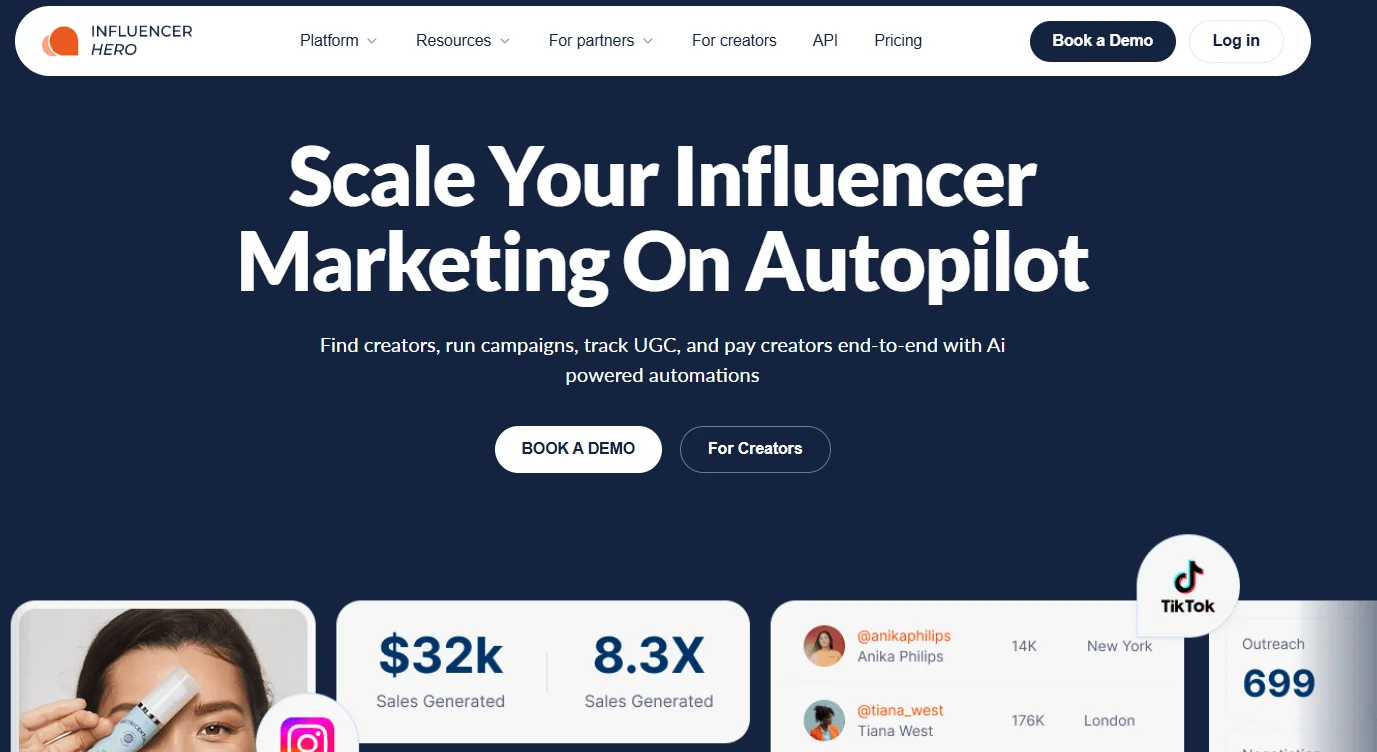
Influencer Hero is the most complete CRM on this list, and that's exactly why it sits at number two. The whole platform is built around a true influencer CRM, so instead of bolting relationship tracking onto a discovery tool, you get a system designed from the ground up to run every creator partnership end to end.
In the CRM, each creator gets a single deal page where communication history, payouts, UGC, and performance all live, so your team always has the full picture. It's especially strong for mid-market and Shopify or WooCommerce brands running performance-driven programs.
The numbers: Plans start at $649/month, or $454/month on annual billing (about $5,452/year), with a 3-month minimum commitment and no free trial. Higher tiers add capacity and seats. Reviews are consistently strong on G2 and Software Advice, with email automation and the all-in-one workflow cited most often.
The honest caveat: that entry price plus the commitment makes it a better fit for brands running influencer marketing as a consistent channel than for teams just testing the water. If you only need a few creators a quarter, it's more platform than you'll use. But if you're scaling and tired of stitching five tools together, the centralized workflow earns its keep fast.
3. Amplify

Amplify is a CRM-native tool built specifically for influencer relationships, not retrofitted from a sales CRM. You visualize your whole funnel with Kanban or list views, drag creators between stages, and filter by owner, segment, or campaign. It stores contracts, tracks deliverables and deadlines, logs creator preferences, and attributes sales through a direct Shopify connection. For D2C brands graduating from spreadsheets, it's one of the cleanest entry points into a real pipeline.
The numbers: Amplify starts at $99/month, priced by team size, with a free trial that needs no credit card. You can import your existing creator list by CSV and be running in minutes.
The trade-off is that Amplify is newer and leaner. Email sequencing is still on the roadmap, so for now you track outreach stages manually rather than automating follow-ups. If you want a focused, affordable CRM that nails relationship tracking and ROI without enterprise bloat, it's a genuinely fresh option worth a look.
4. Influencity
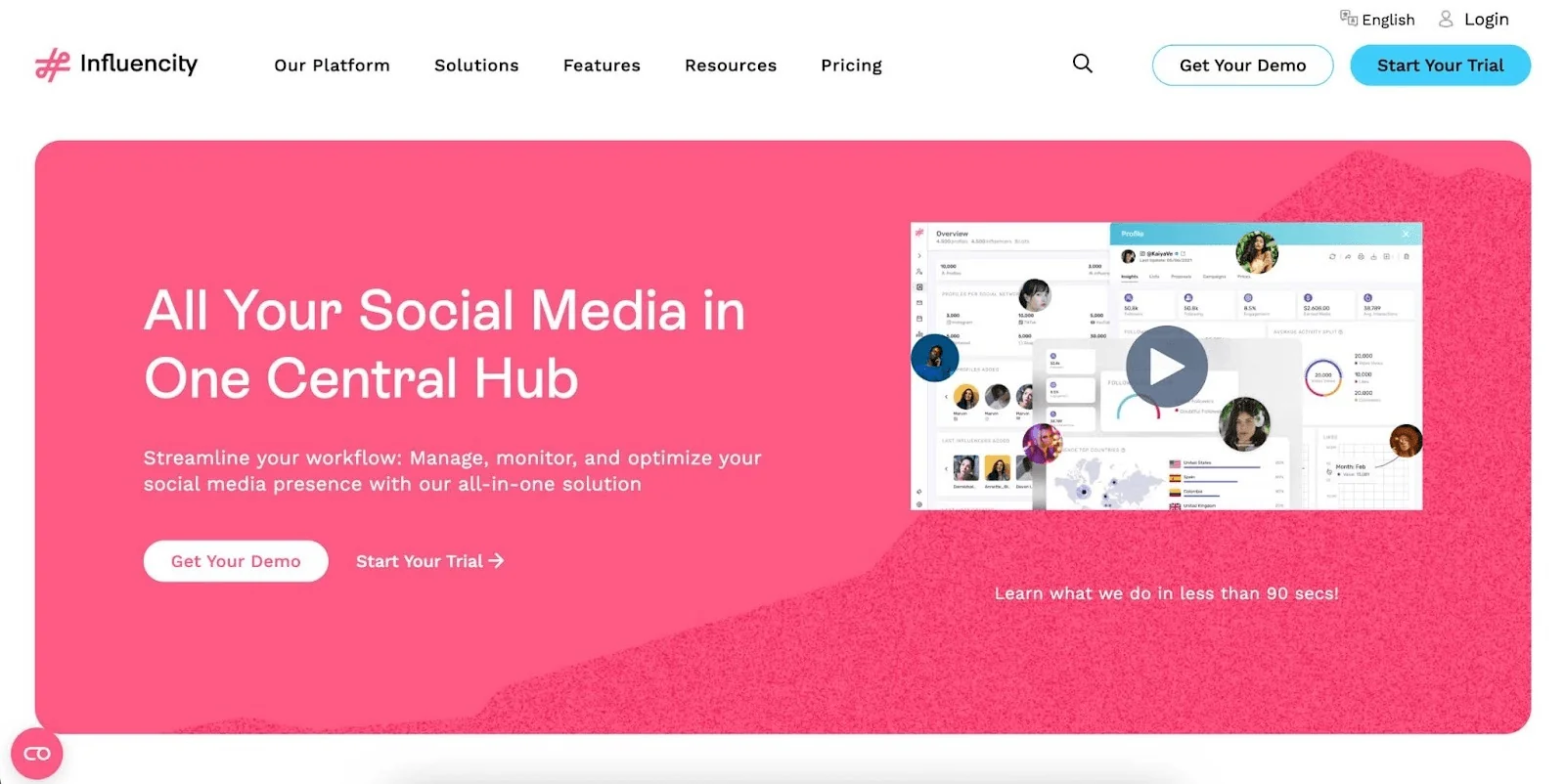
Influencity organizes creators and campaigns with a Trello-style visual interface, layered on top of a deep discovery database of 200M+ profiles. It's strong for data-driven selection, with audience analysis, fake-follower detection, and campaign workflows that help mid-sized brands and agencies run multiple programs at once.
The numbers: The Basic plan starts around $168/month, but it's discovery-only, with no email integration or campaign tools. The CRM and campaign features kick in on Professional, roughly $318/month billed annually or $398/month monthly. Business runs $698 to $998/month, and Enterprise is custom. Billing is month-to-month, so you can subscribe only during active campaign months.
Watch the credit caps, though. Profile and post analyses are metered each month, so heavy discovery teams burn through limits fast. For brands that want polished creator data and visual campaign management without an enterprise contract, Influencity hits a useful middle ground.
5. Modash

Modash is the go-to when discovery is your biggest gap. It taps a 350M+ creator database with verified emails, audience analysis, and a clean campaign pipeline, plus native Shopify integration for gifting and conversion tracking. Teams love it for finding and vetting creators fast, then tracking them through structured stages.
The numbers: Essentials starts at $199/month on annual billing ($299 monthly), Performance is $499/month ($599 monthly), and Enterprise is custom (around $14,700/year). There's a 14-day free trial with no credit card, and Shopify integration is included on every tier.
The honest note for a CRM shortlist: Modash leans more toward discovery than deep relationship management. If your primary workflow is heavy outreach and contracts, you may end up running those in a dedicated CRM alongside it. But for Shopify brands that want to find, vet, and track creators in one place, it's well-priced and widely loved.
6. GRIN

GRIN is a heavyweight creator management platform built for ecommerce brands scaling real programs. It centralizes discovery, relationships, product seeding, payments, content collection, and revenue attribution, with deep Shopify and WooCommerce integrations. The CRM-style workspace is designed to handle hundreds of creator relationships without a bloated internal team.
The numbers: GRIN recently moved to transparent, month-to-month pricing, a big shift from its old annual-contract model. Tiers run Lite at $399/month (15 creators), Essentials at $699 (100), Growth at $1,149 (200), and Complete at $1,799 (400 creators plus API). There's a 30-day free trial and no long-term lock-in, with enterprise volume priced higher.
GRIN is a strong fit for established DTC brands that already have a program running and need infrastructure to scale it. Smaller teams sometimes find it powerful to the point of overwhelming, so it's best once your creator volume justifies the depth.
7. Upfluence

Upfluence is built for ecommerce brands that want influencer marketing tied directly to sales. It unifies a 9M+ creator search, a relationship CRM, campaign management, affiliate tracking, and payments. Its standout is Live Capture, a snippet that detects which of your own customers and site visitors have social reach, so you can recruit influencers who already buy from you.
The numbers: Upfluence doesn't publish prices, but real demo quotes put a typical entry setup around $1,276/month (about $14,400 to $16,000/year), covering all three core modules, one seat, and onboarding. Expect a 12-month contract and per-seat scaling.
It's positioned for mid-market and enterprise brands ready to commit. The annual contract and four-figure monthly cost make it a poor fit for small teams still testing the channel, but for brands chasing influencer-driven conversions, the customer-detection angle is genuinely differentiated.
8. Aspire

Aspire is a full-suite platform for mid-market and enterprise brands running ongoing creator programs. It pairs a 1M+ creator marketplace with customizable relationship workflows, contracts, content approvals, affiliate tracking, payments, and analytics. Brands like HelloFresh, Dyson, and Samsung use it to manage gifting, ambassadorships, and UGC at scale, which makes it a natural home for turning creators into long-term brand ambassadors.
The numbers: Aspire uses custom pricing that starts around $2,000/month with a mandatory annual commitment (roughly $24,000/year minimum). There's no monthly option, so test carefully before you sign.
Aspire shines for brands that want to nurture a community of creators who post consistently, since long-term relationships tend to deliver the highest ROI in influencer marketing. The cost and annual lock-in put it out of reach for smaller programs, but its relationship workflows are among the most mature on this list.
9. Traackr
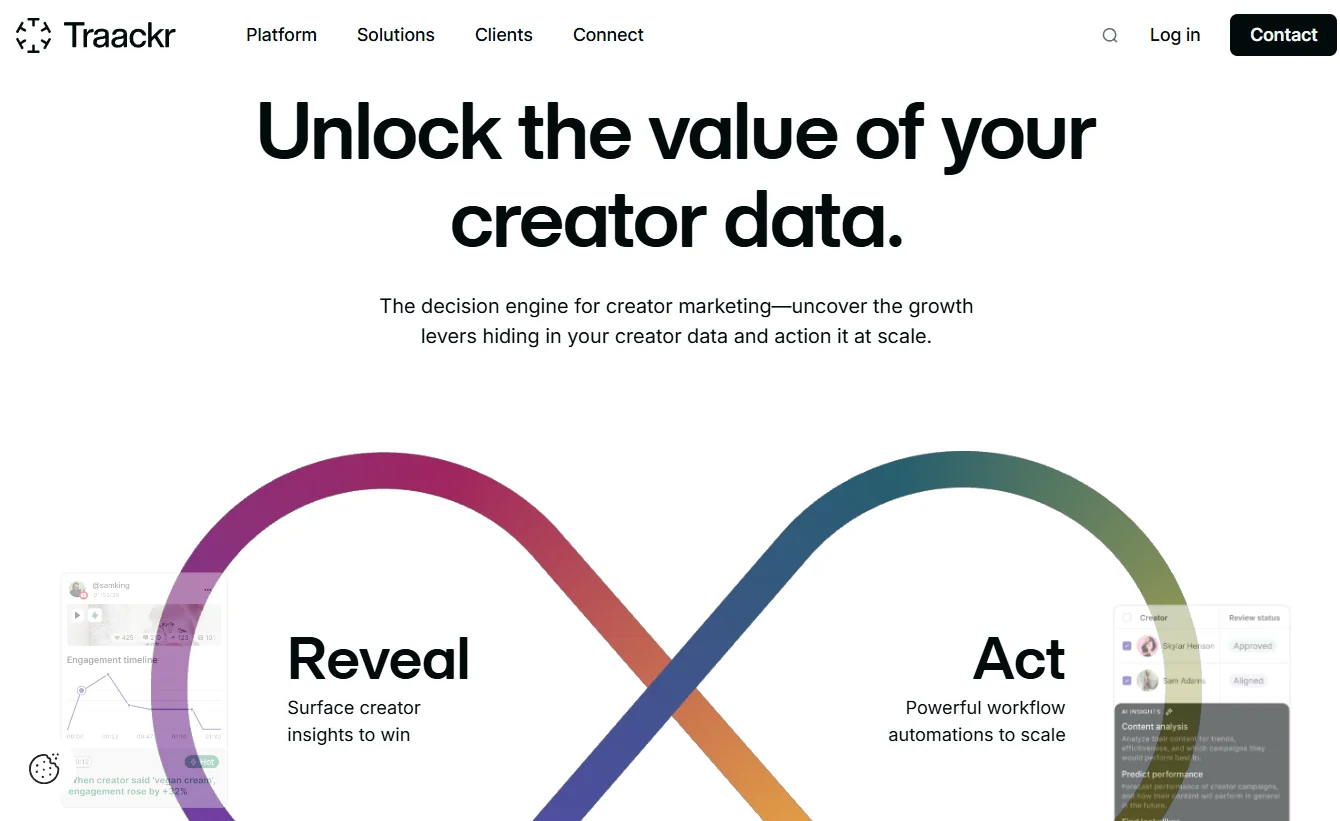
Traackr is the measurement-first choice for global enterprise brands. Beyond a standard influencer CRM, its real edge is rigorous, standardized measurement: benchmarking against named competitors, cross-market reporting, brand-safety checks, and audience analytics across 70 countries. Brands like L'Oréal, Tiffany & Co, and Pandora use it to run compliant, data-driven programs at scale.
The numbers: Traackr is quote-based and annual-only. Reported entry pricing starts around $25,000/year (Growth, 3-user minimum), with a Standard tier near $32,500/year and Plus at $55,000+/year. Benchmarking is often a paid add-on.
The honest caveat: Traackr is built for measurement and management, not outreach. There's no real email automation, so it's a mismatch for outreach-heavy or SEO-style campaigns. For enterprise teams that need board-level reporting and competitive benchmarking, though, few tools go deeper.
10. CreatorIQ
CreatorIQ is the enterprise standard for Fortune 500 brands running global, data-heavy creator programs. It delivers a full-stack creator CRM with discovery, campaign management, content approvals, fraud detection, EMV tracking, and white-labeling for agencies. Disney, Sephora, Unilever, and 1,300+ global brands run on it.
The numbers: CreatorIQ is custom and quote-only, with annual contracts and no monthly plans. Third-party data puts entry contracts around $30,000 to $36,000/year, with a median near $39,000 and large programs running well into six figures.
This is software for organizations with seven-figure influencer budgets, dedicated teams, and procurement departments. Reviewers praise its reporting and security but note a real learning curve. If you're below the enterprise tier, you'll get more value from a purpose-built platform earlier on this list.
How to Choose the Right Influencer CRM in 2026
There's no single best influencer CRM. The right one depends on your program's stage, budget, and how much of the workflow you need in one place. Run your decision through these factors.
- Your program size and budget. A brand managing 10 creators has very different needs than one managing 500. Free and sub-$200 tools cover early programs; $1,000+ platforms make sense once creator volume justifies the spend. Don't pay enterprise prices for a starter program.
- Inbound vs. outbound. If you'd rather have creators apply to you, a marketplace model like Afluencer fits. If you need to actively search and pitch at scale, prioritize a database plus outreach automation.
- Ecommerce integration. Selling on Shopify or WooCommerce? Native integration for product seeding, discount codes, and sales attribution turns gifting from a logistics headache into a few clicks.
- Depth of relationship tracking. Decide whether you need a true pipeline (stages, contracts, payments, history) or mainly discovery and analytics. Some tools nail one and outsource the other.
- Budget for the creators themselves. Software is only part of the cost. Know what you'll pay partners before you commit, and use a current guide to influencer rates so your tooling and creator budgets line up.
The smartest move is to match the tool to where you are now, not where you hope to be in three years. You can always scale up once the program proves itself.
Start Managing Creators the Easy Way
Influencer marketing only gets harder to run from a spreadsheet as it grows. The platforms above turn that chaos into a system, whether you need a free marketplace to start or enterprise software to manage global programs. The market has matured to the point where there's a genuine fit for every stage and budget.
You don't need every tool on this list. You need the one or two that match your program today. For most brands building their first managed program, the fastest, lowest-risk way to start is to let creators come to you.
Start exploring collabs on Afluencer today. Chat with CreatorGPT for creator strategy, or try the Afluencer Collab Finder to get matched with live brand opportunities.
Frequently Asked Questions
<details class="ih-faq"><summary>What is influencer CRM software?</summary><div class="ih-faq-a">Influencer CRM software centralizes how you manage creator relationships, much like a sales CRM does for customers. It stores contacts and contracts, tracks communication and campaign stages, and measures performance and ROI in one dashboard. The goal is to replace scattered spreadsheets and email threads with a single, scalable system.</div></details><details class="ih-faq"><summary>What's the cheapest influencer CRM for small brands?</summary><div class="ih-faq-a">Afluencer is one of the most affordable entry points, starting at $49/month for its Marketplace plan, where you post a Collab and verified creators apply to you. Amplify ($99/month) and Modash ($199/month) come next, and both include free trials. For small DTC and Shopify brands, these tiers are a low-risk way to start managing creators before committing to bigger software.</div></details><details class="ih-faq"><summary>How much does influencer CRM software cost in 2026?</summary><div class="ih-faq-a">Pricing ranges widely. Entry tools start under $200/month (Afluencer at $49, Amplify at $99, Influencity at $168, Modash at $199), mid-market platforms run roughly $400 to $2,000/month (GRIN, Upfluence, Aspire), and enterprise software starts at $25,000 to $36,000+/year (Traackr, CreatorIQ). Most mid-to-enterprise tools require annual contracts, while several entry tools bill month-to-month.</div></details><details class="ih-faq"><summary>Which influencer CRM is best for Shopify brands?</summary><div class="ih-faq-a">Shopify brands should prioritize native ecommerce integration for gifting and sales attribution. Modash, GRIN, Upfluence, Amplify, and Influencer Hero all connect directly to Shopify to automate product send-outs and track creator-driven revenue. Afluencer also offers a Shopify app, making it an easy on-ramp for merchants new to influencer marketing.</div></details><details class="ih-faq"><summary>What's the difference between an influencer CRM and an influencer marketplace?</summary><div class="ih-faq-a">A marketplace, like Afluencer, connects you with creators: you post opportunities and they apply. An influencer CRM manages the relationship after that connection, tracking contracts, communication, content, and performance over time. Many modern platforms now combine both, so you can find creators and manage them in the same place. For more options, see these<a href="https://afluencer.com/8-tools-you-can-use-to-find-influencers-to-promote-products-or-content/" target="_blank"> </a><a href="https://afluencer.com/8-tools-you-can-use-to-find-influencers-to-promote-products-or-content/" target="_blank">tools to find influencers</a>.</div></details><script type="application/ld+json">{"@context":"https://schema.org","@type":"FAQPage","mainEntity":[{"@type":"Question","name":"What is influencer CRM software?","acceptedAnswer":{"@type":"Answer","text":"Influencer CRM software centralizes how you manage creator relationships, much like a sales CRM does for customers. It stores contacts and contracts, tracks communication and campaign stages, and measures performance and ROI in one dashboard. The goal is to replace scattered spreadsheets and email threads with a single, scalable system."}},{"@type":"Question","name":"What's the cheapest influencer CRM for small brands?","acceptedAnswer":{"@type":"Answer","text":"Afluencer is one of the most affordable entry points, starting at $49/month for its Marketplace plan, where you post a Collab and verified creators apply to you. Amplify ($99/month) and Modash ($199/month) come next, and both include free trials. For small DTC and Shopify brands, these tiers are a low-risk way to start managing creators before committing to bigger software."}},{"@type":"Question","name":"How much does influencer CRM software cost in 2026?","acceptedAnswer":{"@type":"Answer","text":"Pricing ranges widely. Entry tools start under $200/month (Afluencer at $49, Amplify at $99, Influencity at $168, Modash at $199), mid-market platforms run roughly $400 to $2,000/month (GRIN, Upfluence, Aspire), and enterprise software starts at $25,000 to $36,000+/year (Traackr, CreatorIQ). Most mid-to-enterprise tools require annual contracts, while several entry tools bill month-to-month."}},{"@type":"Question","name":"Which influencer CRM is best for Shopify brands?","acceptedAnswer":{"@type":"Answer","text":"Shopify brands should prioritize native ecommerce integration for gifting and sales attribution. Modash, GRIN, Upfluence, Amplify, and Influencer Hero all connect directly to Shopify to automate product send-outs and track creator-driven revenue. Afluencer also offers a Shopify app, making it an easy on-ramp for merchants new to influencer marketing."}},{"@type":"Question","name":"What's the difference between an influencer CRM and an influencer marketplace?","acceptedAnswer":{"@type":"Answer","text":"A marketplace, like Afluencer, connects you with creators: you post opportunities and they apply. An influencer CRM manages the relationship after that connection, tracking contracts, communication, content, and performance over time. Many modern platforms now combine both, so you can find creators and manage them in the same place. For more options, see these tools to find influencers."}}]}</script>