.svg)

.png)
10 Best Influencer Databases in 2026
Finding the right creators is the hardest part of any campaign. You can have the budget, the product, and the brief ready to go, but if you're still hunting through Instagram tabs and spreadsheets, you're losing time you don't have.
An influencer database fixes that. It's a searchable pool of creator profiles you can filter by niche, follower count, engagement rate, audience demographics, and location, so you shortlist real matches in minutes instead of days. Some are giant scraped indexes. Others are verified marketplaces where creators apply to you. The best one depends on how you like to work.
We compared the top 10 on price, database size, and what each one is actually built for. The list runs roughly from the most accessible starting points to the most specialized, enterprise-grade platforms. Let's break them down one by one.
Top 10 Influencer Databases for Brands in 2026
Creator discovery budgets keep climbing, and the tools have split into two camps: databases you search yourself, and marketplaces where vetted creators come to you. Both count as a "database" here, because both put a filterable pool of creators at your fingertips. Here's where each one fits.
1. Afluencer
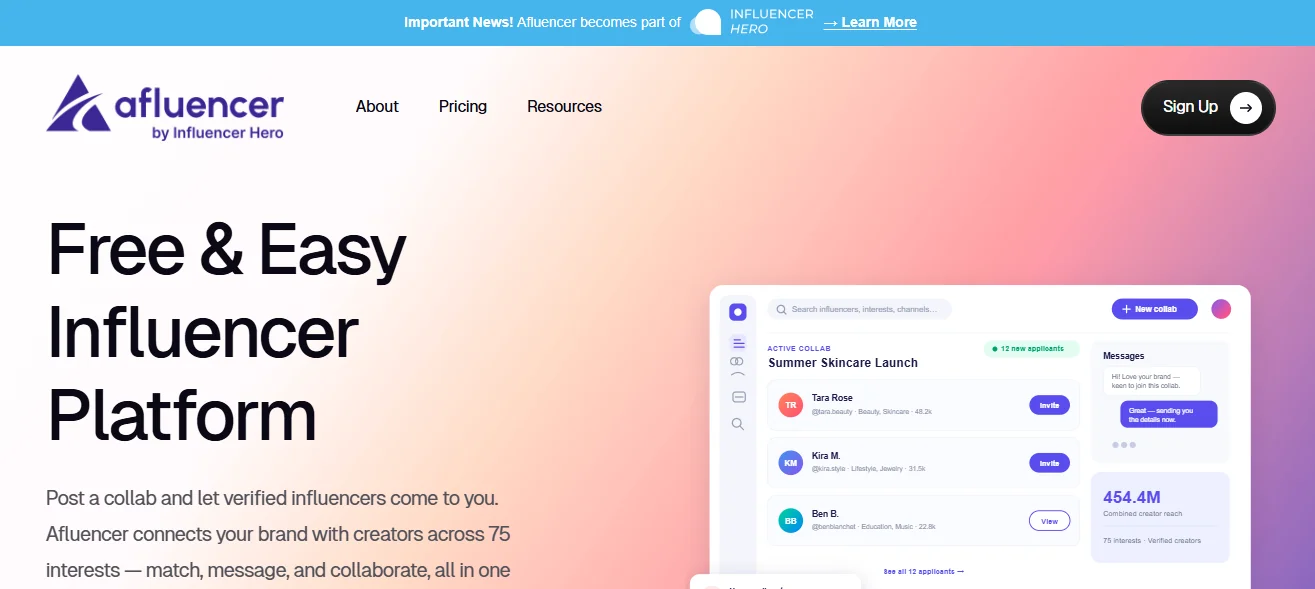
Afluencer is a verified creator marketplace built for brands that want creators to come to them. Instead of scraping social media, it lists 40,000+ real, opted-in influencers across 75 interests. You post a Collab, describe your ideal partner, and creators apply. That's the opposite of cold outreach, and it's a big reason smaller DTC brands and Shopify stores start here.
The numbers: Afluencer starts at $49/month, which includes 60 invitation credits, premium influencer filters, and phone, email, and live chat support. Those invitation credits are what let you go outbound to specific creators rather than waiting on applications. Above that, plans run $649/month with 1,000 reach-outs, product send-outs, and influencer payments, and $1,049/month with 5,000 reach-outs plus a dedicated account manager. Month-to-month, no annual contract, and full details are on the Afluencer pricing page.
What sets Afluencer apart is that every creator is a verified user, not a scraped handle, so the people applying actually want to work with you. Two AI tools sit on top of it: CreatorGPT for campaign strategy and shortlisting, and the Afluencer Collab Finder, which matches you with live opportunities.
If you want a low-risk way to start finding creators today, post a Collab on Afluencer and let the applications roll in. Chat with CreatorGPT for strategy, or try the Collab Finder to get matched fast.
2. Modash

Modash is the database to beat on raw size. It indexes 350M+ creator profiles across Instagram, TikTok, and YouTube, covering anyone with 1,000+ followers. If your priority is casting the widest possible net and vetting audiences before you reach out, this is the discovery engine most marketers name first.
The numbers: Modash publishes its pricing, which is rare in this space. Essentials starts at $199/month on annual billing (or $299 billed monthly), Performance runs $499/month annually ($599 monthly), and Enterprise is custom, reported to start around $14,700/year. There's a 14-day free trial with no card required. Confirm figures on the live pricing page before committing.
The transparent pricing and native Shopify integration make Modash a strong fit for ecommerce brands that have validated influencer marketing and want to scale discovery. The honest caveat: it's discovery-first. Outreach and relationship management are lighter, so heavy-outreach teams often pair it with a dedicated CRM. For pure finding-and-vetting at a mid-market price, though, it's hard to beat.
3. Influencer Hero
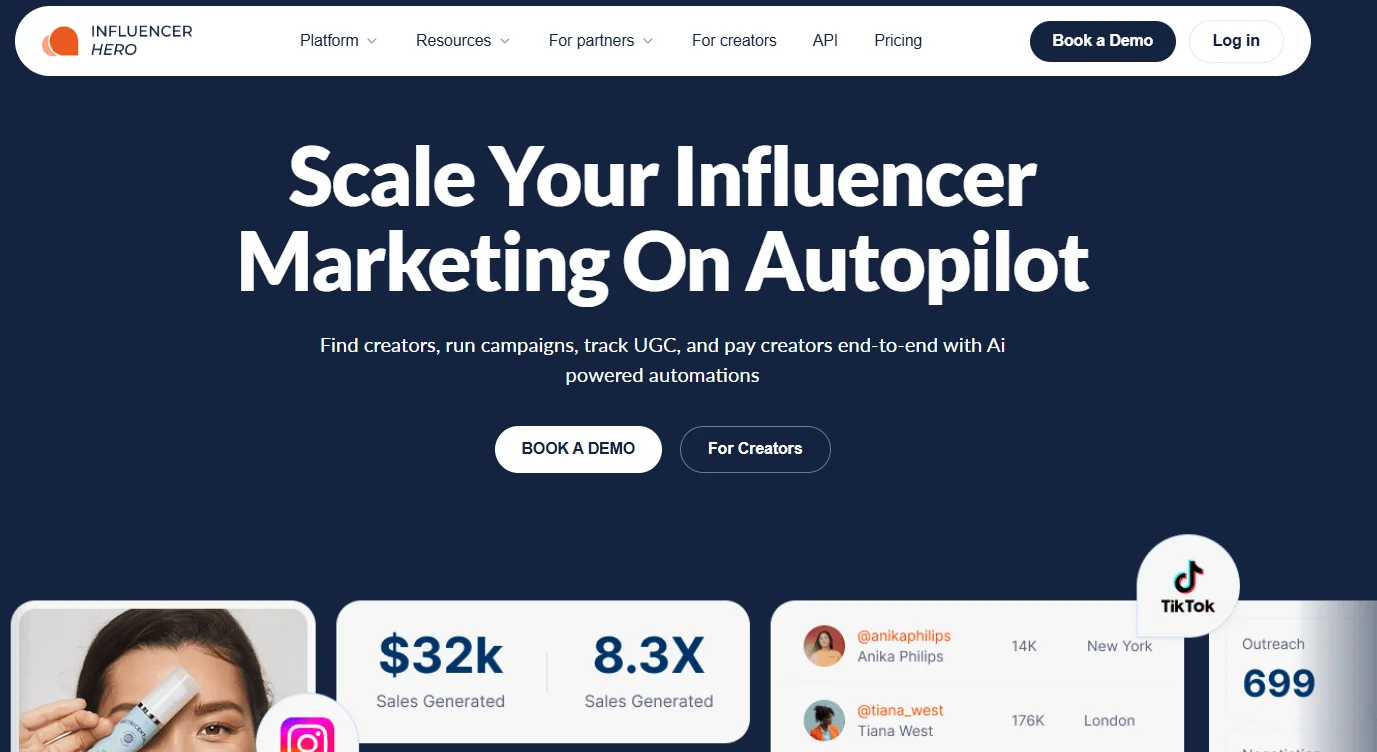
Influencer Hero belongs on a database list for a simple reason: at 450M+ creator profiles across Instagram, TikTok, and YouTube, it's one of the largest indexes here, and the search sitting on top of it does more than filter by follower count.
Four search modes cover most of how brands actually hunt. AI matching turns a plain-language brief into a shortlist, so you can describe your ideal partner instead of guessing at filter combinations. Lookalike search takes a creator who already converted for you and finds profiles with similar audience makeup and content style, which is the fastest way to scale what's working. Brand-follower detection scans your own following and surfaces creators already following you, a pool no scraped index can give you because it depends on your first-party data. And a Chrome extension pulls profile stats while you browse Instagram or TikTok natively, so research you're already doing feeds straight into your shortlist.
Vetting runs inside the same search. Fake-follower detection scores audience authenticity, and demographic filters break down age, gender, location, and interests, so you rule out mismatched audiences before you shortlist rather than after you've paid.
Then the database stops being a dead end. Anyone you find moves straight into a CRM, an automated outreach sequence sent from your own domain, gifting, affiliate tracking, and revenue attribution, which is the gap most discovery-only tools leave you to fill with a second subscription.
The numbers: Pricing is public. Standard is $649/month for up to 1,000 creator contacts a month, Pro is $1,049/month, and Business is $2,490/month. Quarterly and annual billing come at a discount, and plans carry a minimum commitment.
The honest caveat is the entry price. If you only need to search and vet, it's more platform than a discovery-only buyer needs. For teams running creator marketing as a recurring growth channel, the database plus the execution layer is the point. Book a demo to search the database before you commit.
4. Heepsy

Heepsy is the budget-friendly discovery pick. It covers roughly 11M+ profiles across Instagram, TikTok, and YouTube, with clean filters for location, category, follower count, engagement rate, and audience demographics. For brands testing influencer marketing for the first time, it's one of the easiest on-ramps.
The numbers: There's a free tier for basic discovery. Paid plans are reported to start around $89/month for Starter and scale to roughly $369/month for the top Advanced tier, with discounts on annual billing. Prices vary a bit by source and currency, so check the live pricing page before you buy.
Heepsy does discovery well and gets new teams comfortable fast. The honest caveat: some essential filters (like audience demographics) and the Shopify and sales-tracking features sit behind higher tiers, and creators need 3,000+ followers to be indexed. If you want affordable search-and-vet and can live with those limits, it's solid value.
5. Collabstr
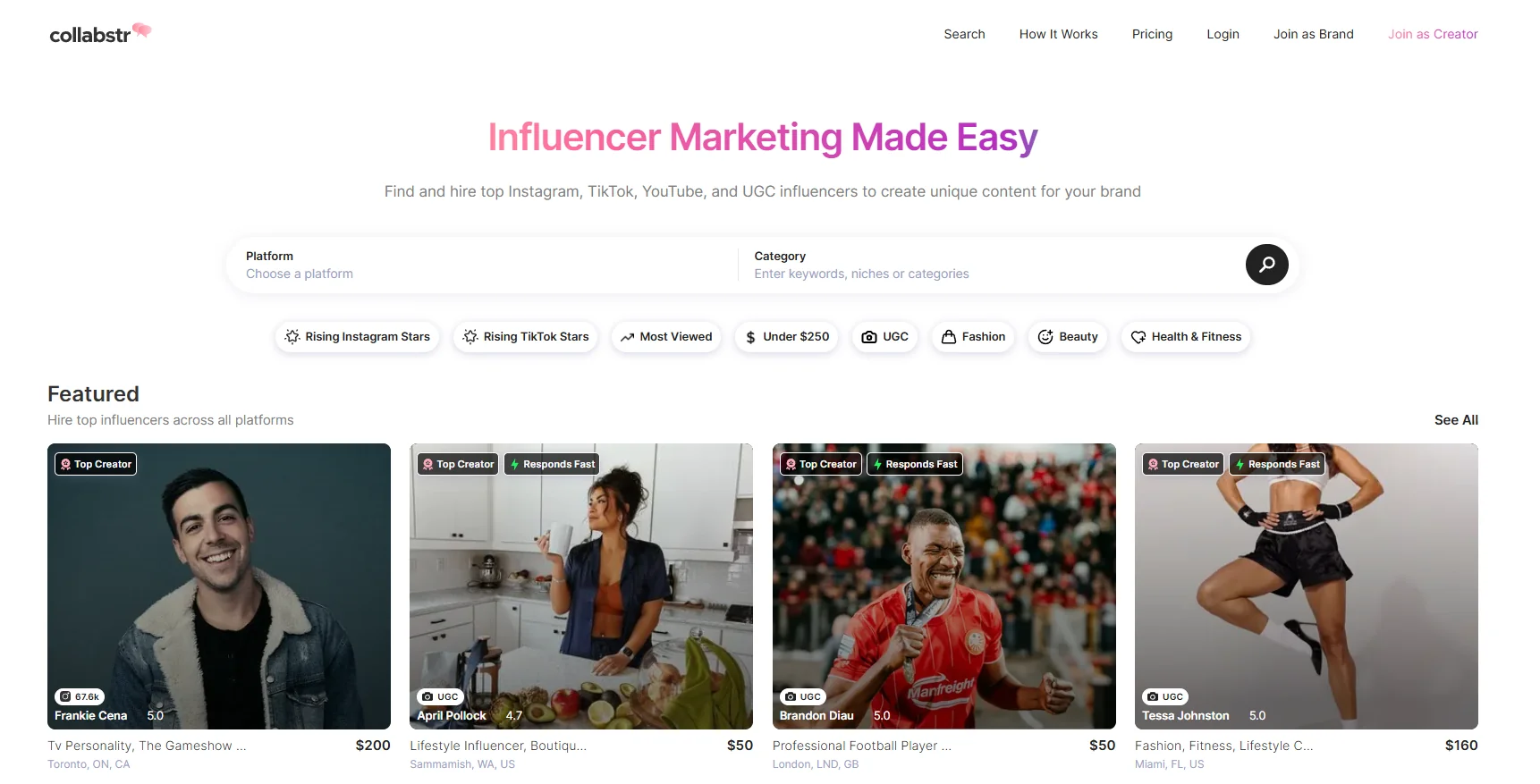
Collabstr flips the model. It's a marketplace of vetted, opted-in creators (200,000+ and growing) who list their rates upfront, so you can search, hire, and pay without a subscription. Think of it as a Fiverr-style approach to creator collabs, which is why it's popular for one-off UGC and sponsored posts.
The numbers: It's free to browse and hire, with a 10% marketplace fee added at checkout. Paid subscriptions are $299/month (Pro) and $399/month (Premium), and the Premium tier drops that fee to 5%. Escrow protects every order, so you only pay when you approve the content. Confirm details on the official pricing page.
The upside is speed and zero cold outreach. You post a brief, matching creators apply with their pricing, and payments are handled for you. The honest caveat: you're limited to creators who've joined the marketplace, and the per-transaction fee adds up on high-volume programs. For testing the channel or sourcing UGC fast, it's one of the cheapest ways in.
6. Influencity
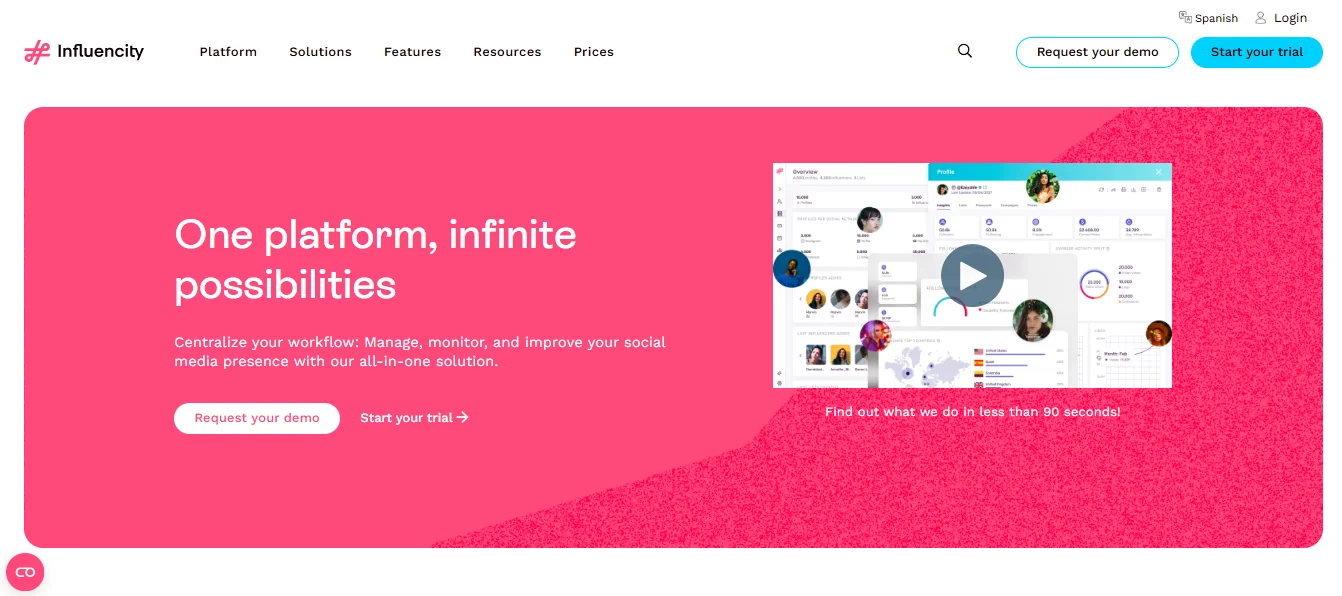
Influencity leans hard into audience analytics. It indexes 200M+ profiles across Instagram, TikTok, YouTube, and Twitch, and its real value is the depth of its creator and audience reports. If your team vets creators on data before spending a cent, this is a strong fit.
The numbers: Plans are reported to start around $168/month for Basic (roughly $134/month on annual billing), with Professional near $348–$398/month and Business around $698/month and up. There's no free plan, but a trial is available, and billing is month-to-month. The public pricing loads behind a sign-in or trial, so figures shift. Verify before you commit.
Influencity's discovery engine and audience analytics genuinely compete with pricier tools. The honest caveat: entry plans cap how many profile analyses you get each month, and you'll burn through them fast during active vetting. It's also discovery-and-analytics only, so it won't handle outreach automation or affiliate tracking on its own.
7. HypeAuditor
HypeAuditor is the vetting specialist. Its database spans 218M+ creator profiles, but the reason brands pay for it is fraud detection. The Audience Quality Score and fake-follower analysis help you avoid inflated followings before your budget is on the line.
The numbers: Pricing is mostly sales-led. Third-party sources report Basic starting around $299/month billed annually and Pro around $499/month, with Enterprise quoted on request. There's a limited free version plus a set of free tools. Because the public page is largely a demo request, confirm your real cost directly with their team.
If authenticity and audience quality are your top concern, HypeAuditor's data depth is best-in-class. The honest caveat: pricing is opaque and usage-metered, so two teams on the same plan can hit very different limits. Outreach and relationship management are also lighter, so many teams pair it with a separate execution tool.
8. Favikon

Favikon is the fresh pick, and it's the one to watch for B2B. It covers 10M+ creators across 9 platforms, including LinkedIn, X, Substack, and Pinterest alongside the usual Instagram, TikTok, and YouTube. Its creator rankings and authenticity scoring make it unusually good for thought-leader and B2B discovery, where most tools fall short.
The numbers: There's a free plan to start. Paid tiers are reported around $79–$99/month (Starter), $159–$199/month (Standard), and $399–$449/month (Pro), with custom Enterprise pricing. It runs on a credit system ("favicoins"), so heavy discovery burns credits faster. Check the live page, since credit-based pricing is harder to compare at face value.
Favikon's edge is coverage no one else matches, especially LinkedIn creator discovery, plus solid authenticity scoring and competitor benchmarking. The honest caveat: third-party integrations and CRM features are thinner than dedicated campaign tools, so it's more of a discovery and intelligence layer than a full operational platform.
9. Upfluence

Upfluence is built for D2C and ecommerce brands that want discovery tied to revenue. Its standout feature is Live Capture, which surfaces influencers hiding inside your own customer and subscriber lists. Those organic advocates convert cheaper, which is a real edge for Shopify and WooCommerce stores.
The numbers: Upfluence doesn't publish pricing. Third-party listings show a Search & Contact module from around $478/month, but a usable full setup with all modules is reported closer to $1,276/month, roughly $14,000–$16,000/year, on a 12-month contract. Per-seat fees apply. These are user-reported estimates, so get a direct quote before budgeting.
The platform shines when you need discovery, outreach, affiliate tracking, and ROI reporting connected in one place, especially with ecommerce integrations. The honest caveat: pricing is opaque, the annual contract locks you in, and the full configuration gets expensive fast. It's overkill for a brand that just needs to search a database.
10. CreatorIQ
CreatorIQ sits at the enterprise end. It indexes 20M+ creator profiles across six platforms and layers on governance, standardized reporting, EMV tracking, white-label tools, and deep API integrations. It's the platform Fortune 500 brands and global agencies run when creator marketing has to behave like a governed operating system.
The numbers: Pricing is quote-only, and it's steep. Procurement data reports entry contracts starting around $30,000–$36,000/year, with larger programs climbing to $50,000–$90,000+. There are no monthly plans and no free tier. Every deal is an annual commitment, so confirm scope and cost directly.
For enterprise teams with dedicated headcount and seven-figure budgets, CreatorIQ's reporting depth and controls are best-in-class. The honest caveat: discovery data can lag its polished analytics, and the pricing prices out most DTC and mid-market brands entirely. It makes sense above roughly $1M in annual influencer spend, and rarely below it.
How to Choose the Right Influencer Database in 2026
There's no single "best" database. The right one depends on how you work and what you're trying to do. Run through these before you commit.
- Your discovery model. Do you want to search a giant index yourself, or have vetted creators apply to you? Scraped databases (Modash, HypeAuditor) reward proactive search. Marketplaces (Afluencer, Collabstr) bring creators to you with less cold outreach.
- Your budget and commitment tolerance. Low-cost, no-contract options (Afluencer at $49/month, Heepsy, Collabstr) let you start today without a lock-in. Enterprise tools (CreatorIQ, Upfluence) mean annual contracts and five-figure floors. Match the spend to your program's maturity, not your ambitions.
- Database size vs. verification. A 350M-profile index gives you reach, but a verified marketplace gives you creators who actually want to collaborate. Decide whether coverage or intent matters more for your campaigns.
- Where you need to execute. If you only need to find and vet, a discovery tool is enough. If you need outreach, gifting, affiliate, and campaign tracking in one place, look at all-in-one platforms instead of stitching tools together.
- Your platforms. Most databases cover Instagram, TikTok, and YouTube. If you're running B2B or LinkedIn programs, Favikon's coverage is the exception. Confirm the tool actually indexes the channels you care about.
- Fraud and audience quality. If inflated followings are a real risk for your budget, prioritize a tool with strong fake-follower detection, like HypeAuditor or Influencity's audience analytics.
Most brands don't need every option. Pick the one or two that fit your model, your budget, and the platforms you actually run on. That beats overpaying for capacity you won't use.
Start Finding Creators Today
The influencer database you pick shapes how fast you can move. The market splits cleanly: massive scraped indexes for proactive search, and verified marketplaces where the right creators come to you. Both get you out of the spreadsheet-and-guesswork era.
You don't need all ten. You need the one or two that fit how your team works and what you can spend. Start with a low-risk option, prove the channel, and scale into something heavier only when the manual work starts costing you.
Ready to skip the cold outreach? Post a Collab on Afluencer and let verified creators apply to you. Chat with CreatorGPT for campaign strategy, or try the Afluencer Collab Finder to get matched with creators who fit your brand. And if you want to sharpen your budget first, our 2026 influencer rates guide breaks down what to pay from nano to mega.