.svg)

.png)
10 Best Influencity Alternatives in 2026
If you're hunting for Influencity alternatives in 2026, you've probably hit one of a few walls. Influencity is a solid influencer discovery and analytics platform. It gives you a large database of creators, 30+ search filters, audience quality checks, and end-to-end campaign management in one place. Brands and agencies lean on it to vet creators and run reporting without juggling five tools.
But it isn't for everyone. Pricing climbs fast once you need the campaign features. Basic starts around $168/month, the Professional tier lands near $348 to $398/month, and Business runs about $698/month. It's also credit-based, so your profile analyses cap out every month, and heavy discovery weeks burn through them quickly. Here's the part that catches teams off guard, though: Influencity is a data and management tool, not a marketplace or an agency. So you still handle all the outreach yourself, negotiate influencer rates, and manage every relationship on your own.
That's the gap most people want to close. Some want a lower, simpler entry price without credit anxiety. Others want creators who come to them instead of pure database search. And plenty want an all-in-one that actually runs outreach, CRM, and affiliate tracking, not just dashboards.
We researched pricing and features fresh for every tool below. Here are the 10 best Influencity alternatives worth a look this year.
1. Afluencer
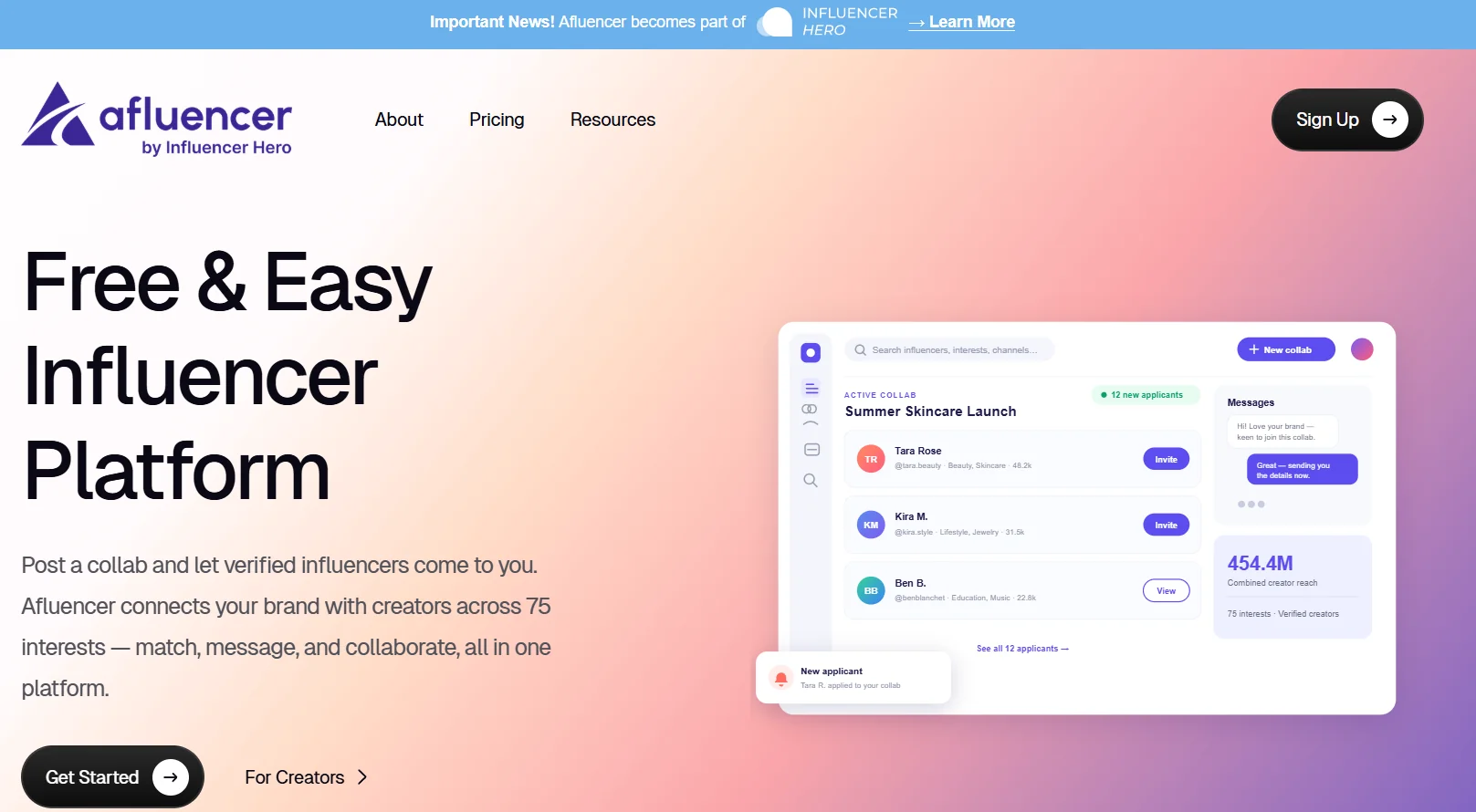
Afluencer flips the whole model that makes Influencity feel like work. Instead of paying to search a database and then chasing creators who never reply, you post a "Collab" with your criteria, and verified creators apply to you. The right partnerships come to your inbox. That's a big shift for small teams that don't have hours to spend on cold outreach.
It's built for DTC and Shopify brands running micro and nano-influencer campaigns, gifting, and affiliate partnerships. The platform has been matchmaking brands and creators since 2017, so the community is active and used to applying to offers. If your niche sits in beauty, fashion, wellness, lifestyle, or food, you'll find plenty of relevant creators fast.
Because discovery runs on applications, there's no credit meter counting down every profile you look at. That alone solves one of the most common Influencity complaints. You review who applied, chat in-platform, and move to shipping or payment without switching tools.
Afluencer also leans on AI to speed things up. CreatorGPT matches brands and creators based on goals, style, and budget, and it can draft your outreach and map a campaign in minutes. The Collab Finder surfaces live opportunities, so both sides spend less time searching and more time collaborating.
On price, Afluencer is one of the most accessible platforms here. Paid plans start at $49/month on the Marketplace plan. Everything is month-to-month, so you can cancel anytime without an annual lock-in.
The honest caveat: it's a marketplace, so you're working with creators who are already on the platform. If you need a specific enterprise-grade creator outside the main niches, or you want to build a massive outbound list, a pure discovery tool will cast a wider net. For most small and mid-sized brands testing or scaling collabs, though, that trade-off is easy to make.
Start free of the credit anxiety, post your first Collab, and let motivated creators apply to you.
2. Influencer Hero
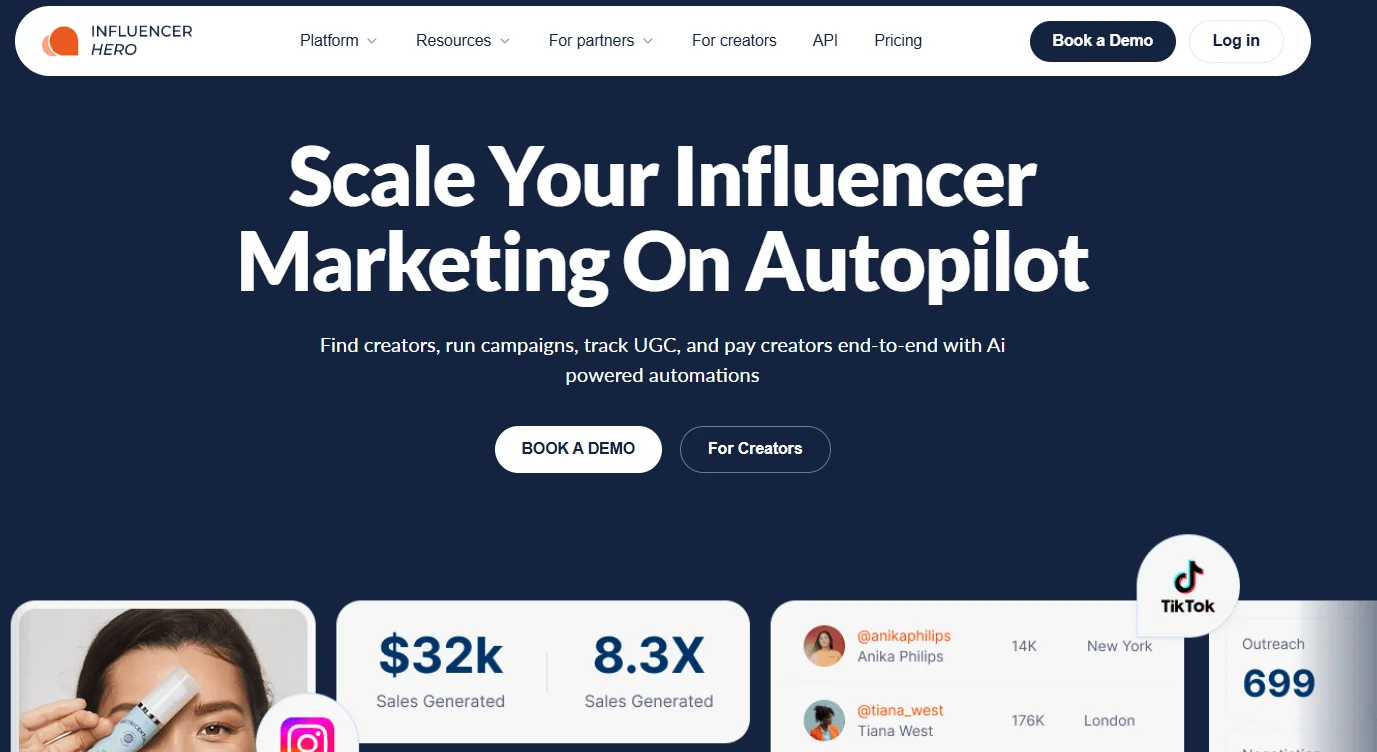
Influencer Hero is the pick for brands who like Influencity's data but want the software to actually run the campaign too. It's a genuine all-in-one: creator discovery across Instagram, TikTok, and YouTube, a built-in CRM, automated email and WhatsApp outreach, product gifting, affiliate tracking, UGC collection, influencer payments, and ROI attribution. Everything lives in one workspace instead of five browser tabs.
The outreach engine is where it pulls ahead of a discovery-first tool like Influencity. You build multi-step email sequences that send from your own domain, with automatic follow-ups when a creator doesn't reply. Reviewers single this out constantly, and the platform holds a 4.8/5 on G2 with strong marks for value. For teams doing serious outbound, that automation replaces hours of manual chasing every week.
It's especially strong for mid-market and Shopify/ecommerce brands and agencies, because it ties creator posts back to revenue. Instead of exporting data and reconciling it against sales later, you see attribution inside the same tool that sent the outreach and processed the payment. That's the full loop Influencity leaves you to stitch together yourself.
Pricing starts at $649/month on the Standard plan, or $454/month billed annually, then $1,049/month for Pro and $2,490/month for Business as your reach-outs, payments, and seats scale. If you're running influencer marketing as an ongoing, revenue-focused channel rather than a one-off test, that investment pays for itself in saved time and cleaner attribution.
3. Modash

Modash is the strongest straight-up discovery swap for Influencity, and it competes hard on database size. It claims 350M+ creator profiles and indexes essentially anyone with 1,000+ followers on Instagram, TikTok, and YouTube. That depth makes it excellent for finding niche micro and nano creators that thinner databases miss entirely.
Beyond search, Modash handles outreach, gifting, payments, and campaign tracking, so it covers more of the workflow than a pure analytics tool. Brands like Google, Victoria's Secret, and Airbnb use it, and the interface stays clean even as you scale lists. The email unlocks and profile analyses are capped per plan, though, so like Influencity you'll want to watch your monthly limits.
Modash pricing starts at $199/month on annual billing, or $299/month month-to-month, with a Performance tier at $499 to $599/month and a quote-based Enterprise plan. It also runs a 14-day free trial with no card required, which is a nice way to test the database before you commit. The main limitation is that the entry Essentials tier caps you at 300 profile analyses a month, and heavy discovery teams hit that wall fast.
4. HypeAuditor
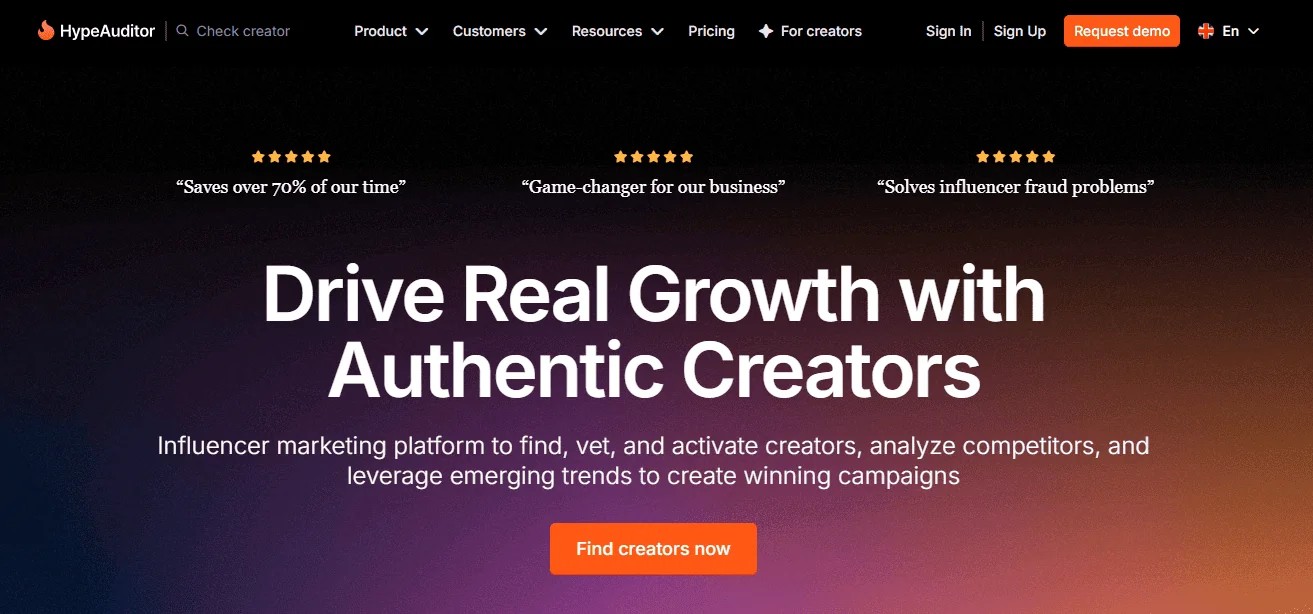
If the reason you're leaving Influencity is data trust, HypeAuditor is built for exactly that. It's an analytics-first platform known for deep audience authenticity scoring and fraud detection, with accuracy that reviewers consistently rate near the top of the category. Before you spend budget, you can confirm a creator's followers are real and their engagement isn't inflated.
It also covers discovery, campaign management, and a light CRM across Instagram, TikTok, YouTube, and X. So it works as a full workflow tool, but its real edge is the vetting layer. For brands that got burned by a creator with a padded audience, that peace of mind is worth a lot.
HypeAuditor publishes pricing at $299/month for Basic and $499/month for Pro on annual billing, with custom Enterprise plans above that. There's a limited free version to explore basic features first. The catch is the entry point: $299/month with an annual commitment is a jump for small brands, and the best analytics features sit behind the pricier Pro tier.
5. Upfluence

Upfluence is a heavier, ecommerce-focused platform that suits brands who found Influencity capable but wanted deeper store integration. Its standout feature is Live Capture, which scans your own customer base to find creators who already buy from you. For DTC brands, activating happy customers as authentic partners is a genuinely different angle than searching a cold database.
It bundles discovery, outreach, campaign management, affiliate tracking, and creator payments, with native connections to Shopify, WooCommerce, and Klaviyo. That makes it a strong fit for brands running influencer marketing as a serious acquisition channel, not a side experiment.
Upfluence doesn't publish prices, but real demo quotes put a usable setup around $1,276/month, or roughly $14,000 to $16,000 a year once you add the required modules and a seat. It's also a 12-month contract, and the modular pricing means you can't run campaigns unless you buy the workflow module on top of search. So it's powerful, but it's a commitment, and per-seat fees stack up fast for agencies.
6. GRIN

GRIN is a creator management platform built for ecommerce, and it just got a lot more accessible. In January 2026 it dropped its enterprise-only, quote-based model and moved to transparent self-serve tiers. That change makes it a real option for mid-market brands who previously wrote it off as too expensive.
Its strengths are product seeding, automated creator payments with 1099 processing, deep-link tracking, and advanced affiliate attribution, all wired into Shopify and other stores. If your program is heavy on gifting and affiliate partnerships, GRIN's fulfillment and attribution workflows are hard to beat. It's the kind of execution muscle Influencity doesn't offer.
Paid plans now run $399/month (Lite), $699/month (Essentials), $1,149/month (Growth), and $1,799/month (Complete), with a 30-day free trial and month-to-month billing. The trade-off shows up in discovery: reviewers consistently flag GRIN's creator search as its weakest feature. If you already have creators you work with, that's fine. If you're sourcing brand-new partners, you may lean on discovery elsewhere.
7. Heepsy
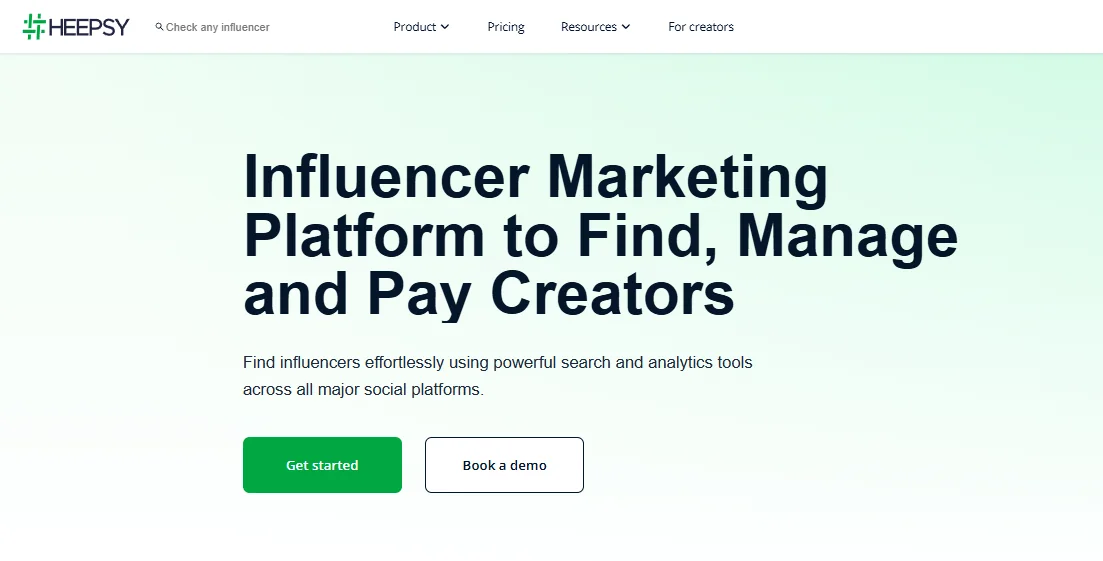
Heepsy is the budget-friendly discovery pick, and it's a natural landing spot for anyone who found Influencity's credit model stressful. It focuses on fast creator search, audience authenticity checks, and simple list-building across the major platforms. For quick vetting and sourcing, it does the core job without the enterprise overhead or the complexity.
That focus is also its limit. Heepsy is lightweight on the campaign side, so you won't get the outreach automation, CRM, or full attribution that heavier tools include. It's a sourcing tool, not an operating system for your whole program.
Pricing starts at around $49/month on the Starter plan, which includes 500 profiles a month, with Business and Gold tiers unlocking 2,000 and 5,000 profiles. For small teams or agencies that mainly need reliable data and fast list-building on a tight budget, that's a strong value. Just plan to pair it with other tools once you need to actually run and track campaigns.
8. Aspire

Aspire (formerly AspireIQ) suits brands whose influencer marketing has grown into a core, ongoing investment. It combines AI-powered discovery with an inbound creator marketplace, so creators can apply to your campaigns while you also search proactively. That dual model shortens time-to-launch compared to pure outbound.
Where it shines is affiliate infrastructure, UGC at scale, and long-term relationship management, all built into one tool. For ecommerce brands running gifting and product seeding programs, the workflows are mature. If you're standing up a gifting campaign and want it to feed content and sales attribution, Aspire handles that end to end.
Pricing starts around $2,000/month with an annual commitment, and Aspire doesn't publish rates publicly, so expect a demo before a quote. That positions it clearly at the higher end of this list. It's overkill for a brand just testing the channel, but a good fit for teams where influencer marketing already drives real revenue.
9. Collabstr
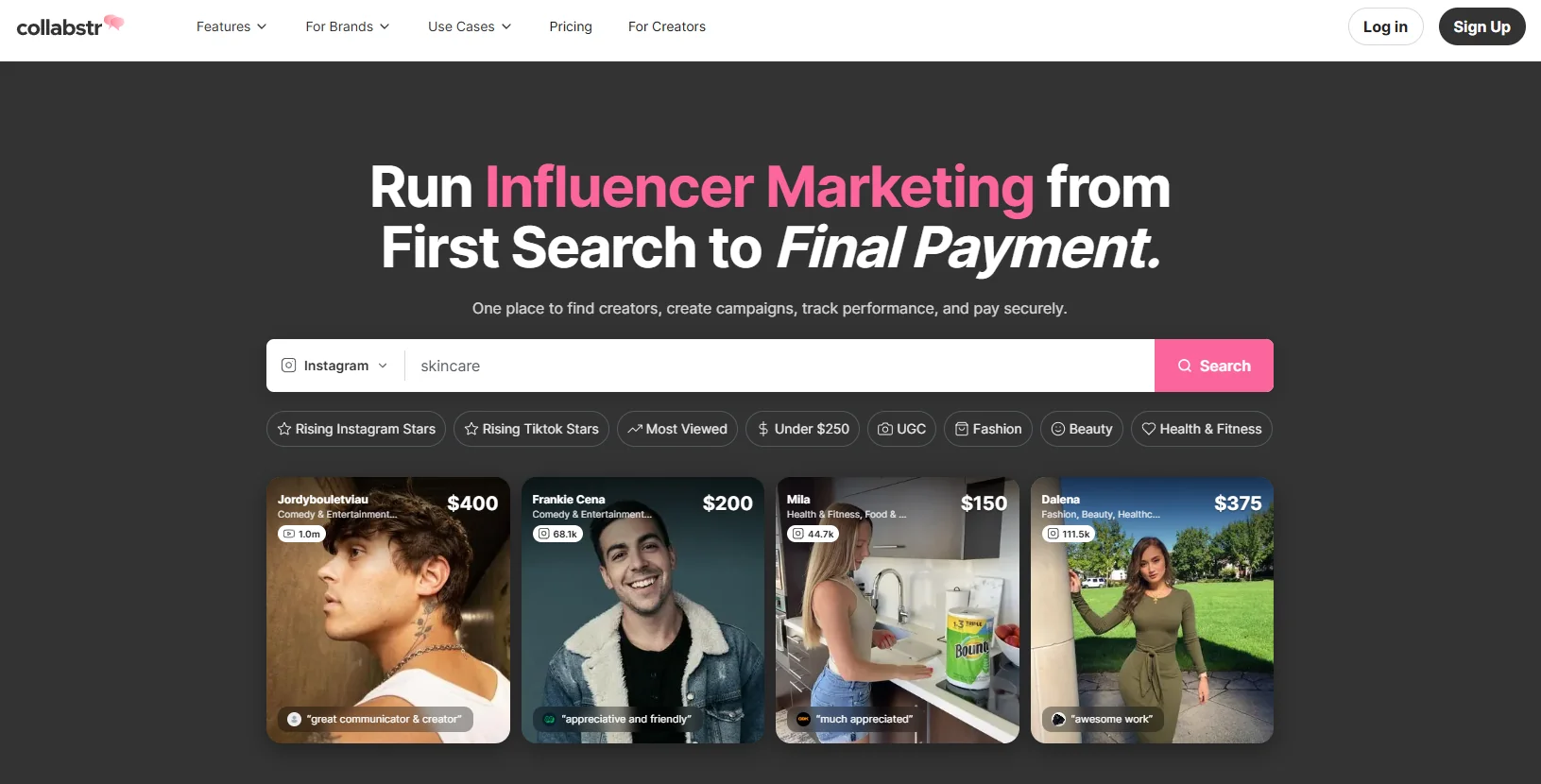
Collabstr goes the opposite direction from Influencity's subscription model: there's no monthly fee at all. It's a public marketplace where creators list their own rates upfront, and you browse, hire, and pay per collaboration. That removes the negotiation phase and the recurring cost, which is a relief for brands that only run occasional campaigns.
It's especially handy for UGC production, product seeding, and one-off content where speed matters more than long-term relationship building. Communication, approvals, and payments all run through the platform, with funds held in escrow until you approve the deliverable. So it's low-risk to test, and there's no annual contract hanging over you. If you're still figuring out how to find influencers who fit your brand, the transparent-rate marketplace makes that first hire simple.
Pricing is pay-per-collaboration, typically starting around $75 per creator depending on their rate, with Collabstr taking a commission on each transaction. The limitation is that you don't get discovery analytics, a CRM, or campaign attribution, so it's built for booking creators, not running a full data-driven program. For that, you'd pair it with a heavier tool.
10. Intellifluence
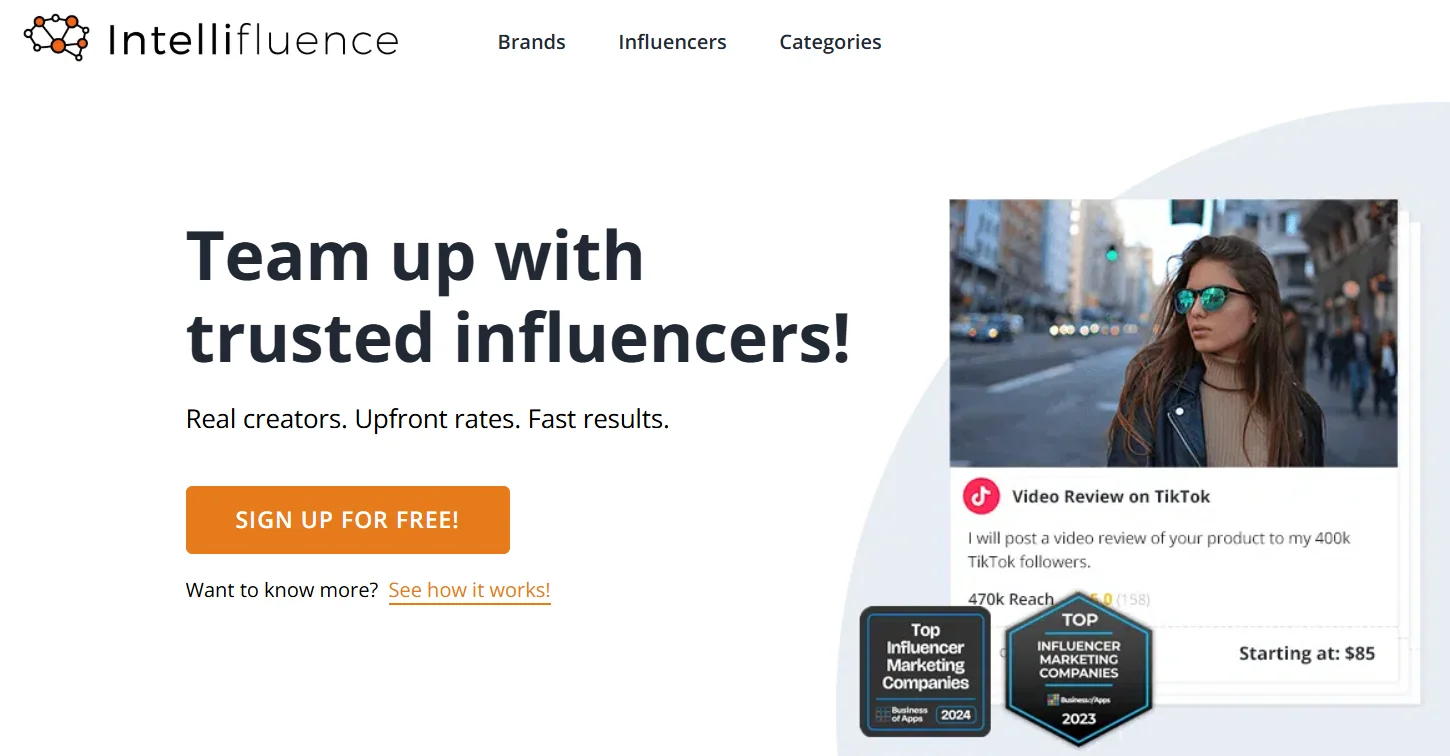
Intellifluence rounds out the list as a small-business-friendly marketplace, and it's a smart pick for brands priced out of Influencity's campaign tiers. It runs on a network of 90,000+ registered creators who opt in, so you post an offer and interested influencers apply, similar to a marketplace flow. Many are open to product-only or low-fee collaborations, which keeps campaign costs down.
It's genuinely straightforward: list what you need, manage the responses in one dashboard, and handle payments in-platform. For a small ecommerce brand that wants micro-influencer campaigns without cold outreach, that simplicity is the whole appeal.
Paid plans run $99/month (Starter), $249/month (Regular), and $599/month (Advanced), all month-to-month with no long-term contract. Even the top tier costs less than most enterprise platforms. The trade-off is depth: you won't get the advanced audience analytics, fraud detection, or reporting that a data-heavy platform like Influencity provides. For budget-conscious micro-influencer programs, though, it delivers where it counts.
Which Influencity Alternative Should You Pick?
Here's the thing: you don't need the exact tool every other brand uses. The right Influencity alternative depends on your size, budget, and how you like to work. If credit caps and a climbing price tag pushed you to look elsewhere, you have plenty of better-fitting options now.
Want deeper data and fraud checks? HypeAuditor and Modash have you covered. Running a serious, revenue-focused program? Influencer Hero, Upfluence, or GRIN bring the automation and attribution.
And if you'd rather stop searching a database and just have vetted creators apply to you, a marketplace model is the simpler path. Afluencer fits brands who want low-cost, low-effort collabs and gifting without an annual lock-in, starting at $49/month. Sign up with Afluencer, post your first Collab, and let the right creators come to you.