.svg)

.png)
10 Best Social Cat Alternatives in 2026
Social Cat built a nice little niche: send free product to vetted micro-influencers, get authentic content back, all from one dashboard. For a small brand testing the waters with gifting, that's a clean pitch. So why are people searching for Social Cat alternatives?
Usually it comes down to what happens after the gifting works. Social Cat keeps things simple, which is great until you need real ROI reporting, outreach automation, a proper CRM, or an integration with your Shopify store. It caps creators, invites, and campaigns by tier, sticks to Instagram and TikTok, and has thin third-party reviews, so brands trying to scale tend to bump into the ceiling fast. The pricing itself is fair (Essentials at $99/month, Performance at $199, and Pro at $299), but the platform is built for starting, not scaling.
The good news: the market is full of tools that solve the exact gaps Social Cat leaves open, whether you want something cheaper, something with deeper data, or a full operating system for your creator program. Here are the best Social Cat alternatives worth a look this year.
1. Afluencer
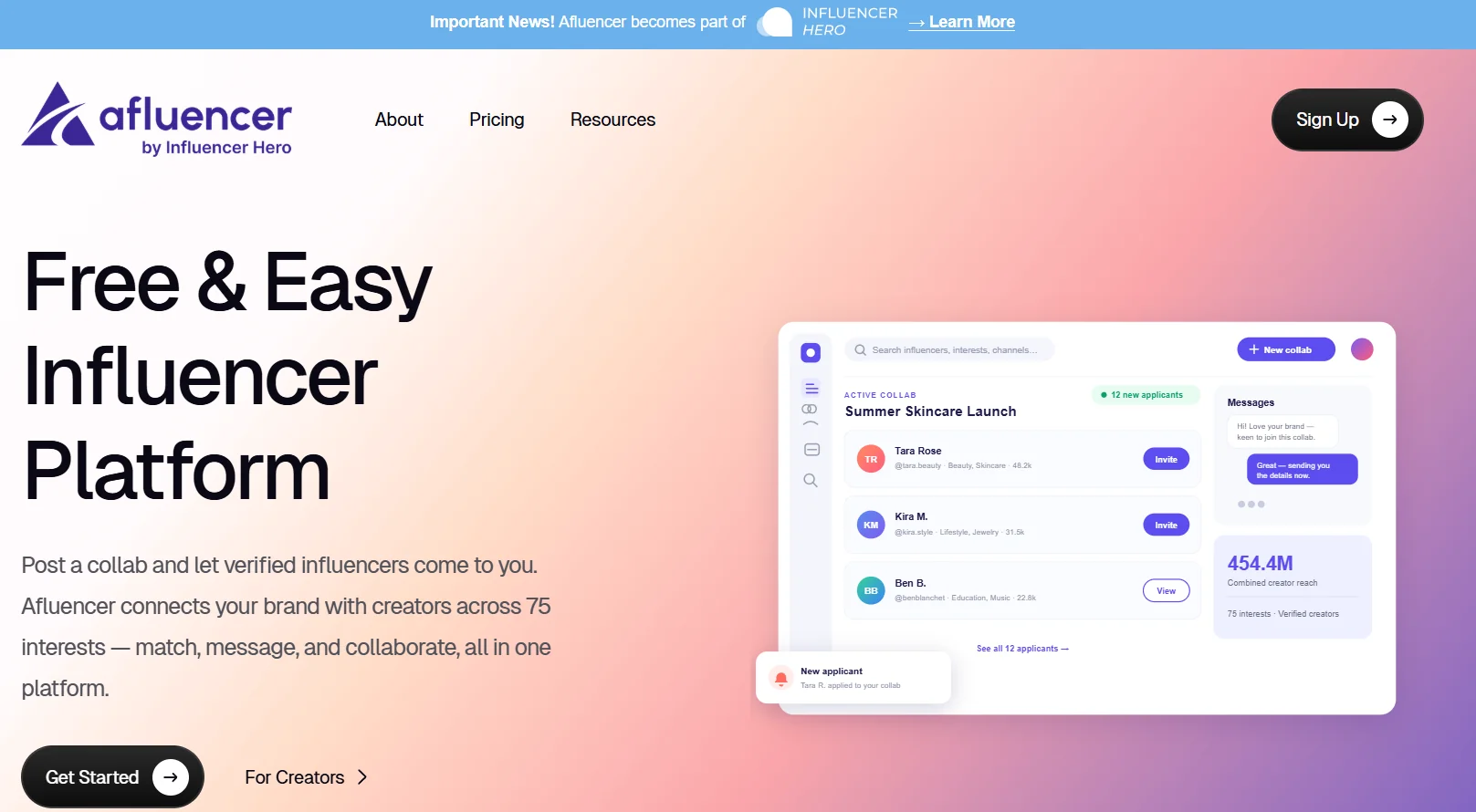
If Social Cat's pull is "creators come to you," Afluencer runs the same play with a bigger, more flexible net. You post a Collab that spells out exactly who you want (platform, follower range, niche, location, compensation type), and verified creators apply directly. No cold outreach, no scraping a database of people who never agreed to be contacted. The right creators raise their hand, and you pick.
That application-first model is what makes Afluencer such a natural swap for a gifting-focused brand. You're not paying to unlock a giant list; you're publishing an opportunity and letting interested creators self-select. For DTC and Shopify brands running product seeding, that cuts the busywork dramatically. You describe the gift, set the deliverable, and shortlist from real applicants.
Afluencer skews toward micro and nano creators, which is exactly the tier that makes gifting work. Smaller creators convert on free product, post authentically, and stick around, so a single Collab often turns into an ongoing relationship rather than a one-off. You can run gifting, paid, and affiliate collabs from the same place, with built-in messaging so the whole conversation lives in one thread.
Where Social Cat locks features behind tiers, Afluencer keeps the barrier low. Creators join free, which keeps the applicant pool deep, and brand plans start at just $49/month on the Marketplace plan, with 60 invitation credits, premium filters, and phone, email, and live chat support. That's the cheapest working entry point in this whole roundup.
Afluencer also leans into AI where it actually helps. CreatorGPT matches brands and creators based on goals, style, and budget, so the right partnerships surface instead of you scrolling endlessly. It doubles as a strategy assistant when you're stuck on brief wording, offer structure, or which niche to target next.
One honest caveat: Afluencer is a marketplace, not a full enterprise suite. If you need granular ROI attribution down to the order, automated multi-step email sequences, or a deep analytics stack, you'll want one of the heavier platforms further down this list. But for finding and gifting the right creators without overpaying, it's tough to beat.
Ready to try it? Sign up and post your first Collab from $49/month, or let CreatorGPT map out your first campaign for you.
2. Influencer Hero
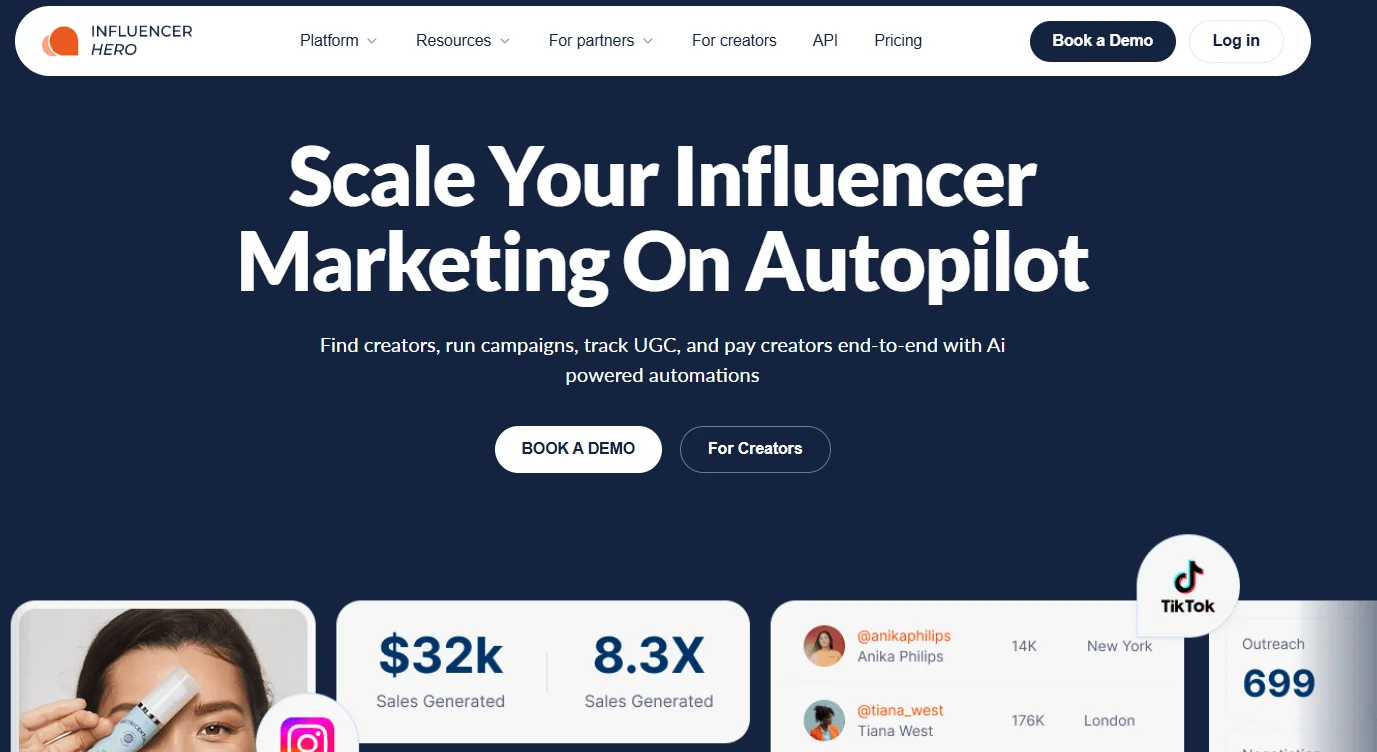
If your frustration with Social Cat is that it stops right when things get interesting, Influencer Hero is the upgrade. It's a full all-in-one influencer marketing platform built for D2C and ecommerce brands that want to run their entire program (discovery, outreach, CRM, gifting, affiliate, UGC, and ROI tracking) inside one tool instead of five.
Start with scale. Influencer Hero gives you a 450M+ creator database across eight platforms, including Instagram, TikTok, YouTube, Facebook, Pinterest, Snapchat, X, and Twitch, with AI-powered discovery and a lookalike feature that finds creators similar to your best performers. Compared to Social Cat's Instagram-and-TikTok focus, that's a different league of reach.
The part that really separates it is automation. Influencer Hero runs personalized email outreach with follow-up sequences and notifies you the moment a creator replies, so you're negotiating instead of chasing. Every conversation flows into a built-in influencer CRM with visual pipelines, which is exactly the layer Social Cat doesn't have once you're managing dozens of relationships at once.
Then there's the ecommerce muscle. Native Shopify, WooCommerce, and Klaviyo integrations mean you can automate gifting and product send-outs, generate affiliate links and discount codes, and track conversions and revenue per influencer. That closed loop (spend to actual sales) is what turns influencer marketing from a soft awareness play into a measurable revenue channel.
Pricing is publicly listed, which is refreshing in a category full of "book a demo" black boxes. Plans run $649/month for Standard (1,000 reach-outs, gifting, analytics), $1,049/month for Pro (5,000 reach-outs, dedicated account manager), and $2,490/month for Business (10,000 reach-outs, UGC tracking, custom API), with quarterly and annual billing discounts and a custom agency tier above that.
The honest caveat: the entry price is higher than Social Cat's, and there's a minimum commitment, so it's overkill if you're only doing occasional gifting. But for a brand serious about scaling creators into real ROI, it replaces a whole stack of tools and pays for itself fast. It also carries strong G2 and Capterra ratings, with users consistently praising the outreach automation and support.
3. Modash

Modash is the pick when discovery is your real gap. Its 350M+ creator database covers essentially every public creator on Instagram, TikTok, and YouTube, with audience analysis, fake-follower detection, and verified email outreach layered on top. Where Social Cat's pool is a curated few, Modash is closer to a search engine for the entire creator internet.
That makes it a strong fit for Shopify DTC brands that have already validated influencer marketing and want to scale discovery, vetting, and content tracking without an enterprise contract. The native Shopify integration ties creator activity to sales data, and gifting plus promo-code tracking are included.
Pricing is mid-market and transparent: Essentials at $199/month on annual billing ($299 monthly) for up to 100 tracked creators, Performance at $499/month annually ($599 monthly) for up to 250, and a custom Enterprise plan (public estimates start around $14,700/year). There's a 14-day free trial with no card required.
The catch is the profile-view caps. Heavy discovery work burns through the 300-analysis limit on Essentials quickly, and Modash's outreach and contract tools are thinner than a dedicated CRM. It's the best discovery layer under $500/month, but outreach-heavy teams often pair it with something else.
4. Insense

Insense competes with Social Cat on the UGC angle but points it squarely at paid social. It's a vetted marketplace of 80,000+ creators across Instagram and TikTok, built to source ad-ready content and push it straight into Meta and TikTok ads via Spark Ads and whitelisting. If your gifting goal is really "fuel for our ad account," Insense is purpose-built for that.
It's an official Meta and TikTok partner, handles licensing and payments in-platform, and turns content around in roughly 7 to 15 days. For performance marketers who live in Ads Manager, that direct pipeline from creator to campaign is the whole appeal. Solid gifting strategies still apply here, since product seeding runs alongside the paid work.
Pricing starts at $500/month on the self-service Brand plan (billed quarterly), with managed packages from around $1,800/month. Just budget for the extras: creator payments are separate, and Insense adds a 7 to 20% marketplace fee on top of every one.
The honest limitation: there's no YouTube support, no affiliate management, no WooCommerce, and no outreach automation, plus the trial isn't free and auto-upgrades. It's excellent at one job (UGC for paid social) and not built to run a full-stack influencer program.
5. SARAL

SARAL positions itself as the "influencer OS" for ecommerce brands, with a heavy focus on ambassador and affiliate programs. It handles discovery, outreach automation, a creator CRM, gifting, cookieless affiliate tracking, and social listening, all wrapped in a clean interface most teams learn in a few days. If your Social Cat gifting has grown into an ongoing ambassador motion, SARAL is built for that lifecycle.
It's intentionally lean and relationship-first, which brands like: no juggling five tools, and onboarding plus consulting come included via Slack and Zoom. Shopify and WooCommerce integrations tie commissions and sales back to the platform. It's a natural home for turning happy customers into long-term advocates, the same way a good micro-influencer gifting program does.
Pricing is where the gap from Social Cat shows. SARAL starts at roughly $1,000/month (Starter at $12,000/year) and scales to around $25,000/year for Professional, billed annually or quarterly, with no lock-in on quarterly plans.
The caveat: discovery depth is thinner than the big database tools, and the entry price is a real jump for a brand still validating the channel. But for outreach and relationship management on a ROI-first program, reviewers rate it highly.
6. Collabstr
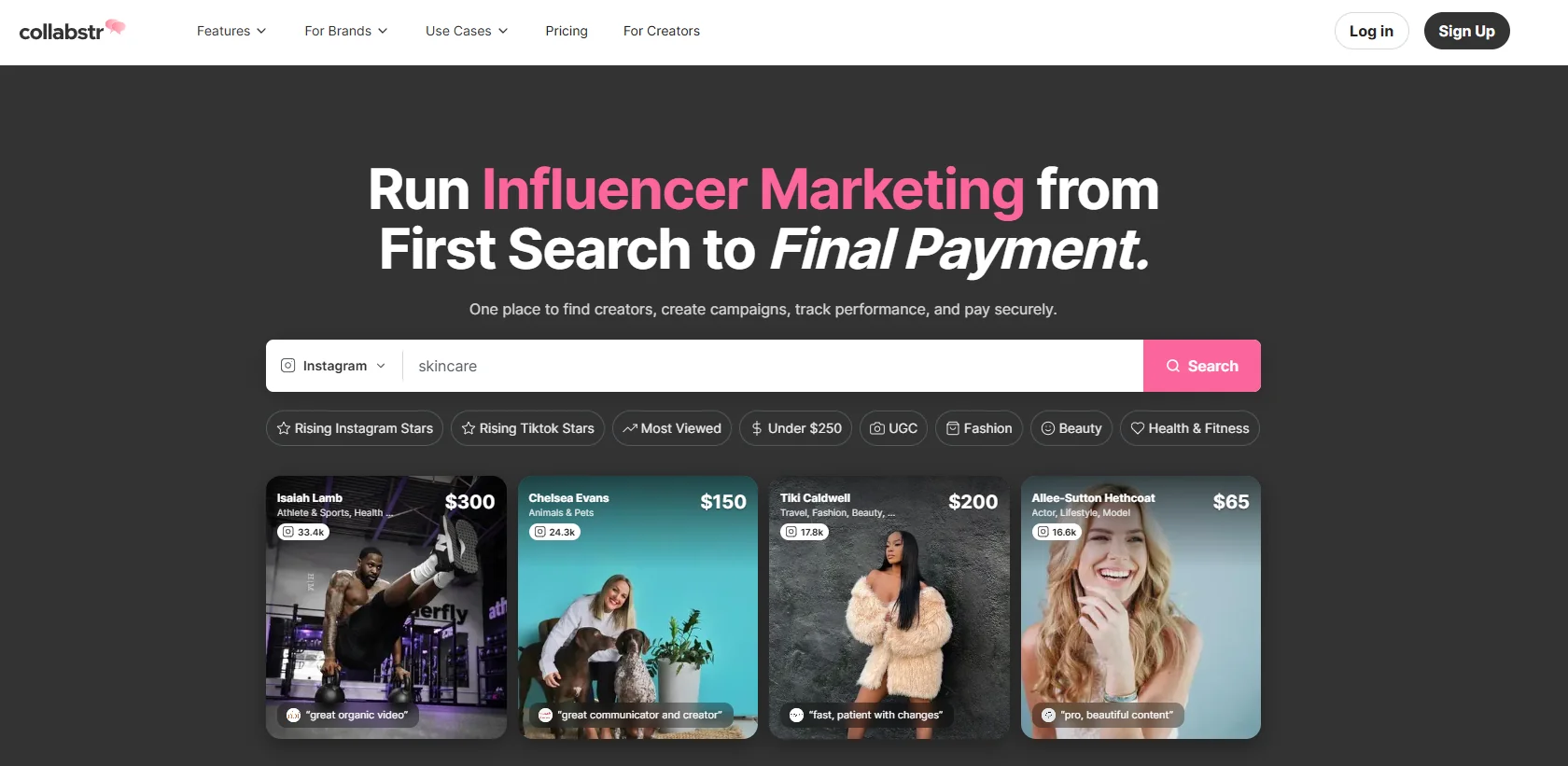
Collabstr is the answer for brands that don't want a subscription at all. It's the largest open marketplace in the category, with 170,000+ creators across Instagram, TikTok, and YouTube, and you hire them like freelancers: browse, see transparent pricing, book, and pay through escrow so funds only release when you approve the content.
That pay-as-you-go model makes it the cheapest way to test creator content without committing to a monthly fee. It's especially good for UGC, where over 40% of campaigns come from small brands with budgets under $5,000. Collaborations start around $75, and average UGC sits near $190 per asset, so you can spin up a rotating content library cheaply. If you're budgeting, our breakdown of influencer rates is a useful gut-check before you book.
There's no platform fee for brands to join and search, and the built-in rate calculator and analytics help you plan spend before you commit a dollar.
The trade-off is depth. Collabstr is a transactional hiring marketplace, not a program manager, so there's no CRM, no outreach automation, and no ROI attribution beyond basic campaign stats. Great for one-off bookings and UGC volume, less so for an always-on program.
7. GRIN

GRIN sits at the enterprise end and is built specifically for established ecommerce and DTC brands running always-on creator programs. Its 190M+ database, deep Shopify integration, product seeding, content management, affiliate codes, and revenue reporting make it a genuine operating system, with its signature move being tying every creator's activity directly to store sales.
For a brand that lives and dies by attributable revenue, that closed loop is the point, which is why fashion, beauty, and tech DTC brands gravitate to it. It goes far beyond what a gifting-first tool like Social Cat can do once you're managing hundreds of partnerships.
Pricing has shifted toward more visible tiers, with reported plans starting around $399/month (Lite) and scaling to roughly $1,799/month (Complete), though full deployments have historically run into enterprise territory ($25,000+/year) and access is demo-gated.
The honest caveats are cost and rigidity: annual contracts are common, several reviewers flag aggressive sales and lock-in, and the feature set can feel overwhelming for a smaller team. It's powerful, but it's built for brands with mature, repeatable processes and the budget to match.
8. Aspire

Aspire (formerly AspireIQ) is a full-suite platform aimed at mid-market and enterprise ecommerce brands. It pairs a 1M+ creator marketplace with relationship management, so you get both inbound (creators apply to your campaigns) and outbound (search by keyword, hashtag, and audience) discovery, plus content approval, affiliate tracking, and analytics in one place.
Its sweet spot is long-term programs: ambassador networks, ongoing UGC, and word-of-mouth commerce, which is a step up from Social Cat's one-off gifting. Household names like HelloFresh, Dyson, and Samsung run on it, so the platform is battle-tested at scale.
Pricing is custom and not published, generally reported to start around $1,000/month and climb into enterprise ranges (roughly $24,000/year), typically with an annual commitment.
The limitation: it's overbuilt and pricey if all you want is fast, high-volume UGC, and the annual lock-in is a lot to sign for a brand just getting started. For established teams building ambassador programs, though, it's one of the more complete options.
9. Heepsy
Heepsy is one of the most affordable discovery tools around, which makes it an easy Social Cat alternative for brands that mainly need to find and vet creators. Its 11M+ profile database spans Instagram, TikTok, and YouTube, with AI, lookalike, and handle search modes, plus audience demographics and built-in fake-follower detection.
It's a clean fit for small teams and agencies testing influencer marketing without a big commitment. There's a free tier for basic browsing, and outreach, lists, and campaign tracking come on paid plans.
Pricing starts at $89/month for Starter ($69 annually), $249/month for Plus, and $369/month for Advanced, with discounts for annual billing.
Two honest catches: the database is smaller than Modash's and strongest in Spain, and Shopify integration plus sales tracking are locked to the top Advanced tier. If ROI attribution is core to you, that's a real consideration. But as a low-cost discovery engine, Heepsy delivers.
10. Upfluence

Upfluence rounds out the list as a data-rich, multi-platform option for brands that want breadth. It covers discovery across Instagram, TikTok, YouTube, Pinterest, Twitch, and even Amazon and blogs, with campaign management, gifting, affiliate tools, and EMV reporting in one dashboard. For brands whose creators live outside the usual IG-and-TikTok lane, that coverage is the draw.
It's especially strong for ecommerce brands on Shopify or Amazon that want to tie influencer activity to sales, with an optional creator-payments tool bolted on.
Pricing is custom and quote-based, generally reported around $2,000/month with a full-year commitment (roughly $24,000/year), plus an optional $399/month payment add-on you can disable.
The caveat: the annual contract and enterprise-style pricing put it well above Social Cat's range, and some users find the discovery and filtering less sharp than dedicated tools. But for a brand that wants one platform covering many channels, Upfluence is a serious contender.
Which Social Cat Alternative Should You Pick?
Here's the thing: you never actually needed Social Cat specifically. You needed a way to find the right creators, get authentic content, and (eventually) prove it drove sales. The best alternative depends on where your program is today, not where Social Cat happened to stop.
If you're gifting and want the simplest, cheapest way to get verified creators applying to you, Afluencer is the natural home, starting at $49/month with no cold outreach and none of Social Cat's per-tier caps. If discovery is your gap, Modash or Heepsy. If UGC for paid social is the goal, Insense or Collabstr. And if you've outgrown "just gifting" and want one platform to run discovery, outreach, CRM, affiliate, and real ROI tracking, that's where the heavier tools earn their price. When you're ready to move past one-off gifts and build a repeatable program, brush up on what makes a micro-influencer worth partnering with, then post your first Collab on Afluencer or let CreatorGPT plan it with you.