.svg)
.png)
- Upfluence vs Afluencer vs Influencer Hero: A Detailed Comparison
- Quick Comparison: Upfluence vs Afluencer vs Influencer Hero
- What Is Upfluence?
- What Is Afluencer?
- What Is Influencer Hero?
- Upfluence vs Afluencer vs Influencer Hero: Feature-by-Feature Breakdown
- Pricing: What You'll Actually Pay
- Which Platform Is Right for You?
- The Bottom Line
Upfluence vs Afluencer vs Influencer Hero: A Detailed Comparison
Comparing influencer marketing platforms is annoying for one reason: almost every article you find is written by one of the platforms. You get a feature list, a soft dig at the competition, and no real answer to the only question you care about, which is whether the tool fits the size of program you're actually running right now.
So let's be upfront. Afluencer and Influencer Hero are part of the same family, and this article is on the Afluencer blog. That doesn't mean Upfluence gets a hatchet job. It's a genuinely strong platform for a specific type of brand, and we'll say exactly which type. If you're still working out the fundamentals before you shop for software, start with the influencer marketing basics and come back.
Here's what you'll walk away with: how each platform finds creators, what outreach and tracking look like inside each one, what you'll really pay, and where the line sits between a marketplace, a full workflow platform, and an enterprise-leaning suite.
Quick Comparison: Upfluence vs Afluencer vs Influencer Hero
What Is Upfluence?

Upfluence launched in 2013 as a search tool and grew into a creator commerce platform. Today it indexes more than 12 million creator profiles and sells access in modules, so you buy discovery, campaign management and payments as separate pieces rather than one flat plan.
The typical Upfluence user is an ecommerce team with an existing affiliate program and someone whose actual job is running creator campaigns. It's built for volume: bulk outreach, discount code generation, product seeding and revenue attribution back to Shopify or Amazon.
AI Discovery With Jaice
Jaice is Upfluence's AI co-pilot. It reads your brand profile and campaign goals, surfaces creators you probably wouldn't find through manual filters, suggests lookalikes based on your top performers, and drafts outreach emails. Teams report cutting creator research from hours to minutes.
The search itself supports 20 plus filters covering location, niche keywords, follower range, engagement rate and audience demographics. If you're used to hunting for influencers on Instagram by hand, this is the part that feels like an upgrade.
Live Capture for Customer Creators
Upfluence can scan your existing customer list and flag the ones with real followings. Turning buyers into creators is a smart play because they already know the product, and Upfluence claims those creators convert far better than cold ones.
Ecommerce Attribution
This is where Upfluence genuinely leads. The Shopify integration shows sales generated, code usage dates and order counts per creator, and the Amazon integration supports Attribution campaigns for FBA sellers. Very few platforms tie creator activity to order-level revenue this deeply.
Where Upfluence Falls Short
The pricing model is the sticking point. Modules are gated, so buying Search and Contact alone means you can't run campaigns or pay creators, and the minimum contract is 12 months. Reviewers regularly mention a steep learning curve and quotes that grew once seats and add-ons were added. It's a lot of commitment for a brand that hasn't proven the channel yet, which is one of the key questions worth answering before you sign anything.
What Is Afluencer?
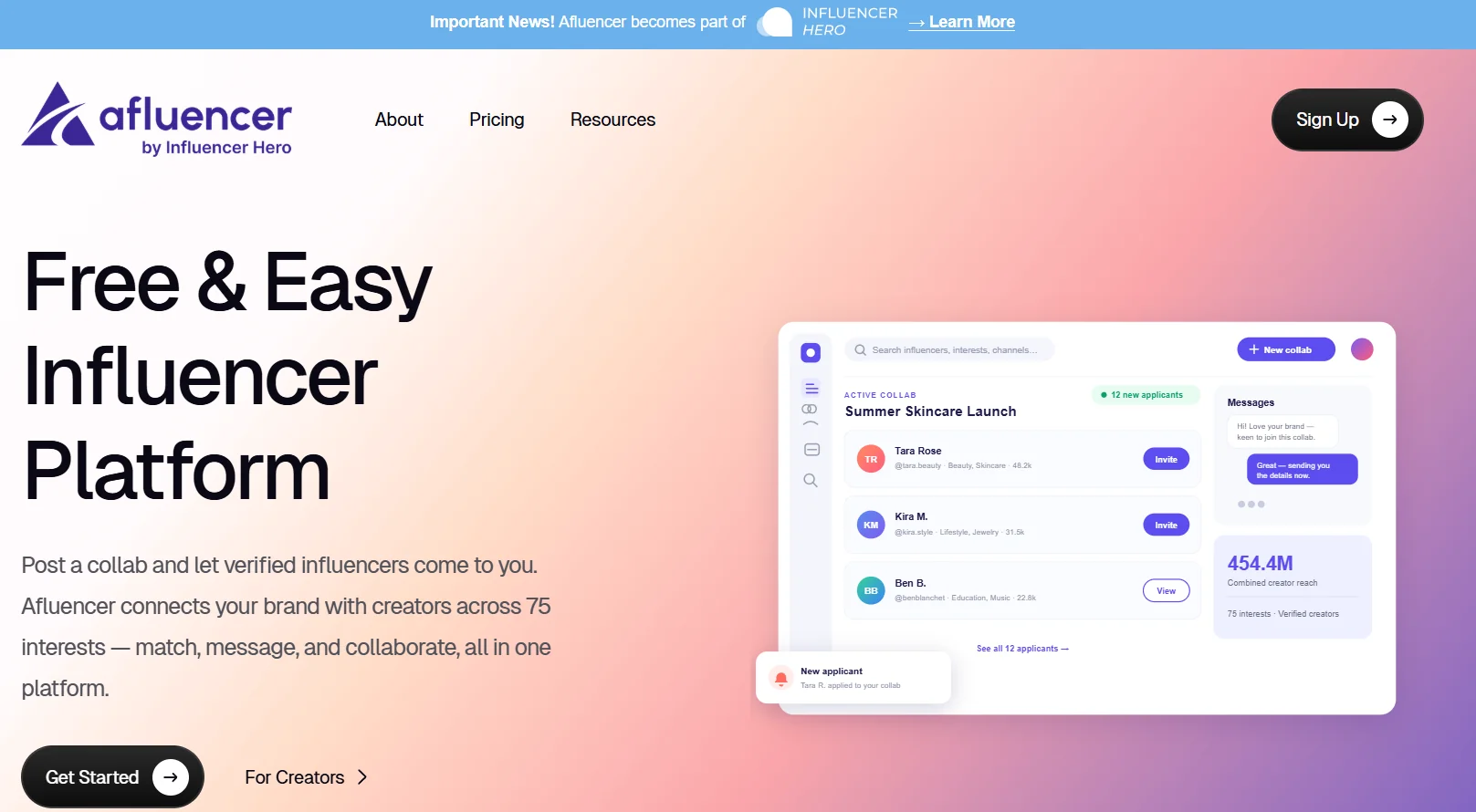
Afluencer flips the model. Instead of searching a database and cold emailing people, you post a Collab describing what you want, and verified creators apply to it. Brands review applications, message applicants directly, and start collaborations from there.
The creator side is the point. Afluencer's community spans 75 plus interests and skews heavily toward nano and micro creators, the tier most small D2C brands actually work with. Everyone who applies has already opted in, so response rates aren't a problem the way they are with cold outreach.
Collabs Instead of Cold Outreach
A Collab listing sets the terms upfront: gifting, affiliate, paid, or a mix. Creators self-select based on whether they want in, which filters out most of the mismatch that kills early campaigns. Setup takes minutes, not a week of list building.
CreatorGPT
Afluencer's AI concierge, CreatorGPT, helps on the strategy side: campaign ideas, collab structures, pitch and brief writing. It's useful when you're not yet sure what you should be asking creators for.
Low Commitment
There's no annual contract and no implementation project. You post, you review applications, you collaborate. For a brand testing whether influencer marketing works at all, that matters more than feature depth.
Where Afluencer Falls Short
Afluencer is a marketplace, not a campaign operating system. There's no built-in affiliate tracking, no creator payment processing and no automated outreach sequences. Once you're managing dozens of creators at once, tracking who got what and which sales came from where moves into spreadsheets fast. That's the ceiling, and it's a real one.
What Is Influencer Hero?
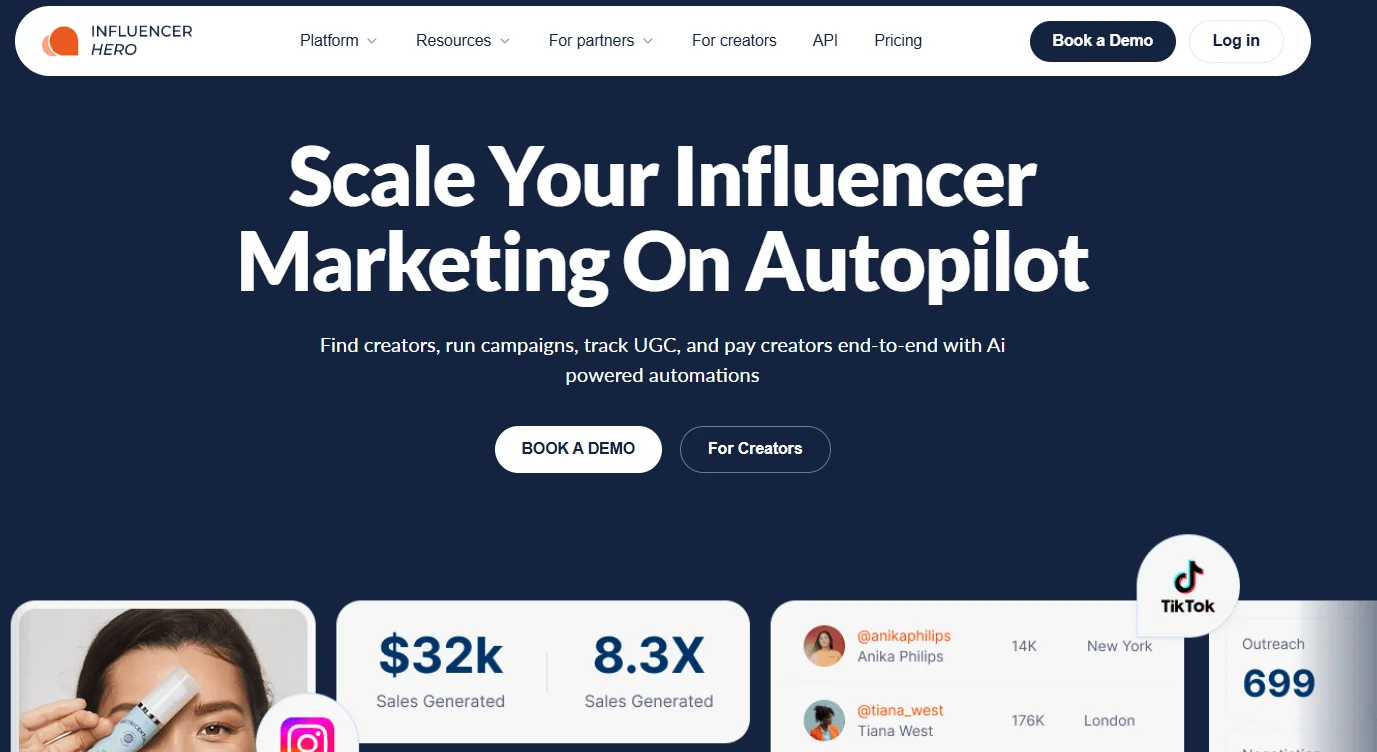
Influencer Hero is the best influencer marketing software in the same family as Afluencer, built for D2C brands that have gotten past the testing stage. It covers discovery, outreach, CRM, gifting, UGC, affiliate tracking, payments and reporting in a single system, and it's used by 1,200 plus brands and 100 plus agencies.
The database sits at 450 million plus creator profiles across Instagram, TikTok and YouTube, with fake follower and bot detection built into the search rather than sold as an add-on. The step up from a marketplace is that everything downstream of discovery is automated too.
Personalized Bulk Outreach
You can run outreach at volume without it reading like a template, with follow-up sequences and a centralized inbox so replies don't get lost across inboxes and DMs. If your current process is manual, these outreach techniques are the ones the platform automates.
CRM Built for Creator Pipelines
Every creator sits in a pipeline stage: contacted, negotiating, product sent, content live. Rules-based automation moves them along, which is the difference between managing 20 relationships and managing 500 without hiring anyone.
Affiliate Tracking and Payments in One Place
Unique affiliate links, discount codes and commission percentages are set per creator, commissions roll into a balance, and payouts process inside the platform. Creators get their own dashboard to check earnings and cash out. Attribution stays in one system instead of scattered across Shopify reports, an affiliate app and a spreadsheet.
Where Influencer Hero Falls Short
There's no free plan, and entry starts at $649 a month. For a brand doing two gifting collabs a quarter, that's more platform than the program needs. The affiliate module also takes some setup time if you're building multi-tier commission structures.
Upfluence vs Afluencer vs Influencer Hero: Feature-by-Feature Breakdown
Influencer Discovery
Upfluence and Influencer Hero both run on outbound search, and both use AI to narrow the field. The gap is index size and vetting: 12 million profiles versus 450 million, with fraud detection sitting inside Influencer Hero's search rather than in a separate audit tool. Afluencer works the other direction entirely, surfacing creators who applied to you, which is faster to start but caps out at the size of the applicant pool.
Outreach and Communication
Upfluence handles email sequences with Gmail and Outlook sync. Influencer Hero does personalized bulk outreach with automated follow-ups and a shared inbox. Afluencer keeps it in-app: you message applicants directly, which works beautifully at 10 creators and gets heavy at 100.
CRM and Campaign Management
Upfluence's IRM keeps lists, tags, statuses and discount codes connected. Influencer Hero adds rules-based automation on top of the pipeline, so status changes trigger the next action instead of waiting for someone to notice. Afluencer covers applications and messages, and expects your campaign management to live elsewhere once volume grows.
Tracking and Analytics
Upfluence reports revenue, ROI, AOV and per-creator clicks and sales, with Amazon Attribution support that nobody else matches. Influencer Hero reports verified impressions, clicks and conversions alongside content capture, so the creative and the revenue sit in the same view. Afluencer leaves performance measurement to your store analytics, which is fine early on when you're still deciding whether reach or impressions is the metric you care about.
Integrations
All three connect to a store in some form. Upfluence is strongest on Amazon and pairs Stripe-powered payments with Shopify and WooCommerce. Influencer Hero integrates with Shopify, WooCommerce and custom stores, plus tools like Klaviyo, Slack, Zapier and DocuSign. Afluencer sits alongside your stack rather than plugging into it.
Pricing: What You'll Actually Pay
Upfluence doesn't publish prices. Modules start around $478 a month each, but a usable setup with search, campaign management and payments plus one seat lands closer to $1,300 a month, and additional seats add roughly $79 each. The minimum contract is 12 months, so the real commitment is five figures a year.
Afluencer starts at $49 a month on the Marketplace plan, with higher tiers for brands running larger recruitment programs. You can see current plans before committing, and there's no annual lock-in.
Influencer Hero publishes its pricing: Standard at $649 a month with 1,000 reach outs, Pro at $1,049 a month with 5,000 reach outs and three seats, and Business at $2,490 a month with 10,000 reach outs and unlimited seats. Everything is listed, so you can size the plan before you talk to anyone.
Here's the practical math. If your total monthly influencer budget is $2,000, putting $1,300 of it into software before you've paid a single creator doesn't leave much for the campaigns themselves. Starting at $49 a month while you learn what converts, then upgrading once the channel earns its budget, is the sequence that actually works.
Which Platform Is Right for You?
Upfluence has earned its position with ecommerce brands, and the Amazon Attribution support is a real differentiator that nothing else in this comparison replicates. If you sell on Amazon, run an established affiliate program, and have a dedicated person managing creator campaigns full time, the modular structure lets you buy exactly the pieces you need. That's a legitimate reason to choose it.
Influencer Hero makes more sense when the bottleneck is workflow rather than discovery. If you're running outreach at volume, managing dozens of creators through different stages at once, issuing affiliate links and codes, and paying people every month, having all of that in one system with published pricing and no 12-month minimum removes a lot of friction.
The full workflow works better here when you need discovery, CRM, affiliate and payouts talking to each other instead of living in four tools. Curious how that plays out with your product and your margins? Book a demo with Influencer Hero and see the workflow on your own numbers.
And if you're earlier than that, Afluencer is where to start. Post a Collab, see who applies, run a few collaborations and find out what your creators actually produce before you commit to platform spend. It's the same logic behind why brands starting small get traction with creators faster than the ones waiting for a perfect setup.
The Bottom Line
These three tools solve different problems: Upfluence solves attribution for ecommerce teams already running programs at scale, Afluencer solves the cold start, and Influencer Hero solves everything between recruiting a creator and paying them. Pick based on which of those problems is currently costing you the most time.
If you're recruiting your first creators, start on Afluencer and get a Collab live this week. If you already have a program and it's held together by spreadsheets, Influencer Hero is the version of that program that runs itself.
Frequently Asked Questions
<details class="ih-faq"><summary>What's the main difference between Upfluence and Influencer Hero?</summary><div class="ih-faq-a">Upfluence sells its platform in modules on a 12-month contract with quote-based pricing, and leads on Amazon attribution. Influencer Hero publishes its plans, includes discovery, CRM, affiliate tracking and payments together, and runs month to month. The difference is packaging and commitment more than raw capability.</div></details><details class="ih-faq"><summary>Which platform fits a brand running its first collabs?</summary><div class="ih-faq-a">Afluencer. You post a Collab, creators apply, and you start collaborating without an onboarding project or an annual contract. At $49 a month it lets you learn what your audience responds to before you move budget into a full campaign platform like Influencer Hero.</div></details><details class="ih-faq"><summary>Does Afluencer track affiliate sales?</summary><div class="ih-faq-a">No. Afluencer handles recruitment and communication, so affiliate links, discount codes and sales attribution live in your store or affiliate app. If tracking revenue per creator inside one dashboard is the priority, that's what Influencer Hero's affiliate and payments module is built for.</div></details><details class="ih-faq"><summary>Can I use Afluencer and Influencer Hero together?</summary><div class="ih-faq-a">Yes, and plenty of brands do. Afluencer brings inbound applications from creators who chose your brand, while Influencer Hero manages outreach, pipeline, affiliate tracking and payouts. Recruitment on one side, operations on the other, with no overlap between the two.</div></details><details class="ih-faq"><summary>Does Upfluence require an annual contract?</summary><div class="ih-faq-a">Yes. Upfluence's standard minimum is 12 months, and pricing is quoted after a sales call rather than published. Budget for the full year and confirm which modules you need upfront, since search alone won't let you run campaigns or pay creators.</div></details><script type="application/ld+json">{"@context":"https://schema.org","@type":"FAQPage","mainEntity":[{"@type":"Question","name":"What's the main difference between Upfluence and Influencer Hero?","acceptedAnswer":{"@type":"Answer","text":"Upfluence sells its platform in modules on a 12-month contract with quote-based pricing, and leads on Amazon attribution. Influencer Hero publishes its plans, includes discovery, CRM, affiliate tracking and payments together, and runs month to month. The difference is packaging and commitment more than raw capability."}},{"@type":"Question","name":"Which platform fits a brand running its first collabs?","acceptedAnswer":{"@type":"Answer","text":"Afluencer. You post a Collab, creators apply, and you start collaborating without an onboarding project or an annual contract. At $49 a month it lets you learn what your audience responds to before you move budget into a full campaign platform like Influencer Hero."}},{"@type":"Question","name":"Does Afluencer track affiliate sales?","acceptedAnswer":{"@type":"Answer","text":"No. Afluencer handles recruitment and communication, so affiliate links, discount codes and sales attribution live in your store or affiliate app. If tracking revenue per creator inside one dashboard is the priority, that's what Influencer Hero's affiliate and payments module is built for."}},{"@type":"Question","name":"Can I use Afluencer and Influencer Hero together?","acceptedAnswer":{"@type":"Answer","text":"Yes, and plenty of brands do. Afluencer brings inbound applications from creators who chose your brand, while Influencer Hero manages outreach, pipeline, affiliate tracking and payouts. Recruitment on one side, operations on the other, with no overlap between the two."}},{"@type":"Question","name":"Does Upfluence require an annual contract?","acceptedAnswer":{"@type":"Answer","text":"Yes. Upfluence's standard minimum is 12 months, and pricing is quoted after a sales call rather than published. Budget for the full year and confirm which modules you need upfront, since search alone won't let you run campaigns or pay creators."}}]}</script>