.svg)
.png)
- Wednesday App vs Afluencer vs Influencer Hero: A Detailed Comparison
- Quick Comparison: Wednesday App vs Afluencer vs Influencer Hero
- What Is Wednesday App?
- What Is Afluencer?
- What Is Influencer Hero?
- Feature-by-Feature Breakdown
- Pricing: What You'll Actually Pay
- Which Platform Is Right for You?
- The Bottom Line
Wednesday App vs Afluencer vs Influencer Hero: A Detailed Comparison
Every influencer platform comparison you find online was written by someone with a stake in the answer. That includes this one, so let's be upfront: Afluencer and Influencer Hero are part of the same family. What follows is still an honest breakdown, because pushing you toward a tool that doesn't fit your budget helps nobody.
Wednesday App, Afluencer and Influencer Hero get compared a lot, and it makes sense. All three help brands find creators. But they solve the problem in completely different ways, and the price difference between them is roughly 13x from bottom to top. If you're still getting started with the channel, that gap matters more than any feature list.
Wednesday App is a discovery tool for lean teams. Afluencer is a marketplace where creators apply to you. Influencer Hero is a full campaign operating system for brands running programs at scale.
By the end of this you'll know which model fits how you actually work, what each one costs, and where the ceiling is on all three.
Quick Comparison: Wednesday App vs Afluencer vs Influencer Hero
What Is Wednesday App?
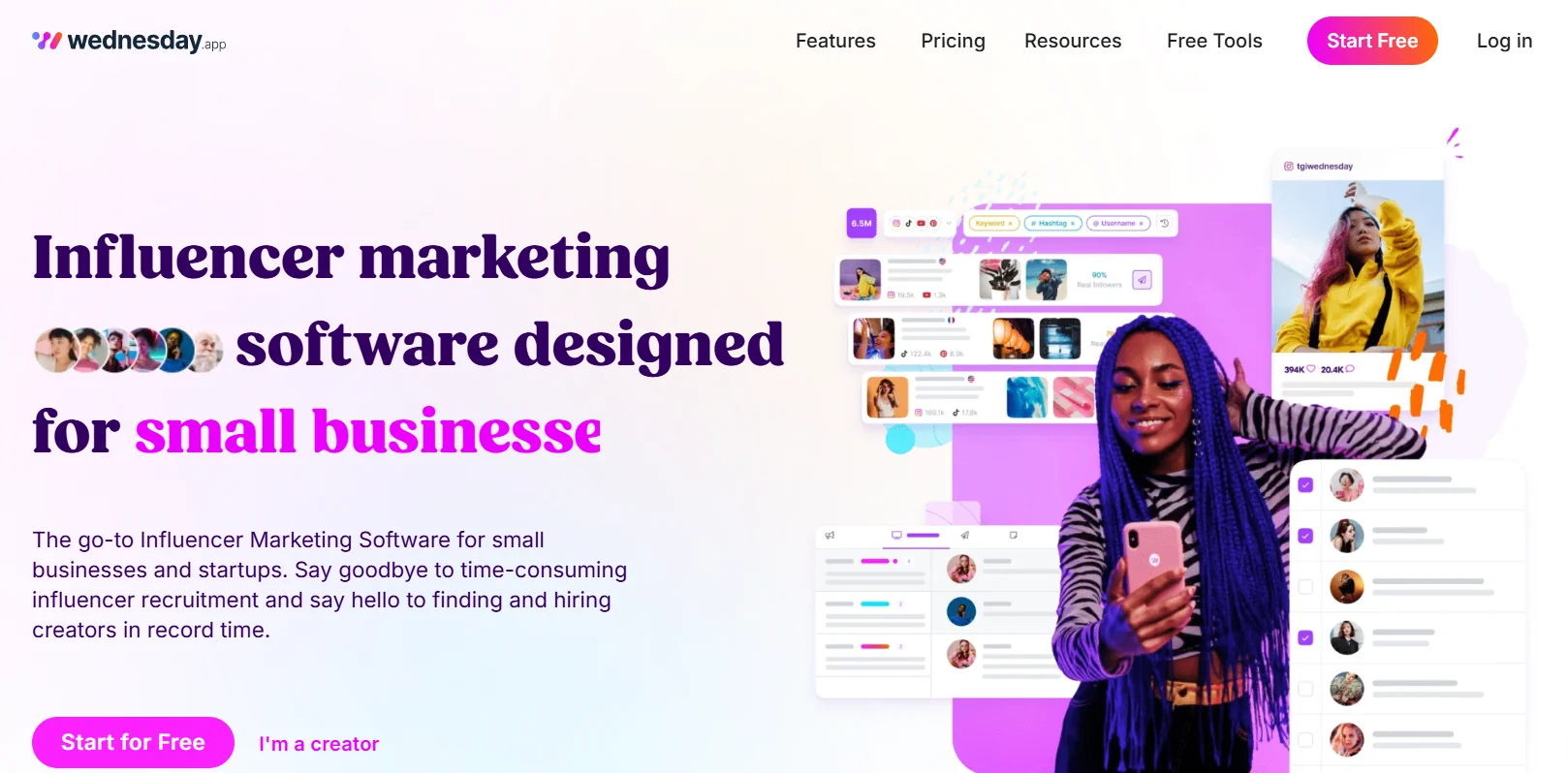
Wednesday App is an influencer discovery and relationship tool built for small businesses, startups and solopreneurs. It's powered by Upfluence, which means it draws on serious data infrastructure while keeping the interface stripped down for people who don't want an enterprise onboarding process.
The workflow is simple. You search a database of over 3 million creators across seven platforms, open profiles to check audience data, message people one by one, and track those conversations in a built-in CRM. No implementation calls, no sales process, no annual contract.
That simplicity is the whole product thesis. Wednesday isn't trying to run your program, it's trying to replace the spreadsheet you're using to find and track creators.
Creator Search Across 3M+ Profiles
Wednesday covers Instagram, TikTok, YouTube, Twitch, X, Snapchat and Pinterest, with filters for niche, audience size, engagement and location. For a brand that mostly needs to find Instagram influencers in a specific niche, the search does the job without a learning curve.
The database is smaller than what larger platforms offer, so expect fewer results in narrow verticals. For most small campaigns that's a non-issue.
Lookalike Matching and AI-Assisted Search
Once you find a creator who performs, Wednesday can surface profiles with similar audiences and content patterns. It's a fast way to build out a list without restarting your filters from scratch.
There's also a ChatGPT integration for natural-language searching, which is useful when you're still scoping a campaign and don't know exactly who you're looking for yet.
Built-In IRM and Free Audit Tools
The influencer relationship manager lets you tag creators, track conversations and group people by campaign. It's basic compared to platforms with proper pipeline stages, but it beats a Google Sheet.
Wednesday also gives away free audit tools for fake follower checks and engagement rates across most major platforms, which anyone can use without a paid plan.
Where Wednesday App Falls Short
The ceiling shows up fast once you move past discovery. There's no affiliate tracking, no creator payments, no gifting workflow and no ecommerce integrations, so anything tied to revenue happens outside the tool. Mass outreach is locked behind the $279 Outreach plan, extra seats cost $29 each, and there's no API. Most reviewers describe outgrowing it within a year.
What Is Afluencer?
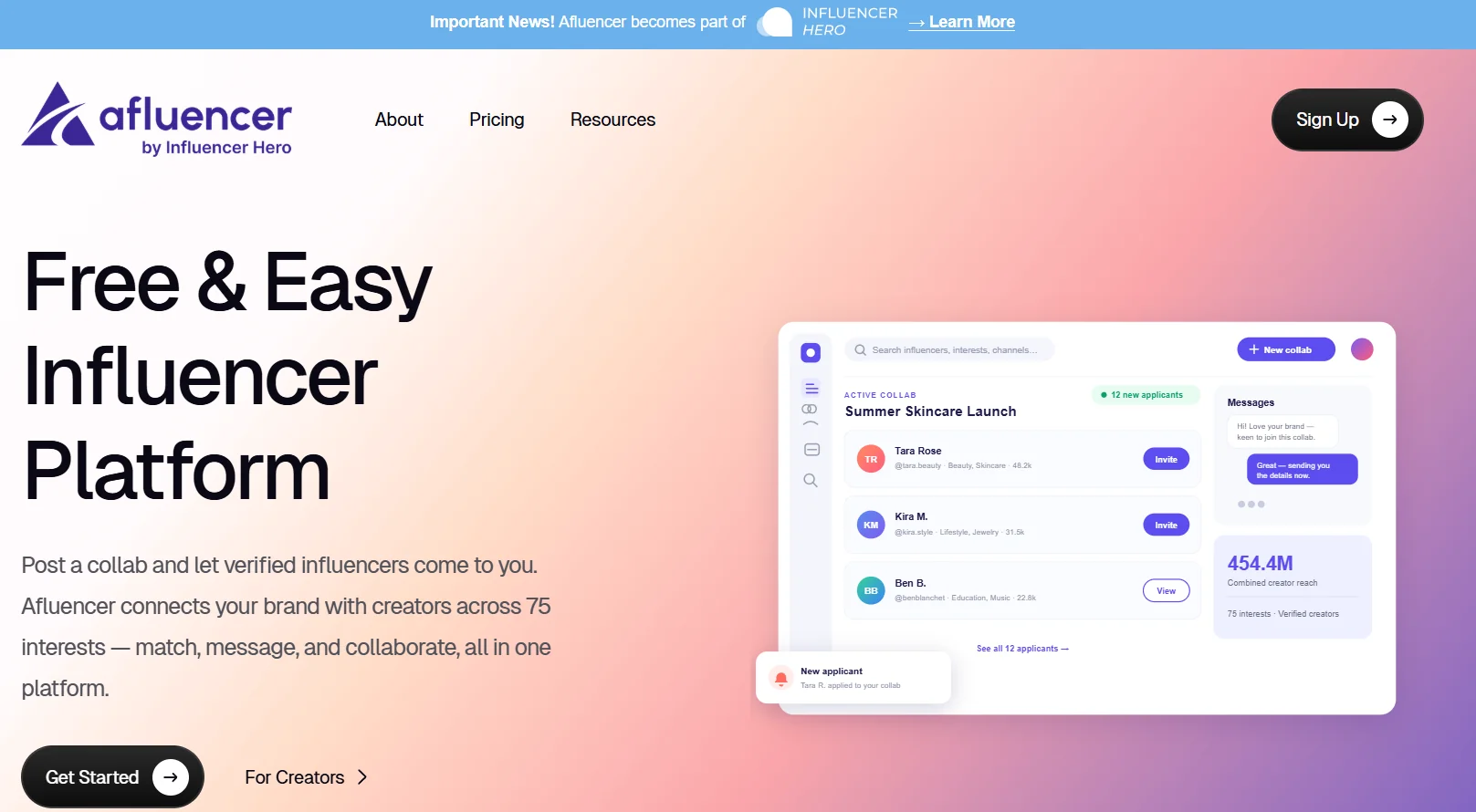
Afluencer flips the discovery model. Instead of searching a database and cold-messaging strangers, you post a Collab describing your product, your terms and the kind of creator you want. Verified creators browse those listings and apply to you.
That inbound structure removes the hardest part of early influencer marketing, which is getting a reply. Everyone in your inbox already raised their hand, so response rates aren't the bottleneck. You review applicants, message them in-app and move forward with the ones that fit.
Afluencer is built for small and mid-sized brands who want creator relationships without managing a complex tool. It's also part of the Influencer Hero family, which matters later when your program grows.
The Collab Model
A Collab is a public listing. You define compensation, deliverables, product details and creator criteria, then let applications come in. Brands running gifting or product-seeding programs get the most out of this, because creators self-select based on whether they actually want the product.
The trade-off is straightforward: you're limited to creators active on the platform rather than the entire open social graph.
CreatorGPT for Campaign Planning
Afluencer's AI assistant, CreatorGPT, helps with the parts brands tend to stall on. Writing a Collab that attracts the right applicants, shaping campaign angles, and matching creators to briefs.
It's a practical shortcut for teams without a dedicated influencer marketer on staff.
Direct Messaging and Ecommerce Apps
All communication happens inside the platform, so early conversations stay in one place instead of scattered across DMs and personal inboxes. Afluencer also ships Shopify and BigCommerce apps, which makes product-based collabs easier to run for ecommerce brands.
Outbound invitations run on a credit system, with 60 invite credits per month on the entry Marketplace plan.
Where Afluencer Falls Short
Afluencer is a marketplace, not a campaign engine. There's no affiliate link tracking, no automated outreach sequences and no revenue attribution tying a post back to an order. Invite credits cap how proactive you can be. Once you're managing dozens of creators with commission structures and performance tracking, the model runs out of room by design.
What Is Influencer Hero?
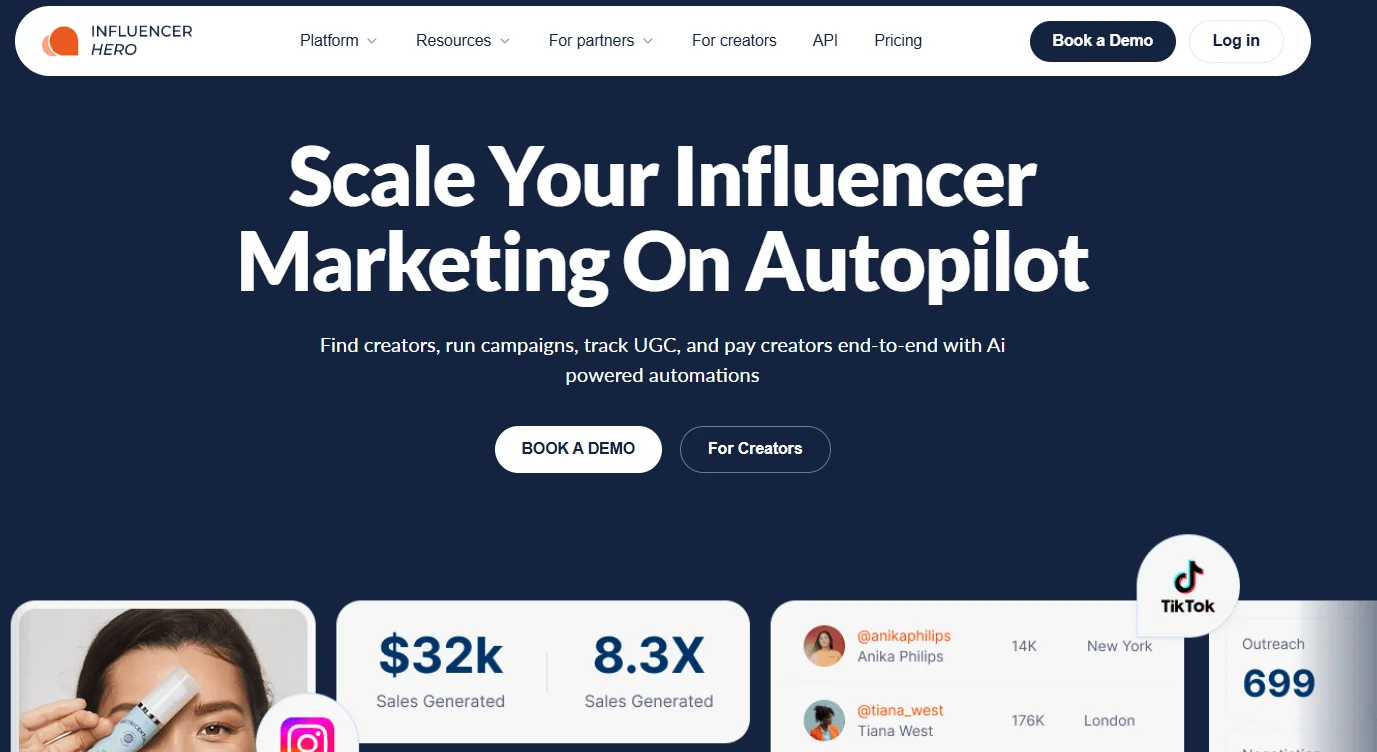
Influencer Hero is the step up from a marketplace. It's an all-in-one platform covering discovery, outreach, CRM, gifting, affiliate tracking, payments, UGC management and ROI reporting in a single system, built specifically for D2C and ecommerce brands.
The difference in scope is the point. Where Afluencer ends, at inbound applications from creators in its network, Influencer Hero begins: active search across 450M+ profiles, automated outbound at volume, and attribution that connects a creator's post to actual orders in your store.
It's also worth saying plainly that Afluencer and Influencer Hero are part of the same group, and brands regularly move from one to the other as their programs mature.
Discovery at Volume
Search across Instagram, TikTok and YouTube with filters for audience demographics, engagement, location and niche, plus AI matching, lookalike search, fake follower detection and a tool that surfaces creators already following your brand. Those people convert best because they're already customers.
Automated Outreach
This is the biggest functional gap between Influencer Hero and the other two. You build email sequences with AI personalization and follow-ups, then run them at volume instead of messaging creators one at a time. If your outreach techniques currently involve a spreadsheet and manual reminders, this is what replaces that.
Affiliate Tracking and Payments
Every creator gets unique links or discount codes, with sales attributed back to them automatically and commissions calculated on the spot. Payouts are handled inside the platform, and there's code leakage protection so your discount codes don't end up on coupon sites.
For brands running performance-based creator programs, this is the feature the other two simply don't have.
Where Influencer Hero Falls Short
The honest caveats: pricing starts at $649/month with a three-month minimum, there's no free trial, and the feature depth means a real learning curve. If you're running two collabs a quarter, you'd be paying for capacity you won't touch.
Feature-by-Feature Breakdown
Influencer Discovery
Three different philosophies here. Wednesday gives you filter-based search over 3 million profiles. Afluencer gives you applications from creators who chose your brand. Influencer Hero gives you active search over 450M+ profiles with AI matching layered on top.
Inbound wins on effort per creator. Active search wins on control and reach. Wednesday sits in between, with less database depth but a clean interface.
Outreach and Communication
Afluencer keeps conversations in-app with invite credits for proactive outreach. Wednesday keeps outreach manual unless you upgrade to the $279 plan, which unlocks mass email plus Gmail and Outlook sync. Influencer Hero automates sequences with personalization and follow-ups from the start.
If you're contacting 20 creators a month, manual is fine. At 200, automation stops being a luxury.
CRM and Campaign Management
Wednesday's IRM handles tags and conversation history. Afluencer manages applicants and campaign communication. Influencer Hero runs a full CRM with pipeline stages, plus gifting workflows, contracts and content approvals.
The question worth asking is how many creators you'll have in motion at once. Under 20, a lightweight tracker works. Past that, stages and statuses stop being optional.
Tracking and Analytics
This is where the three genuinely diverge. Wednesday reports on campaign activity, Afluencer covers basic campaign tracking, and Influencer Hero ties content to revenue with order-level attribution, EMV and full ROI reporting.
If your reporting still stops at reach or impressions, the gap between vanity metrics and attributed sales is the real decision point here.
Integrations and Payments
Wednesday has no ecommerce integrations and no payment handling, so gifting and payouts happen elsewhere. Afluencer offers Shopify and BigCommerce apps, with influencer payments included from the Standard plan. Influencer Hero connects to Shopify, WooCommerce, Magento, Klaviyo, Slack, Zapier and DocuSign, with automated payouts and an API for teams that want creator data in their own systems.
Pricing: What You'll Actually Pay
Wednesday App runs $79/month for the Discovery plan and $279/month for Outreach, which is the tier that unlocks mass email and Gmail or Outlook sync. Extra seats are $29/month each, and there's a $1 seven-day trial on the paid plan. All month to month, no commitment.
Afluencer starts at $49/month for the Marketplace plan, which includes 60 invite credits a month, premium creator filters and live support. The Standard plan at $649/month adds 1,000 monthly reach-outs, product shipping and influencer payments, and Pro at $1,049/month brings 5,000 reach-outs, a dedicated account manager and three or more seats. Full details are on the Afluencer pricing page.
Influencer Hero lists its pricing publicly too: $649/month for Standard, $1,049/month for Pro and $2,490/month for Business, with custom and agency plans available. Plans carry a three-month minimum, and quarterly or annual billing lowers the monthly rate.
Here's the practical math. If your total influencer budget is $1,000/month, committing $649 of it to software leaves very little for the creators themselves. That's the real filter, more than any feature comparison, and it's one of the key questions worth answering before you commit to anything.
Which Platform Is Right for You?
Wednesday App earns its place for a specific kind of buyer. If you're a solo marketer or a two-person team whose main problem is finding creators, the $79 Discovery plan is genuinely well priced for what it does, and the free audit tools are useful even if you never pay. Nobody is going to build a scaled affiliate program on it, but that's not what it's for.
Influencer Hero makes more sense when your bottleneck moves from finding creators to running them. If you need automated outreach at volume, a CRM that tracks 200 relationships without falling apart, affiliate links tied to actual orders, gifting workflows and payouts in the same system, that's the full stack in one place instead of four tools stitched together with exports.
Brands with real revenue coming from creators tend to hit that point faster than they expect. Curious how that looks with your own store connected? Book a demo with Influencer Hero.
And if you're not there yet, don't force it. Afluencer's $49/month Marketplace plan lets you post Collabs, get applications from verified creators and run your first campaigns without betting a quarter of your budget on software. It's the natural starting point for brands starting small, and when the program outgrows the marketplace model, Influencer Hero is the step up.
The Bottom Line
Wednesday App solves discovery, Afluencer solves getting creators to say yes, and Influencer Hero solves running the whole program once both of those are working. Those are three different problems, and the one you have right now should decide where your money goes.
Most brands start with applications rather than cold search, which is why the marketplace route is the cheapest way to prove the channel works.
Sign up on Afluencer and post your first Collab, then look at Influencer Hero when outreach volume, affiliate tracking and attribution become the thing holding you back.
Frequently Asked Questions
<details class="ih-faq"><summary>What's the main difference between Wednesday App and Afluencer?</summary><div class="ih-faq-a">Wednesday App is a search tool: you filter a database of 3 million creators and message them yourself. Afluencer is a marketplace: you post a Collab and verified creators apply to you. One puts the work on outbound, the other on writing a listing that attracts the right people.</div></details><details class="ih-faq"><summary>Does Wednesday App track affiliate sales?</summary><div class="ih-faq-a">No. Wednesday covers discovery, messaging and a lightweight CRM, but it doesn't include affiliate links, discount code tracking or sales attribution, and it has no ecommerce integrations. Brands running commission-based creator programs handle that in a separate tool or move to a platform with affiliate tracking built in.</div></details><details class="ih-faq"><summary>Can I use Afluencer and Influencer Hero together?</summary><div class="ih-faq-a">Yes, and plenty of brands do. Afluencer brings in inbound applications from creators who already like your product, while Influencer Hero handles outbound at volume, affiliate tracking and payouts. They're part of the same family, so running both is a common setup during the transition.</div></details><details class="ih-faq"><summary>How many creators can I realistically manage on each platform?</summary><div class="ih-faq-a">Wednesday and Afluencer both work well up to roughly 20 to 50 active creators, where conversations and tracking stay manageable manually. Past that, you need pipeline stages, automated follow-ups and attribution, which is where a full platform like Influencer Hero is designed to operate.</div></details><details class="ih-faq"><summary>Which one is best for a brand running its first campaign?</summary><div class="ih-faq-a">If you've never worked with creators, the inbound model is the softest landing, because applications remove the response-rate problem entirely. Afluencer's $49/month Marketplace plan keeps the software cost low enough that most of your budget still goes to the creators and products themselves.</div></details><script type="application/ld+json">{"@context":"https://schema.org","@type":"FAQPage","mainEntity":[{"@type":"Question","name":"What's the main difference between Wednesday App and Afluencer?","acceptedAnswer":{"@type":"Answer","text":"Wednesday App is a search tool: you filter a database of 3 million creators and message them yourself. Afluencer is a marketplace: you post a Collab and verified creators apply to you. One puts the work on outbound, the other on writing a listing that attracts the right people."}},{"@type":"Question","name":"Does Wednesday App track affiliate sales?","acceptedAnswer":{"@type":"Answer","text":"No. Wednesday covers discovery, messaging and a lightweight CRM, but it doesn't include affiliate links, discount code tracking or sales attribution, and it has no ecommerce integrations. Brands running commission-based creator programs handle that in a separate tool or move to a platform with affiliate tracking built in."}},{"@type":"Question","name":"Can I use Afluencer and Influencer Hero together?","acceptedAnswer":{"@type":"Answer","text":"Yes, and plenty of brands do. Afluencer brings in inbound applications from creators who already like your product, while Influencer Hero handles outbound at volume, affiliate tracking and payouts. They're part of the same family, so running both is a common setup during the transition."}},{"@type":"Question","name":"How many creators can I realistically manage on each platform?","acceptedAnswer":{"@type":"Answer","text":"Wednesday and Afluencer both work well up to roughly 20 to 50 active creators, where conversations and tracking stay manageable manually. Past that, you need pipeline stages, automated follow-ups and attribution, which is where a full platform like Influencer Hero is designed to operate."}},{"@type":"Question","name":"Which one is best for a brand running its first campaign?","acceptedAnswer":{"@type":"Answer","text":"If you've never worked with creators, the inbound model is the softest landing, because applications remove the response-rate problem entirely. Afluencer's $49/month Marketplace plan keeps the software cost low enough that most of your budget still goes to the creators and products themselves."}}]}</script>