.svg)
.png)
Ainfluencer vs Influencer Hero: A Detailed Comparison
Comparing influencer platforms is exhausting. Every "review" is secretly an ad, every feature list reads the same, and half the pricing hides behind a "book a demo" button. So let's skip that.
Ainfluencer and Influencer Hero get lumped together a lot, but they're barely in the same category. One is a free marketplace where creators apply to your campaigns. The other is a paid platform built to run influencer marketing like a real revenue channel, with outreach, a CRM, and affiliate tracking baked in.
If you're just getting started with influencer marketing, the difference matters more than it looks, because these two push you toward completely different ways of working.
Here's the honest breakdown: what each one actually does, what you'll pay, and which one fits where your brand is right now. No "winner" at the end, because the right pick depends entirely on how you plan to run your program.
Quick Comparison: Ainfluencer vs Influencer Hero vs Afluencer
What Is Ainfluencer?
Ainfluencer is a marketplace-style platform built around a simple idea: post a campaign, and creators come to you. Brands create a free account, publish an "Ad" or campaign brief, and creators apply to collaborate. You review applications, message creators in-app, and pay through an escrow system that holds funds until the work is done.
It's been popular with small brands and first-time influencer marketers, mostly because there's no upfront cost and no learning curve. You're not searching a database or writing outreach sequences. You post, you wait, you pick. For a brand running its first gifting campaign or testing whether influencer marketing works at all, that low barrier is the whole appeal.
The model skews toward Instagram, with TikTok and YouTube supported but a smaller active pool. Here's what it does genuinely well.
Zero Upfront Cost
This is Ainfluencer's biggest draw. Brands pay nothing to use the platform. You only pay the creator's agreed fee, and Ainfluencer makes its money by taking a commission from the creator's payout, not from you. If your budget is tight or you're not sure the channel will work for you yet, that's a real advantage.
Nano and Micro Creator Access
The platform leans heavily into smaller creators, which is where a lot of the best engagement lives. If your strategy is built around micro-influencers and authentic, lower-cost collabs rather than big-name reach, there's a solid pool to pull from here.
Instagram-First Creator Pool
Ainfluencer's roots are on Instagram, and that shows in the depth of its creator base there. If most of your campaigns live on Instagram, you'll find a lot of active creators ready to apply, especially in the beauty, fashion, and lifestyle niches.
Where Ainfluencer Falls Short
The ceiling shows up fast once you try to scale. There's no outreach automation, so you can't proactively reach out to a specific creator you've spotted, you can only wait for applications. There's no CRM, no affiliate or discount-code tracking, and no real analytics tying creator activity to sales. Running a serious program on Ainfluencer means a lot of manual work and very little visibility into what's actually driving revenue.
What Is Influencer Hero?
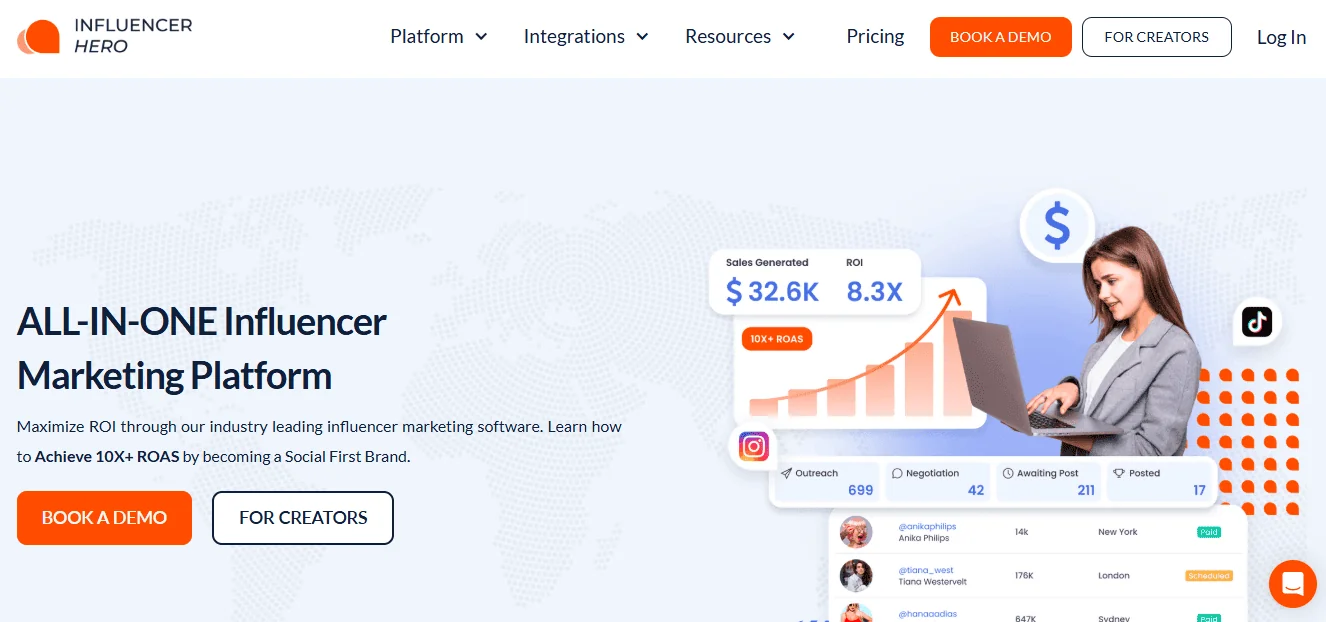
Influencer Hero sits at the opposite end. It's not a marketplace you dip into, it's an all-in-one platform for running influencer marketing as a repeatable, trackable channel. Discovery, outreach, CRM, affiliate tracking, UGC capture, payments, and reporting all live in one place. Influencer Hero is also part of the same ecosystem as Afluencer, so the two are built to complement each other rather than compete.
It's aimed at DTC and eCom brands that have moved past "let's try a few collabs" and into "let's make this a real acquisition channel." That's the dividing line between the two tools.
AI-Powered Discovery
Instead of waiting for creators to apply, you search a global database and filter by audience, engagement, niche, location, and more. You go find the exact creators you want rather than hoping the right ones stumble onto your campaign.
Outreach Automation
This is the piece Ainfluencer doesn't have at all. Influencer Hero runs automated email sequences with AI-personalized opening lines, so you can contact hundreds of creators without it reading like a mail merge. If you've ever tried scaling manual outreach, you know why this matters. Pair it with solid outreach techniques and your response rates climb fast.
Affiliate Tracking and Payments
Influencer Hero handles affiliate links, discount codes, and creator payouts natively, and ties them back to actual sales. You can see which creator drove which order, which is the kind of attribution that turns influencer marketing from a brand-awareness gamble into a performance channel.
Where Influencer Hero Falls Short
It's not cheap, and it's not built for a brand running one collab a quarter. If you're not ready to treat influencer marketing as an ongoing channel, a lot of the platform sits unused. The value only clicks once you have real volume to manage.
Ainfluencer vs. Influencer Hero: Feature-by-Feature Breakdown
Here's where the two really split.
Influencer Discovery
Ainfluencer is reactive: you post, creators apply, you pick from who shows up. Influencer Hero is proactive: you search and filter a global database to find specific creators, then reach out. The reactive model is easier to start with but caps how targeted you can get. If you care about choosing a platform based on how much control you want over who you work with, this is the first question to settle.
Outreach and Communication
Ainfluencer keeps everything in-app: creators apply, you message them, done. It works, but it's fully manual and limited to the people who came to you. Influencer Hero automates outreach across email with personalization, so you can run campaigns at a scale that would be impossible to manage by hand.
CRM and Campaign Management
Ainfluencer has no CRM. You're managing relationships through a message inbox. Influencer Hero gives you a full pipeline: track every creator's status, manage multiple campaigns at once, and keep the whole roster organized as your program grows. For a handful of collabs, an inbox is fine. For dozens, it falls apart.
Campaign Tracking and Analytics
Ainfluencer's tracking is basic, and it doesn't tie creator activity back to sales. Influencer Hero tracks performance at the deal level with revenue attribution, so you know your actual ROI, not just likes and comments. If you're trying to report on what worked, understanding the difference between reach or impressions and real conversions is exactly the gap Influencer Hero closes.
Integrations
Ainfluencer runs as a self-contained marketplace with escrow payments and no native Shopify attribution. Influencer Hero integrates with Shopify and ties influencer-driven revenue directly to your store, plus offers API access for brands that want to pipe data into their own stack. If eCommerce attribution matters to you, that's a meaningful difference.
Pricing: What You'll Actually Pay
Ainfluencer is free for brands. You pay only the creator's agreed fee, and Ainfluencer takes its cut from the creator's payout, not yours. The only paid offering is its fully managed agency service, with packages starting around $7,999 and priced on request. Worth noting: that package price mostly covers creator spend, not the management fee, so budget for extra on top.
Influencer Hero starts at $649/month and scales up for larger programs. There's no free trial, but you can book a demo to see it in action. That price reflects what it is: a full operating system with outreach automation, a CRM, affiliate tracking, UGC capture, and Shopify revenue attribution. It's a different type of tool than a free marketplace, and the price reflects the operational depth.
Afluencer sits in the middle. Its paid plans start at $49/month and run up to $199/month, billed monthly with no annual contract, and there's a free trial to test it before you commit. You get an application-based marketplace of verified, active creators, with more curation than a fully open marketplace but a much lower entry point than a full platform.
Which Platform Is Right for You?
Ainfluencer earns its spot. For a brand with no budget and no team, a genuinely free marketplace with escrow payments and unlimited campaigns is a rare thing. If you're testing influencer marketing for the first time, running the occasional gifting campaign, it's a legitimately good place to start.
Influencer Hero makes more sense when influencer marketing stops being an experiment and becomes a channel you're accountable for. If your brand needs to find specific creators, run outreach at scale, manage a growing roster in a CRM, track affiliate sales, and see revenue attribution tied back to Shopify, that full workflow works better in one place than stitched together across a marketplace and three spreadsheets.
Curious how that plays out for your brand? Book a demo with Influencer Hero.
And if you're somewhere in between, not ready for a full platform but wanting more curation than a wide-open marketplace, Afluencer is the middle path. At $49/month with a free trial, it gives you an application-based marketplace of verified creators, which is a lower-risk way to find the right creators without a big commitment.
The Bottom Line
These two tools solve different problems. Ainfluencer is the free front door for brands testing whether influencer marketing works at all, and Influencer Hero is the engine room for brands ready to run it as a serious, tracked channel. Neither is "better," they just meet you at different stages.
If you want the full outreach-to-attribution workflow in one place, Influencer Hero is built for exactly that. And if you'd rather start small and curated before scaling up, try Afluencer.