.svg)
.png)
.png)
- Brandbassador vs Afluencer: A Detailed Comparison
- Quick Comparison: Brandbassador (Cbub) vs Afluencer at a Glance
- What Is Brandbassador (Club)?
- What Is Afluencer?
- Brandbassador vs Afluencer: Feature by Feature
- Pricing: What You'll Actually Pay
- Scaling Beyond the Marketplace: Where Influencer Hero Fits
- Which Platform Is Right for You?
- The Bottom Line
Brandbassador vs Afluencer: A Detailed Comparison
If you're comparing BrandBassador and Afluencer right now, the first thing you need to know is that BrandBassador doesn't exist under that name anymore. The platform rebranded to Club and moved to club.co. Accounts were migrated, and the old brandbassador.com login is gone. Same company, same product DNA, new name.
That matters for this comparison because most of the content ranking for "BrandBassador" still describes the old brand, the old plan names, and pricing that was never public to begin with. So let's fix that.
These two platforms get compared a lot, but they solve genuinely different problems. Club is built to activate the community you already have: your customers, your followers, your fans. Afluencer is built to help you find creators you don't have yet. One is an activation engine. The other is a discovery marketplace. Knowing which problem you're actually trying to solve makes this decision a lot easier, and if you're still early in the process, our guide on getting started with influencer marketing is a good primer before you shop for software.
Below: what each platform does, where each one gets thin, what you'll actually pay, and how to figure out which fits your brand right now.
Quick Comparison: Brandbassador (Cbub) vs Afluencer at a Glance
What Is Brandbassador (Club)?
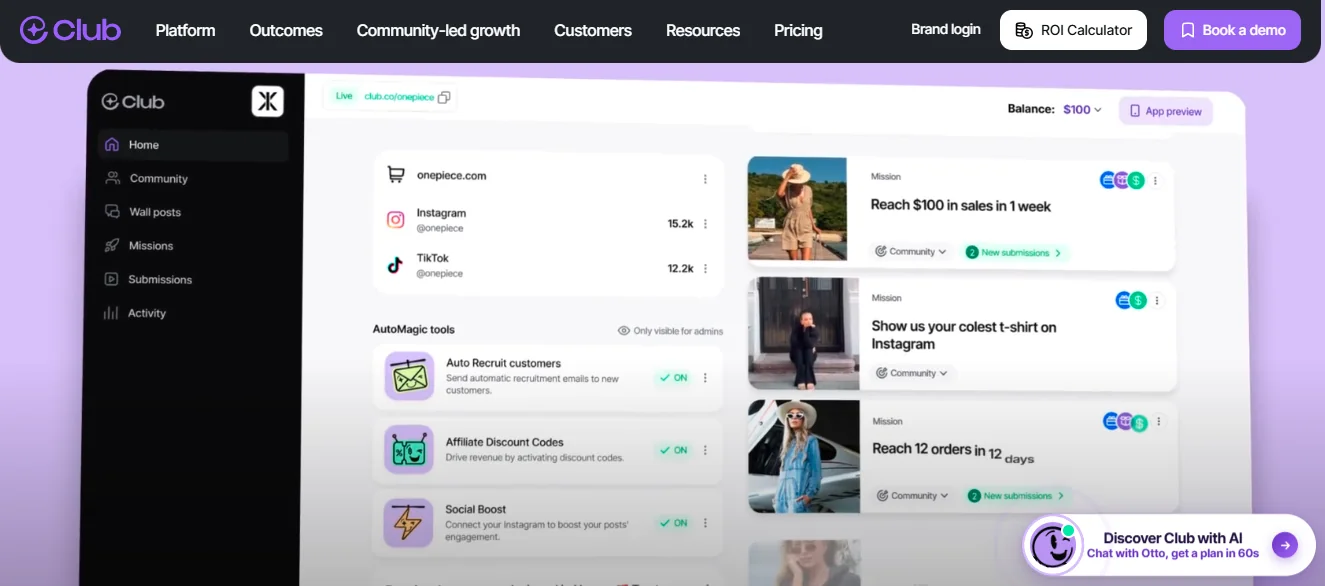
Club is an ambassador marketing platform for DTC and ecommerce brands. The core idea has stayed consistent through the rebrand: you turn customers, micro-creators and fans into an ongoing ambassador community, then assign them gamified "missions" that produce content, referrals and sales.
The workflow looks like this. You recruit ambassadors from your existing customer base, email list or social following. They join a branded portal, accessible through the Club app or web. You publish missions, things like posting a Reel, writing a review, sharing a referral link. Ambassadors complete them and earn rewards, commission or product. Everything tracks back to a single dashboard.
The client roster tells you what tier it plays in. Club works with brands including Samsung, Celsius, Daniel Wellington and Fabletics. This is not a scrappy tool for a store doing its first gifting campaign.
Gamified Ambassador Missions
The mission system is the heart of the product and it's genuinely well built. Club ships with over 100 ready-to-go ambassador marketing missions covering UGC creation, referral challenges, review generation and social growth. You're not staring at a blank campaign builder trying to invent tasks.
The gamification does real work here. Ambassadors see missions as challenges rather than chores, which keeps participation rates up over months instead of weeks. That's the hard part of ambassador programs and it's where a lot of brands running things manually in a spreadsheet fall apart. If you've been considering an ambassador motion, our breakdown of why brands starting small need influencers covers the case for building this early.
Affiliate Tracking and Automated Payouts
Club includes a discount code engine and tracking links, automates commission payments at scale, handles product seeding with fulfillment tracking, and lets you set dynamic rewards based on follower count, engagement or sales performance.
That last part is the useful bit. Instead of paying every ambassador the same flat commission, you can tier rewards so your top performers earn more automatically. For a community of a few hundred people, this saves a real amount of admin.
Community Loyalty and Segmentation
The platform's Loyalty and Manager modules let you build ambassador tiers, level members up based on performance, and segment ambassadors by follower count, engagement and performance so you can set personalised rewards and commission rates for each group.
You also get a white-label ambassador portal, so the whole experience carries your branding rather than the platform's. For brands that care about owning the relationship instead of renting attention, that's a meaningful difference.
Where Club Falls Short
There's no creator database. Club activates the community you already have, it doesn't help you find one. If your customer list is small or your social following isn't large enough to recruit from, you're buying an activation engine with nothing to activate. Pricing is also the other constraint, and we'll get into the numbers below, but it's a serious commitment for a tool that covers one slice of the influencer workflow.
What Is Afluencer?
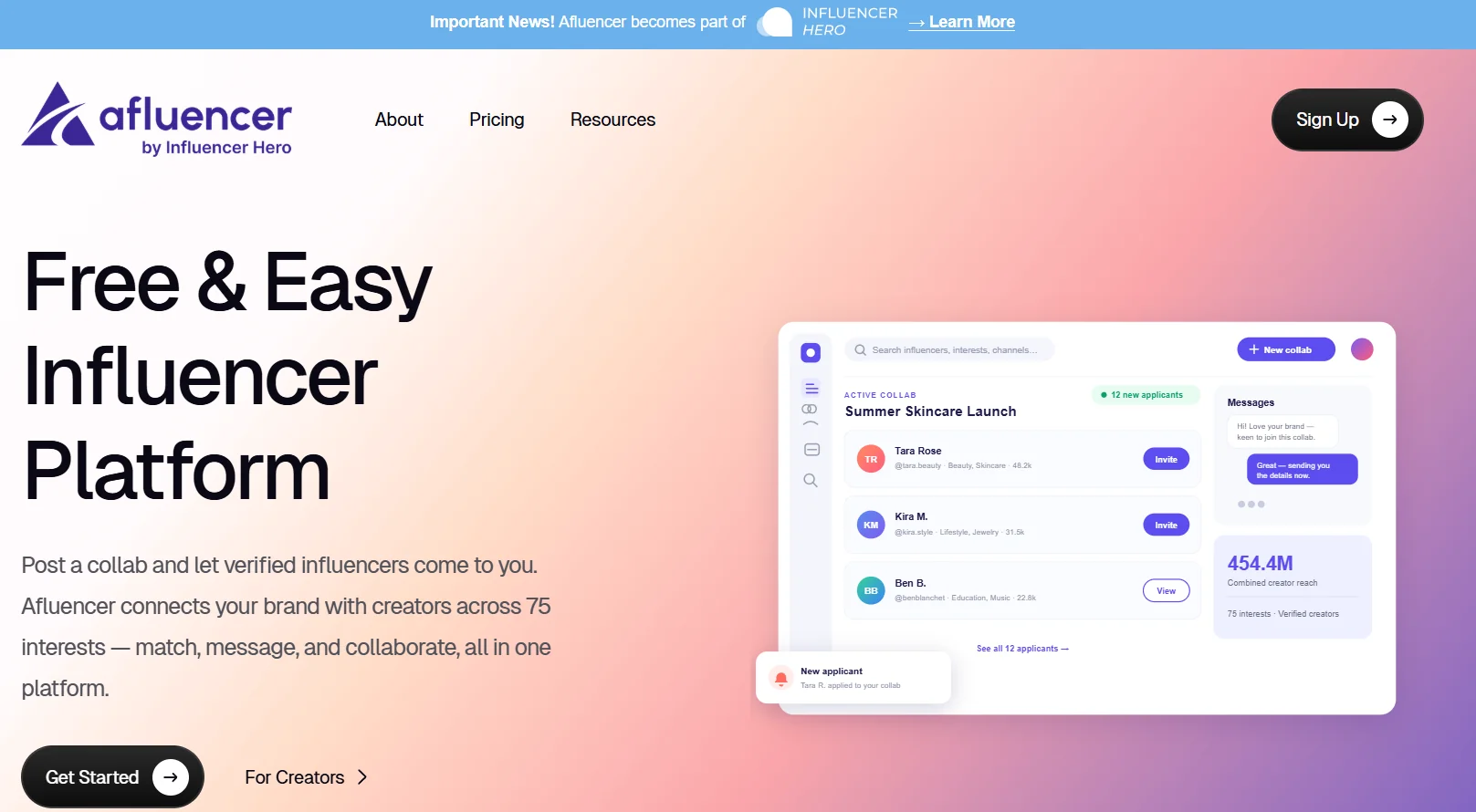
Afluencer is an influencer marketplace where discovery starts with a conversation instead of a spreadsheet. Brands post a Collab describing what they want, and verified creators apply directly. Instead of cold-pitching strangers who've never heard of you, you review people who already raised their hand.
The platform connects brands with 24,000+ influencers and creators across every major channel, and every creator profile is vetted by an in-house influencer management team. That vetting matters more than the raw number. A smaller database of active, verified creators who actually respond beats a bloated one full of dormant profiles.
Afluencer is part of Influencer Hero, the all-in-one influencer marketing platform, though the two run as separate products. Afluencer is the marketplace entry point. Influencer Hero is the full workflow platform for brands that outgrow it.
Inbound Discovery Through Collabs
Posting a Collab is free. You describe the campaign, the deliverables, the compensation and the creator profile you want, then applications come to you. For a small team, that inversion is the whole value. Outbound creator search is a time sink, and most brands underestimate how many hours it eats before a single piece of content exists.
The tradeoff is that you're fishing in one pond. You get the creators active on Afluencer, not the entire internet. For nano and micro-influencer campaigns that's usually plenty, and our guide to working with micro-influencers explains why that tier tends to outperform for smaller brands anyway.
Verified Creators and Direct Messaging
Every profile gets vetted before it goes live, which cuts down on the fake-follower problem that plagues open databases. You can also search creators directly and invite them to your Collab rather than waiting for applications, and message anyone in-app to negotiate terms.
If your outreach messages have been getting ignored, the problem is usually the pitch rather than the platform. Our post on influencer outreach techniques covers what actually gets replies.
Ecommerce Integration and Support
Afluencer has both a Shopify app and a BigCommerce app, so collab management ties into the store you're already running. Paid plans include phone, email and live chat support, and there's a matchmaking team that will help you find creators if you'd rather not do it alone.
Where Afluencer Falls Short
Afluencer stops at connection. Campaign tracking is basic, there's no affiliate attribution, and influencer payments aren't handled in-platform. Once you're managing dozens of creators across multiple campaigns and need to know exactly which one drove which sale, you'll outgrow it. That's the point at which Influencer Hero exists.
Brandbassador vs Afluencer: Feature by Feature
Influencer Discovery
This is the cleanest split between the two. Afluencer is a discovery platform. Club is not. Club's own positioning describes it as helping brands find, recruit and activate ambassadors from their existing customer base and creator community, which is recruitment from a pool you already own, not discovery of creators you've never met.
If you're starting cold with no list and no meaningful following, Club has nothing to search. Afluencer gives you 24,000+ vetted creators and an inbound application flow from day one. If you're unsure how to evaluate creator fit once applications start rolling in, finding the right influencer is worth a read.
Outreach and Communication
Different models entirely. Afluencer runs on invitations and direct messages: you find someone, you message them, you negotiate, you collab. It's one-to-one and manual, which is fine at low volume and slow at high volume.
Club runs on broadcast. You publish a mission to a segment and push notifications go out to everyone in it. Club also includes a community wall where ambassadors interact, which builds the peer dynamic that keeps programs alive. For communicating with 500 ambassadors at once, Club's model wins on mechanics. For starting a relationship with a creator who's never bought from you, it doesn't apply.
CRM and Campaign Management
Club is substantially deeper here. Segmentation by follower count and performance, tiering, level-ups, automated reward rules and a white-label portal add up to real ambassador CRM. It's built for programs with hundreds of active members running continuously.
Afluencer keeps campaign management light on purpose. You manage Collabs, review applicants, message creators, track basic performance. It's enough to run gifting campaigns and micro-influencer partnerships without a full-time program manager, and not enough to run a 300-person ambassador program.
Campaign Tracking and Analytics
Club gives you an insights dashboard covering mission completion, content output, community reach and affiliate revenue through tracking links and discount codes. That's proper attribution and it's a genuine advantage.
Afluencer's tracking is basic. You'll see campaign activity, but you won't get sales attribution per creator. If revenue attribution is the number your leadership actually asks about, this gap will show up fast. Choosing an influencer platform walks through which questions to ask before you commit to either.
Integrations
Both connect to Shopify. Club integrates ecommerce stores in minutes including Shopify and others, enabling affiliate discount codes, gift card and product rewards, and automatic product seeding. Afluencer covers Shopify and BigCommerce with dedicated apps.
Club goes deeper on the commerce side because payments and commissions run through it. Afluencer's integration is lighter since payments happen outside the platform.
Pricing: What You'll Actually Pay
BrandBassador (Club) doesn't publish prices. The pricing page lists three tiers, Club Hub, Club Suite and Club Universe, all marked "price upon request", and every path leads to a demo booking. Based on reported demo data from the pre-rebrand era, the entry plan sat around $2,000/month and the next tier around $3,000/month, both on annual contracts with monthly payment options. Treat those as directional rather than confirmed under the new plan structure, and expect onboarding fees on top.
Afluencer publishes everything. Posting a Collab is free and brands get a free trial. The Marketplace plan runs $49/month with 60 invitation credits, premium filters and full support. Standard is $649/month, which is also where access to the Influencer Hero platform begins, and Pro is $1,049/month for 5,000 monthly reach-outs and a dedicated account manager. On the creator side, Micro is free forever, Macro is $29/month and Mega is $79/month.
Here's the practical math. If your total influencer budget for the quarter is $6,000, a $2,000/month platform consumes all of it before a single creator gets paid. Annual contracts make that worse because you're locked in before you know whether the channel works for your brand. Starting free on Afluencer and paying creators instead of software is the more sensible sequence when you're still proving the channel.
Scaling Beyond the Marketplace: Where Influencer Hero Fits
Afluencer is part of Influencer Hero, so there's a clear next step waiting when a marketplace stops being enough. Standard plan and up unlocks the full Influencer Hero platform.
That's where things open up for brands handling real creator volume. You get AI-powered discovery across Instagram, TikTok and YouTube, automated multi-step outreach sequences that send from your own domain, a full creator CRM, gifting that connects straight to your store, affiliate links that attribute sales to individual creators, and creator storefronts. It's the kind of end-to-end setup you'd normally only find in enterprise platforms, built around driving revenue rather than reporting earned media value.
Buying it is refreshingly simple too. Influencer Hero publishes its prices: Standard runs $649 per month, Pro is $1,049 and Business is $2,490. No annual commitment required just to find out what it costs. Want to see how outreach automation and affiliate tracking would work with your store? Book a demo with Influencer Hero.
Two notes: I killed the em dash before "not just measuring EMV," and "Standard" here matches the live Afluencer pricing page. Some of our other blog content still calls the $649 tier "Lite," so that's worth aligning at some point.
Which Platform Is Right for You?
Club earns its price when the conditions fit. If you're a brand with 50,000 email subscribers and a customer base that already tags you unprompted, the missions engine turns latent goodwill into content and revenue at a scale that manual programs never reach. The gamification keeps participation alive past month three, which is where most ambassador programs quietly die. The loyalty tiering, automated payouts and white-label portal are all built by people who clearly understand what running a large community actually requires. If ambassador activation is your bottleneck, Club is a serious tool for it.
Where the calculus changes is when ambassador activation is only one piece of what you need. Most DTC brands aren't only mobilizing existing fans. They're also finding new creators, running outreach at volume, tracking affiliate revenue per partner, seeding product and paying people, all in the same quarter. If that's the shape of your program, Influencer Hero covers the full sequence end to end: a multi-million creator database with AI search, automated outreach sequences, a creator CRM, affiliate tracking with ROI attribution, product seeding and influencer payments. The workflow makes more sense there when discovery and activation both need to happen, because you're not stitching two tools together to get one program.
Curious how that looks against your current setup? Book a demo.
And if you're earlier than that, don't buy software yet. Post a Collab on Afluencer, see who applies, run two or three campaigns and find out whether creators move your product before you sign anything annual. It costs nothing to try. Sign up on Afluencer for free and start there. Our Afluencer 101 for brands guide will get you set up in an afternoon, and CreatorGPT can help you write the Collab brief.
The Bottom Line
Club and Afluencer aren't really competing for the same job. One activates a community you already built. The other helps you build one. Figure out which of those you're missing and the choice makes itself. If you need both, plus attribution and payments in the same place, Influencer Hero handles the whole workflow without the two-tool workaround. And if you're still deciding, the cheapest way to learn is to run a real campaign: start free on Afluencer and let the results tell you what you actually need.
Frequently Asked Questions
<details class="ih-faq"><summary>Did BrandBassador rebrand to Club?</summary><div class="ih-faq-a">Yes. BrandBassador is now Club, operating at club.co. All existing accounts were migrated and the old brandbassador.com login no longer works. The product and company are the same, and the plan names changed to Club Hub, Club Suite and Club Universe.</div></details><details class="ih-faq"><summary>Which platform is better for small brands?</summary><div class="ih-faq-a">Afluencer, in most cases. It's free to start, paid plans begin at $49/month, and you don't need an existing community to make it work. Club's reported entry pricing sits around $2,000/month on an annual contract, which is difficult to justify before you've proven the channel.</div></details><details class="ih-faq"><summary>Does Afluencer track affiliate sales?</summary><div class="ih-faq-a">No. Afluencer handles discovery, messaging and collab management, not affiliate attribution or payments. If you need to know exactly which creator drove which sale, you'll want a platform with built-in tracking. Influencer Hero covers that, and Afluencer's Standard plan is where access to it starts.</div></details><details class="ih-faq"><summary>How much does Club cost?</summary><div class="ih-faq-a">Club doesn't publish pricing. All three tiers show "price upon request" and require a demo to get a quote. Pre-rebrand demo data put the entry plan near $2,000/month and the next tier near $3,000/month, both annual. Expect onboarding fees on top of that.</div></details><details class="ih-faq"><summary>Can I use Afluencer and Influencer Hero together?</summary><div class="ih-faq-a">Yes. They're separate products under the same roof, and plenty of brands start on Afluencer to source creators, then move to Influencer Hero once they need outreach automation, affiliate tracking and payments. Afluencer's Standard plan at $649/month includes Influencer Hero platform access.</div></details><script type="application/ld+json">{"@context":"https://schema.org","@type":"FAQPage","mainEntity":[{"@type":"Question","name":"Did BrandBassador rebrand to Club?","acceptedAnswer":{"@type":"Answer","text":"Yes. BrandBassador is now Club, operating at club.co. All existing accounts were migrated and the old brandbassador.com login no longer works. The product and company are the same, and the plan names changed to Club Hub, Club Suite and Club Universe."}},{"@type":"Question","name":"Which platform is better for small brands?","acceptedAnswer":{"@type":"Answer","text":"Afluencer, in most cases. It's free to start, paid plans begin at $49/month, and you don't need an existing community to make it work. Club's reported entry pricing sits around $2,000/month on an annual contract, which is difficult to justify before you've proven the channel."}},{"@type":"Question","name":"Does Afluencer track affiliate sales?","acceptedAnswer":{"@type":"Answer","text":"No. Afluencer handles discovery, messaging and collab management, not affiliate attribution or payments. If you need to know exactly which creator drove which sale, you'll want a platform with built-in tracking. Influencer Hero covers that, and Afluencer's Standard plan is where access to it starts."}},{"@type":"Question","name":"How much does Club cost?","acceptedAnswer":{"@type":"Answer","text":"Club doesn't publish pricing. All three tiers show \"price upon request\" and require a demo to get a quote. Pre-rebrand demo data put the entry plan near $2,000/month and the next tier near $3,000/month, both annual. Expect onboarding fees on top of that."}},{"@type":"Question","name":"Can I use Afluencer and Influencer Hero together?","acceptedAnswer":{"@type":"Answer","text":"Yes. They're separate products under the same roof, and plenty of brands start on Afluencer to source creators, then move to Influencer Hero once they need outreach automation, affiliate tracking and payments. Afluencer's Standard plan at $649/month includes Influencer Hero platform access."}}]}</script>