.svg)

.png)
- BrandBassador (Now Club) vs CreatorIQ vs Influencer Hero: A Detailed Comparison
- Quick Comparison: BrandBassador vs CreatorIQ vs Influencer Hero vs Afluencer
- What Is BrandBassador (now Club)?
- What Is CreatorIQ?
- What Is Influencer Hero?
- Feature-by-Feature Breakdown
- Pricing: What You'll Actually Pay
- Which Platform Is Right for You?
- The Bottom Line
BrandBassador (Now Club) vs CreatorIQ vs Influencer Hero: A Detailed Comparison
Three platforms, three completely different products, one shared label. That's the first thing worth saying about this comparison.
Brandbassador turns your existing customers into an ambassador community and gives them gamified missions to complete. CreatorIQ is enterprise infrastructure for Fortune 500 brands running creator programs across dozens of markets with legal sign-off at every step. Influencer Hero is an operations platform for DTC brands treating creators as a sales channel. All three get filed under "influencer marketing software," and all three would solve a different problem for you.
So the useful question isn't which is best. It's which problem you actually have. Because picking the wrong category here costs a lot more than picking the wrong vendor inside the right one.
Here's what each platform does, what each one costs, and how to work out which category you're shopping in. If you're at the very start of this, our 5 steps to get started with influencer marketing is the better starting point than any sales call.
Quick Comparison: BrandBassador vs CreatorIQ vs Influencer Hero vs Afluencer
What Is BrandBassador (now Club)?

Brandbassador is a London-based ambassador marketing platform built for ecommerce brands, and the first thing to know is that it's now called Club. The company rebranded to Club.co in 2025, migrated all accounts and campaigns over, and turned the Brandbassador app into the Club App. The old name still carries the search traffic, which is why you'll see both used interchangeably.
The model is genuinely different from everything else on this list. Instead of finding creators in a database and pitching them, you recruit your own customers and fans into a community, then post "missions" they can claim. A mission might be posting a TikTok, writing a review, sharing a referral link or creating UGC. Ambassadors complete them and earn rewards in cash, product or discount codes. Payments and product seeding are automated.
Brands using it include Samsung, Celsius, Daniel Wellington and Fabletics. The common thread is a brand with people who already like it enough to want the merch. That prerequisite matters more than any feature comparison.
Turning Existing Customers Into Creators
This is the core insight and it's a good one. Your best advocates are usually already buying from you. Brandbassador gives them a structured way to promote you and get paid for it, which converts better than cold outreach to strangers because the enthusiasm is already there. Most ambassadors sit in nano and micro territory, which our post on working with micro-influencers explains is often where the engagement actually lives.
Gamified Missions at Scale
You post one mission and your whole community sees it. No individual outreach, no negotiating each collab separately. For a brand with a few thousand ambassadors, that broadcast model produces content volume that would take a team weeks to coordinate manually.
Automated Rewards and Seeding
Payments, discount codes and product dispatch run automatically once a mission is completed and approved. Given that reward admin is the part of ambassador programs that quietly consumes an entire headcount, automating it is a real saving.
Unlimited Community Size
There's no cap on ambassadors, so the program can grow without the pricing changing shape underneath you. That's unusual in this category, where most platforms meter you by creators managed.
Where Brandbassador Falls Short
You need an existing fan base for this to work at all. A brand nobody has heard of yet has nobody to recruit, and no amount of platform will fix that. Discovery exists but there's no AI matching, so brands report receiving hundreds of applications per mission with most ambassadors never hearing back. Pricing is quote-only starting around $2,000/month on annual contracts, with onboarding fees between $1,000 and $5,000 on top, plus optional charges for advanced analytics and ecommerce tracking. And the top tier advertises access to a 1.7M ambassador pool with terms and conditions that aren't published, which is worth pressing on during the sales call.
What Is CreatorIQ?
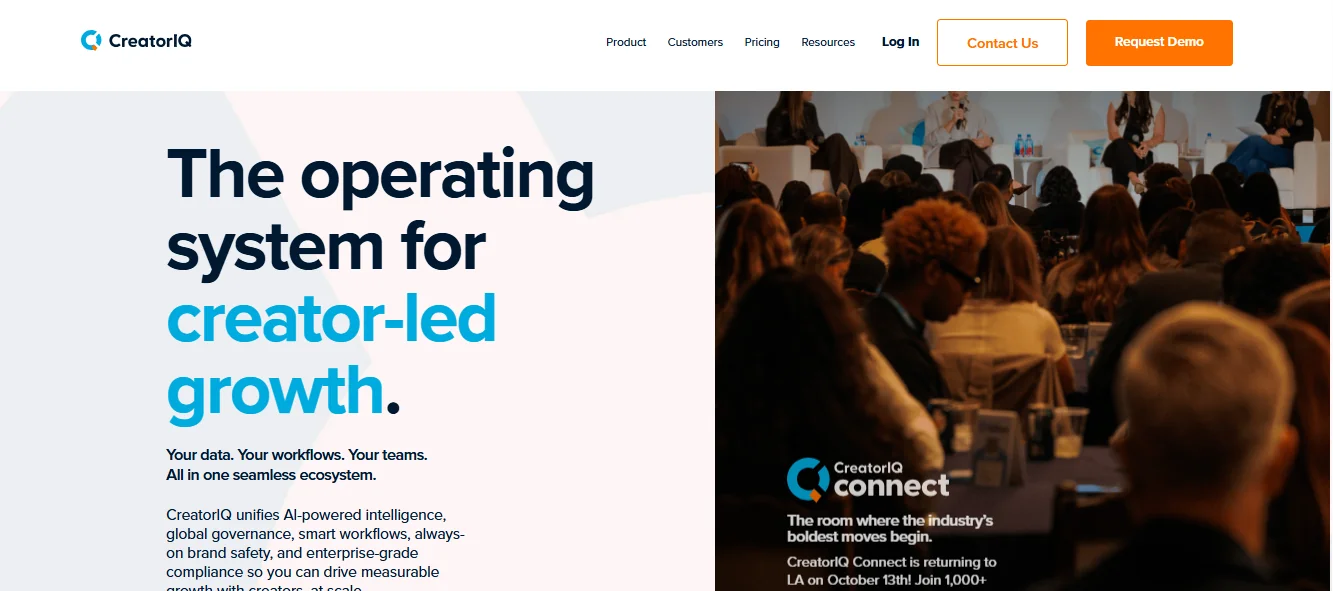
CreatorIQ is an enterprise creator marketing platform founded in 2014 and based in Los Angeles. Its customer list reads like a Fortune 500 roster: Disney, Unilever, Ralph Lauren, CVS, Salesforce, Sephora. That's not incidental, it's the entire positioning.
The platform covers discovery, campaign management, creator CRM, analytics, fraud detection, global creator payments and compliance workflows, all through direct API integrations with the social platforms. Its 2021 acquisition of Tribe Dynamics added earned media value tracking and community analytics, which is still one of the strongest EMV implementations in the market.
What you're really buying is governance. Multi-brand structures, regional workspaces, approval chains, audit trails, white-label tooling for agencies managing client portfolios. If your influencer program involves legal review, five markets and a quarterly board slide, this is built for exactly that. If it doesn't, most of what you're paying for sits unused.
EMV and Earned Media Analytics
The Tribe Dynamics inheritance gives CreatorIQ reporting depth that few competitors match, particularly for brands that measure share of voice and earned media rather than direct sales. If your CMO asks how you compare to competitors on creator-driven brand presence, this answers that question properly. Related reading on which metrics deserve your attention: reach vs. impressions.
Direct Social Platform API Access
Rather than scraping, CreatorIQ pulls data through official platform integrations. That means more reliable data, better permissions handling and fewer of the gaps that show up in tools built on workarounds. For compliance-heavy categories, that distinction is not academic.
Fraud Detection and Vetting
Audience quality scoring, fraud signals and demographic verification across 20M+ profiles on Instagram, TikTok, YouTube, Facebook, X and Pinterest. The vetting rigor is a big part of why regulated industries choose it. Our guide on how to find the perfect influencer covers what to check when you're doing this without enterprise software.
Multi-Brand and Agency Governance
Separate workspaces, permissions, approval routing and white-label options for agencies running many client programs from one login. Very few platforms handle organizational complexity at this level.
Where CreatorIQ Falls Short
The price is the obvious barrier. Procurement data puts contracts starting around $30,000 per year with a median near $39,000 and a high end past $59,000, all on annual commitments with no monthly option. Implementation takes real planning time before you're running, so the cost of ownership includes weeks of internal effort. Reviewers also note that creator statistics can fluctuate, which is a strange complaint at that price point. And the platform is generally acknowledged as overkill for lean teams, which most DTC brands are.
What Is Influencer Hero?
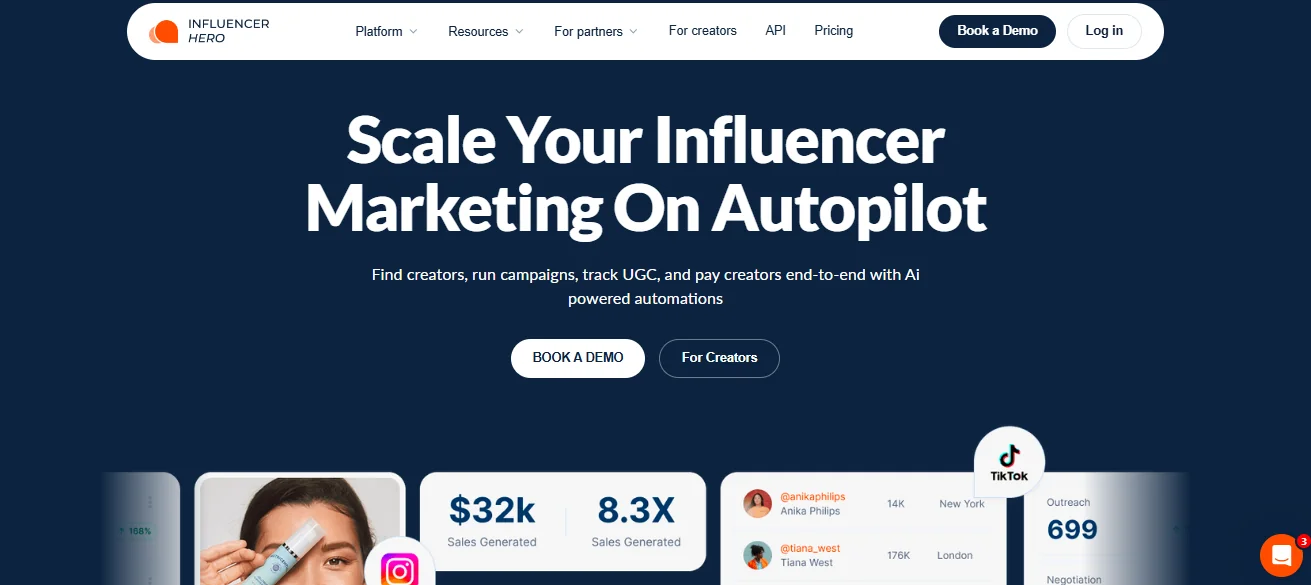
Influencer Hero is an all-in-one influencer marketing platform built for DTC brands and agencies that run creator programs as a revenue channel rather than a brand awareness exercise. It's part of the same family as Afluencer now, so the marketplace side and the software side connect instead of competing for the same buyer.
It sits deliberately between the other two. There's no ambassador community model that requires an existing fan base, and no enterprise governance layer that requires an enterprise. What you get is the operational middle: discovery across 450M+ profiles on eight platforms, AI outreach with automated follow-ups, a creator CRM, gifting and seeding, contracts, UGC collection and reuse, affiliate links and codes, payments, and revenue attribution down to the order.
The practical difference shows up in the day-to-day. You describe the creator you want in plain language, shortlist, launch a sequence that follows up on its own, ship product, generate their code, and watch which creators produce orders. No community to build first, no twelve week implementation.
Outreach That Scales Without Headcount
Brandbassador broadcasts to a community you already have. CreatorIQ manages campaigns you've already negotiated. Influencer Hero handles the part in between: contacting creators who don't know you yet, at volume, with personalization and automatic follow-ups. Since most replies land on touch two or three, that automation is usually the single biggest lever on response rate. Pair it with our influencer outreach techniques so the messages earn the reply.
Revenue Attribution, Not Media Value
Unique links and codes per creator, order-level tracking, ROI by campaign and by creator, gifting cost against results, plus AI detection when discount codes leak onto coupon sites. The reporting answers which creators made money, which is a different question from what your earned media value was.
Ecommerce Coverage Past Shopify
Shopify, WooCommerce, Magento, BigCommerce and Prestashop natively, plus Klaviyo, Mailchimp, Omnisend, Brevo and GetResponse on email, and Slack, Zapier, Gorgias and Docusign around the edges. If you sell across more than one storefront, this is where the differences get practical.
Published Pricing and a Shorter Commitment
$649/month for Lite, $1,049/month for Pro, $2,490/month for Business, with a three-month minimum. Still demo-gated to get in, but you know the number before the call and you're not signing away a year.
Where Influencer Hero Falls Short
No free trial and no self-serve signup, so a demo comes first. It doesn't do ambassador community management the way Brandbassador does, so if your goal is specifically activating thousands of existing customers with gamified tasks, that's a different tool. And it doesn't carry CreatorIQ's compliance and multi-market governance layer, which matters if you're a global enterprise with legal in the approval chain.
Feature-by-Feature Breakdown
Influencer Discovery
These three barely compete here. Brandbassador's creators come from your own customer base and application inbox, with no AI matching to sort them. CreatorIQ searches 20M+ vetted profiles with fraud detection and API-verified data. Influencer Hero searches 450M+ with natural language queries and 20+ filters. If discovery is your bottleneck, Brandbassador isn't the answer regardless of budget.
Outreach & Communication
Brandbassador broadcasts missions to an opted-in community, which is efficient but only reaches people who already joined. CreatorIQ centralizes campaign communication with approval routing built for teams with stakeholders. Influencer Hero automates cold and warm outreach with personalized sequences. Three different problems: activating a community, coordinating an organization, and reaching people who don't know you yet.
CRM & Campaign Management
CreatorIQ is the strongest here on pure organizational capability, with multi-brand workspaces, permissions and audit trails. Influencer Hero organizes around creator lifecycle stages, gifting logistics and repeat collaborations, which suits a team of two to ten. Brandbassador manages a community rather than individual relationships, so its CRM works at the group level.
Campaign Tracking & Analytics
CreatorIQ leads on EMV and earned media benchmarking. Influencer Hero leads on revenue attribution per creator. Brandbassador tracks referral revenue, UGC volume and engagement, which fits its model well but won't satisfy a finance team wanting creator-level ROI. Pick based on who reads your report and what they consider proof.
Integrations
All three connect to Shopify. Influencer Hero adds WooCommerce, Magento, BigCommerce and Prestashop natively along with five email platforms. CreatorIQ offers deep API access as part of enterprise contracts. Brandbassador's ecommerce tracking exists but may carry additional monthly cost depending on your quote.
Pricing: What You'll Actually Pay
Brandbassador doesn't publish pricing. Reported figures put the Growth plan around $2,000/month and Pro around $3,000/month, both on annual contracts with monthly payment options. Add onboarding at $1,000 to $5,000 one-time, and possible extras for advanced analytics and ecommerce tracking. Higher tiers bundle managed service hours, from 2 hours on Pro up to 30 on the top plan.
CreatorIQ also quotes privately. Procurement data puts contracts starting near $30,000 per year, median around $39,250, with enterprise deployments passing $59,000. Annual only, no monthly option, and implementation time to budget for on top.
Influencer Hero publishes its numbers: $649/month for Lite, $1,049 for Pro, $2,490 for Business, three-month minimum. Annualized, the entry plan is around $7,800.
Afluencer gives brands a free trial and lets you post a Collab at no cost. Paid brand plans start at $49/month, and creators join free on the Micro plan.
Line those up and the gap is stark. Influencer Hero's floor is roughly a third of Brandbassador's and about a quarter of CreatorIQ's. More importantly, both of the others want a year signed before you know whether the channel works for your brand. If your total annual influencer budget is under about $50,000, committing $30,000 of it to software leaves very little for the creators actually doing the work, which is a version of a mistake we've written about in the most common brand mistakes in influencer marketing.
Which Platform Is Right for You?
Brandbassador and CreatorIQ both earn their positions, in very different ways. Brandbassador solved a problem most tools ignore entirely: your existing customers are your most credible promoters, and nobody had built a proper system for activating them at scale. The gamified mission model genuinely works when you have a fan base, and brands like Celsius and Fabletics didn't pick it by accident. CreatorIQ, meanwhile, is the most complete enterprise platform in the category. The EMV analytics, API-verified data and multi-market governance are legitimately best-in-class, and for a global brand with compliance requirements, nothing lighter would pass internal review.
Influencer Hero fits the space between them, which happens to be where most DTC brands live. If you need to reach creators who don't already know you, contact them at volume without adding headcount, ship product, track which ones drive orders, and reuse their content in paid, that full workflow is what the platform is built around. It also doesn't ask you to already have a community or already be an enterprise, which is the prerequisite the other two quietly assume.
Want to see how it works for your brand? Book a demo →
And if every price on this page feels like a lot for a channel you haven't proven yet, that instinct is correct. Afluencer is where brands figure this out before they buy software for it. Post a Collab, review applications from creators who actively want brand work, and run real campaigns with nothing signed.
The Bottom Line
Ambassadors, enterprise governance, and creator operations are three separate businesses that happen to share a software category. Brandbassador wins when you already have fans. CreatorIQ wins when you already have complexity. Influencer Hero wins when you have products to sell and nobody to sell them yet.
If you can't tell which of those describes you, that's the answer to act on. Run a few collabs through Afluencer first, see what your program looks like with real creators in it, and let that decide the software instead of a demo deck. Influencer Hero is the natural step up once the operations get heavy, and our post on why smaller brands need influencers makes the case for starting now rather than waiting.
Frequently Asked Questions
<details class="ih-faq"><summary>Is Brandbassador the same as Club?</summary><div class="ih-faq-a">Yes. Brandbassador rebranded to Club in 2025, moving to club.co and renaming the ambassador app to the Club App. Existing accounts, data and campaigns were migrated across. Older reviews and comparisons using the Brandbassador name are describing the same platform.</div></details><details class="ih-faq"><summary>Which of these is cheapest?</summary><div class="ih-faq-a">Influencer Hero, by a wide margin, starting at $649/month with a three-month minimum. Brandbassador starts around $2,000/month and CreatorIQ around $30,000 per year, both on annual contracts. Afluencer is cheaper than all three, with a free trial and free Collab posting for brands.</div></details><details class="ih-faq"><summary>Do I need an existing customer base for Brandbassador?</summary><div class="ih-faq-a">Effectively yes. The model works by recruiting your existing customers and fans into an ambassador community. If your brand is new or doesn't yet have people who'd want to represent it, there's nobody to activate and the platform can't manufacture that for you.</div></details><details class="ih-faq"><summary>Is CreatorIQ worth it for a DTC brand?</summary><div class="ih-faq-a">Usually not. It's built for global enterprises with compliance requirements, multiple markets and dedicated influencer teams. A DTC brand running campaigns from a team of two would pay for governance features it never touches. The analytics are excellent, but excellence you don't use is just cost.</div></details><details class="ih-faq"><summary>Can I test influencer marketing before committing to any of these?</summary><div class="ih-faq-a">Yes, and you should. Post a free Collab on Afluencer, work directly with creators who apply, and see what response rates, content quality and sales actually look like for your brand. That data makes every later software conversation shorter and cheaper.</div></details><script type="application/ld+json">{"@context":"https://schema.org","@type":"FAQPage","mainEntity":[{"@type":"Question","name":"Is Brandbassador the same as Club?","acceptedAnswer":{"@type":"Answer","text":"Yes. Brandbassador rebranded to Club in 2025, moving to club.co and renaming the ambassador app to the Club App. Existing accounts, data and campaigns were migrated across. Older reviews and comparisons using the Brandbassador name are describing the same platform."}},{"@type":"Question","name":"Which of these is cheapest?","acceptedAnswer":{"@type":"Answer","text":"Influencer Hero, by a wide margin, starting at $649/month with a three-month minimum. Brandbassador starts around $2,000/month and CreatorIQ around $30,000 per year, both on annual contracts. Afluencer is cheaper than all three, with a free trial and free Collab posting for brands."}},{"@type":"Question","name":"Do I need an existing customer base for Brandbassador?","acceptedAnswer":{"@type":"Answer","text":"Effectively yes. The model works by recruiting your existing customers and fans into an ambassador community. If your brand is new or doesn't yet have people who'd want to represent it, there's nobody to activate and the platform can't manufacture that for you."}},{"@type":"Question","name":"Is CreatorIQ worth it for a DTC brand?","acceptedAnswer":{"@type":"Answer","text":"Usually not. It's built for global enterprises with compliance requirements, multiple markets and dedicated influencer teams. A DTC brand running campaigns from a team of two would pay for governance features it never touches. The analytics are excellent, but excellence you don't use is just cost."}},{"@type":"Question","name":"Can I test influencer marketing before committing to any of these?","acceptedAnswer":{"@type":"Answer","text":"Yes, and you should. Post a free Collab on Afluencer, work directly with creators who apply, and see what response rates, content quality and sales actually look like for your brand. That data makes every later software conversation shorter and cheaper."}}]}</script>