.svg)
.png)
GRIN vs Influencer Hero: A Detailed Comparison
Most comparison articles about GRIN are out of date, and it's not the writers' fault. GRIN rebuilt its pricing from scratch in 2026. The old story about $25,000 annual contracts and a mandatory sales call is gone. There's a free plan now, no card required, and you can sign up without talking to anyone.
That changes the comparison completely. GRIN and Influencer Hero are both full creator management platforms covering discovery, outreach, gifting, affiliate tracking and revenue reporting. They now charge for that in fundamentally different ways, and which model fits you depends less on your company size and more on how you work with creators day to day.
Here's what each platform actually does in 2026, where the pricing gets tricky, and how to figure out which one matches your program. If influencer marketing is still new territory, start with these 5 steps to get started so the feature comparison makes more sense.
Quick context on the third column below: Afluencer is now part of Influencer Hero. It's the marketplace entry point of the same ecosystem, which matters if neither of these platforms fits your budget yet.
Quick Comparison: GRIN vs Influencer Hero
What Is GRIN?
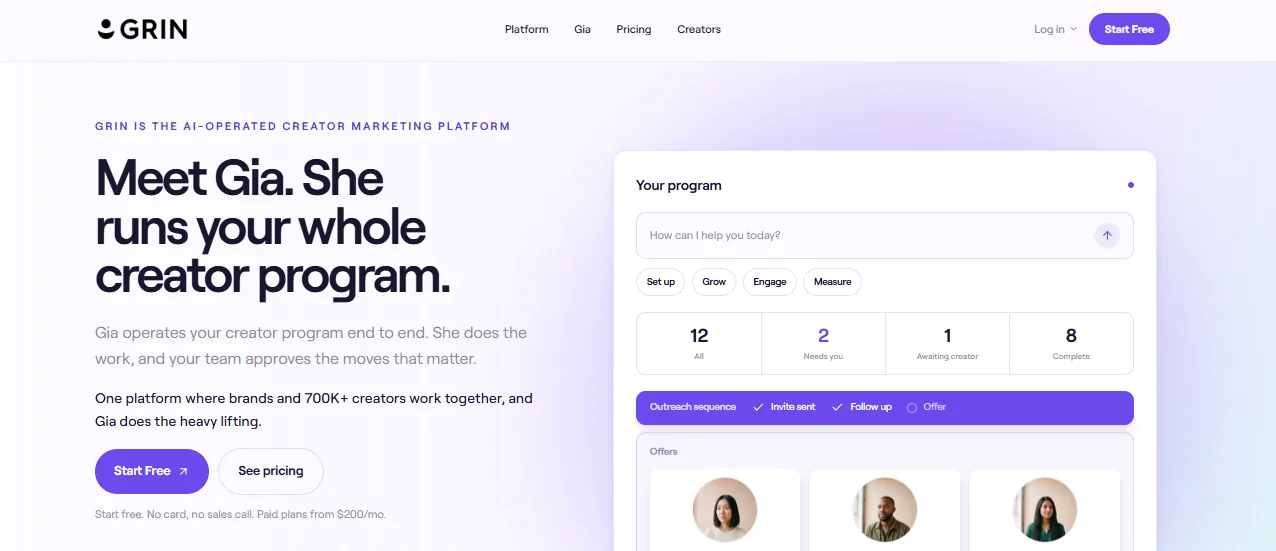
GRIN is a creator management platform built for e-commerce, founded in 2014 and long considered the enterprise standard for DTC influencer programs. Brands like SKIMS, ColourPop and IPSY run on it. Historically it was expensive, contract-bound and gated behind a sales call.
In 2026 GRIN restructured around Gia, an AI operator that does the work rather than just surfacing data. You give Gia a task, sourcing a shortlist, running a report, setting up a gifting workflow, and she executes it. You pay in credits based on how much work she does, not per seat.
The platform splits into two pieces. Gia is the AI layer and comes on every plan including Free. GRIN Classic is the hands-on management workspace, the traditional CRM with email sequences, campaign workrooms and landing pages, and it only appears on Growth ($500/month) and above with active-creator caps of 100, 250 or 500 depending on tier.
A Free Plan That Isn't a Trial
GRIN's Free tier gives you 200 monthly credits, no card, no countdown clock. It doesn't expire into a paywall after 14 days. You can source creators, generate affiliate links and pull reports at a small scale indefinitely.
That's an unusually generous move for a platform in this category, and it's a real advantage for brands who want to poke around before deciding anything. Most platforms at this level make you sit through a demo first.
Content Usage Rights Included
Every GRIN plan includes content usage rights on everything creators produce for you. That's a genuinely good detail. A lot of platforms leave licensing as a separate negotiation, and brands find out after the fact that they can't run a creator's Reel as a paid ad.
With GRIN, the UGC you collect is yours to reuse across paid social, email and your product pages. For a brand treating gifting as a content engine rather than a reach play, that changes the math on what each collab is worth.
Affiliate Infrastructure With No Take Rate
Affiliate link generation, discount code creation and GMV tracking don't consume credits on any GRIN plan. They're free actions, and GRIN doesn't charge a transaction fee or revenue share on the sales those links produce.
For a brand running an ambassador or affiliate program, that's genuinely valuable. Plenty of affiliate tools take a percentage of everything you earn. GRIN's model means your creator commissions are the only variable cost. Pairing that with a strong micro-influencer roster is a cheap way to build a revenue-driving program.
Deep E-Commerce Attribution
Revenue attribution is what GRIN has always been best at. Shopify is a one-click connection, and for other stacks GRIN provides a tracking SDK and signed order webhooks. The SDK is available even on Free, so you can confirm it works with your custom storefront before paying anything.
Genuinely Transparent Pricing
Every tier and every credit bundle is published on the pricing page. No sales call, no annual contract, no minimum commitment, and you can change plans mid-cycle with prorated billing. In a category where most platforms hide numbers behind a demo form, GRIN now publishes more detail than almost anyone.
Where GRIN Falls Short
The credit model is the tradeoff. Heavy work costs more: building personas, running reports, setting up campaigns and gifting workflows all burn credits faster than sending messages. That means your monthly cost moves depending on how actively you use the platform, and forecasting it takes a few cycles of learning. The bigger catch is that the traditional CRM workspace, GRIN Classic, doesn't appear until the $500/month Growth plan. On Free and Starter you're working with Gia alone, which is a different experience from the hands-on GRIN most reviews describe.
What Is Influencer Hero?
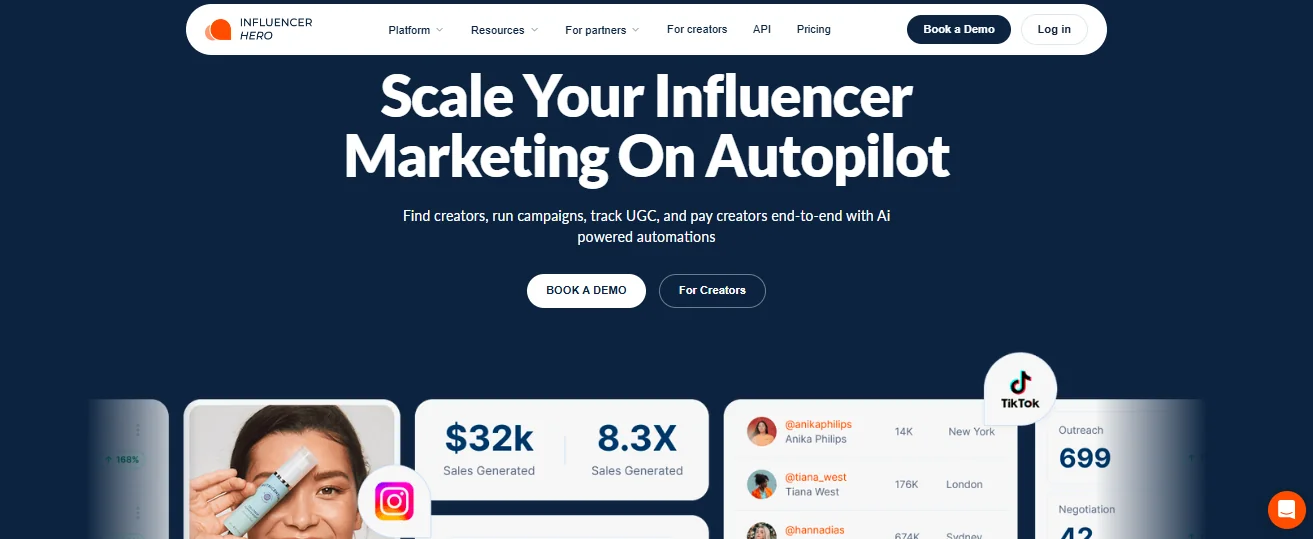
Influencer Hero is an all-in-one influencer marketing platform built for DTC brands and agencies running ongoing creator programs. It covers the full lifecycle in one place: discovery across Instagram, TikTok, YouTube, Facebook, Pinterest and X, automated outreach, a creator CRM, product gifting, affiliate tracking, UGC collection, creator storefronts and revenue reporting.
The design principle is consolidation. Instead of a discovery tool plus an affiliate app plus a spreadsheet plus a shared inbox, everything lives on a single creator deal page. Communication history, product shipments, affiliate links, commission rates and content collected all sit in the same record.
Afluencer is now part of Influencer Hero, which creates a clean progression. The $49/month Afluencer Marketplace plan handles discovery and Collabs for brands testing the channel. The Standard plan at $649/month unlocks the full Influencer Hero platform. Same ecosystem, no migration when you scale.
Outreach Across Email and DMs
Most platforms in this category are email-only. Influencer Hero automates outreach through email sequences and Instagram and TikTok DMs, with reach-out volumes of 1,000 per month on Standard, 5,000 on Pro and 10,000 on Business.
That matters more than it sounds. Plenty of creators, especially micro and nano, barely check the email on their bio and respond fast to a DM. Running both channels roughly doubles your realistic response rate. If you want to sharpen the messages themselves, these outreach techniques cover what actually gets replies.
Affiliate Tracking and Payouts in the CRM
Affiliate links, discount codes, commission calculation and payout processing all live on each creator's deal page rather than in a separate affiliate app. Creators get their own branded dashboard where they can check earnings and submit payment details themselves, which removes a whole category of back-and-forth admin.
Creator storefronts extend this. Each creator gets a branded page pulling from your live catalog with trackable links generated automatically, connected to Shopify, WooCommerce and Magento.
Flat Pricing With No Meter
You pay a fixed monthly fee and use the platform as much as you want. Discovery searches, profile analyses and AI recommendations don't draw down a credit balance. For teams that run heavy discovery cycles, this removes the mental overhead of deciding whether a search is worth spending on.
Broad E-Commerce Support
Native integrations cover Shopify, WooCommerce, Magento and BigCommerce, plus Gmail and Outlook connectivity. If your store isn't on Shopify, you're not falling back to a developer-built workaround. Before you commit to any platform, run through these questions worth asking.
Where Influencer Hero Falls Short
There's no free tier and no self-serve signup. You book a demo, and the entry point is $649/month with a three-month minimum commitment. That's a real barrier for brands running a small budget or testing the channel for the first time. Influencer payments are also capped by plan (20 on Standard, 100 on Pro), so high-volume paid programs need a higher tier than the reach-out numbers alone would suggest.
GRIN vs Influencer Hero: Feature by Feature
Influencer Discovery
GRIN searches 38M+ profiles and has 700K+ creators in its own opted-in network, which is useful because those creators have already signaled they want brand work. Gia handles sourcing, scoring and shortlisting, but each of those actions costs credits.
Influencer Hero covers six platforms including Pinterest and X, with AI recommendations and fake-follower detection included in the plan price. The practical difference is metering. If you run three shortlist rounds a week, GRIN's credits deplete; Influencer Hero's don't. If you source occasionally, GRIN's Free tier costs you nothing at all. Either way, finding the right creator is still the step where most programs stall.
Outreach and Communication
Influencer Hero has the edge on channel coverage with email plus IG and TikTok DM automation. GRIN Classic offers 10 email sequences and 150 templates on Growth and up, and Gia can send outreach on any plan for a light credit cost.
The structural difference: GRIN's sequence and template limits are fixed regardless of tier, while Influencer Hero scales reach-out volume with plan level. Neither approach is better in the abstract. It depends on whether your bottleneck is message volume or sequence variety.
CRM and Campaign Management
This is where the GRIN tier structure bites. GRIN Classic, the actual CRM workspace, requires the $500/month Growth plan minimum and caps you at 100 active creators there, 250 on Scale, 500 on Complete. It gives you 5 user logins, 10 landing pages, 12 campaign activations and 30 partnerships at every tier.
Influencer Hero includes the full CRM at Standard, with 1 seat, scaling to 3 on Pro and 8 on Business. So GRIN's entry to a real CRM is cheaper at $500 versus $649, but GRIN gives you 5 seats there while Influencer Hero gives you 1. If you're a solo marketer, Influencer Hero's tier is better value. If you're a team of five, GRIN's is.
Campaign Tracking and Analytics
Both platforms do proper revenue attribution, which puts them in a different league from marketplace tools. GRIN tracks GMV per creator with no take rate. Influencer Hero tracks clicks, conversions and revenue per creator and per campaign, with a UGC library that auto-collects content as creators post it.
One difference worth noting: Influencer Hero's UGC tracking is capped by plan (200 posts on some Standard configurations, 1,500 on Business), so content-heavy programs should check that limit against their volume. Understanding reach versus impressions helps here too, since both platforms report on both.
Integrations
GRIN is Shopify-first with a developer path for everything else. Influencer Hero ships native integrations for Shopify, WooCommerce, Magento and BigCommerce. If you're on Shopify, this is a wash. If you're on WooCommerce or Magento, Influencer Hero saves you a build.
Pricing: What You'll Actually Pay
GRIN runs five tiers: Free (200/month, 2,000 credits), Growth (1,000/month, 20,000 credits, 250 creators) and Complete ($1,500/month, 30,000 credits, 500 creators). Everything is month to month with no contract. Overage runs at one flat rate under a hard cap you set, and unused included credits don't roll over.
Influencer Hero publishes its tiers too: Standard at $649/month, Pro at $1,049/month and Business at $2,490/month, with Agency and Enterprise quoted custom. All plans carry a three-month minimum. Quarterly billing saves 20% and annual saves 30%, bringing Standard down to $454/month on an annual commitment.
Afluencer starts free. Creators pay nothing, and brands can post a Collab and run a free trial before paying. Paid brand plans start at $49/month for Marketplace.
The honest math: if you're spending $2,000 a month total on influencer marketing including creator fees and product costs, a $649 platform bill is a third of your budget before a single creator gets paid. GRIN's Free and $200 tiers are far friendlier at that stage, though you won't get the full CRM. And if you're still testing whether creators in your category will even work with you, spending anything on software is premature. Starting free on Afluencer answers that question first.
Which Platform Is Right for You?
GRIN has done something genuinely interesting here, and it deserves credit for it. Publishing every tier, removing the sales call, offering a real free plan with no clock on it and charging nothing on affiliate transactions are all moves that make the category more honest. The revenue attribution has been best in class for years, and Gia handling operational work rather than just surfacing data is a real shift, not a feature checkbox. For a team comfortable with metered usage, and especially for one already deep in Shopify, GRIN is a strong fit.
Influencer Hero makes more sense when predictability and channel coverage matter more than a low entry price. If you're running outreach at volume across email and DMs, managing dozens of creator relationships that each need shipping, contracts, affiliate links and payouts tracked in one place, and you want a bill that doesn't move based on how hard your team worked that month, the flat-fee model fits better. It also covers more e-commerce stacks natively, which matters if you're not on Shopify.
Want to see how that runs against your actual store and creator list? Book a demo with Influencer Hero.
If neither budget works right now, that's a normal place to be. Afluencer is free to start, and posting a Collab tells you within a week whether creators in your niche want what you're offering. That's the question worth answering before you buy software. The Afluencer 101 guide for brands covers the setup, and why brands starting small need influencers is worth reading if you're still weighing it up.
The Bottom Line
The real split here isn't features, it's cost behavior. GRIN's bill moves with how much work you hand to its AI. Influencer Hero's bill doesn't move at all. Both track revenue properly, both handle affiliates, both integrate with your store. Pick the pricing model you can actually plan around.
If you need the full workflow with fixed costs and DM outreach on top of email, Influencer Hero covers it end to end. If you're earlier than that, start free on Afluencer, post a Collab, and let the creator response tell you what to buy next.