.svg)
.png)
- Heepsy vs Afluencer: A Detailed Comparison
- Quick Comparison: Heepsy vs Afluencer at a Glance
- What Is Heepsy?
- What Is Afluencer?
- Heepsy vs Afluencer: Feature-by-Feature Breakdown
- Pricing: What You'll Actually Pay
- Scaling Beyond the Marketplace: Where Influencer Hero Fits
- Which Platform Is Right for You?
- The Bottom Line
Heepsy vs Afluencer: A Detailed Comparison
Most comparison posts about influencer platforms are written by the platforms themselves, which makes them about as useful as a menu written by one restaurant about another. You end up with a list of features and no real sense of which tool matches how you actually work.
Heepsy and Afluencer both help brands connect with creators, but they solve the problem from opposite directions. Heepsy is a search-first discovery tool: you filter a database, vet profiles, and reach out cold. Afluencer is a marketplace: you post a Collab, creators apply, and you pick from people who already raised their hand.
That difference shapes everything downstream, from how much time your team spends on outreach to what your response rates look like.
Below you'll get the pricing on both, a feature-by-feature breakdown, and an honest read on which setup fits your stage. If you're still early in the process, our guide on getting started with influencer marketing is worth a read first.
Quick Comparison: Heepsy vs Afluencer at a Glance
What Is Heepsy?
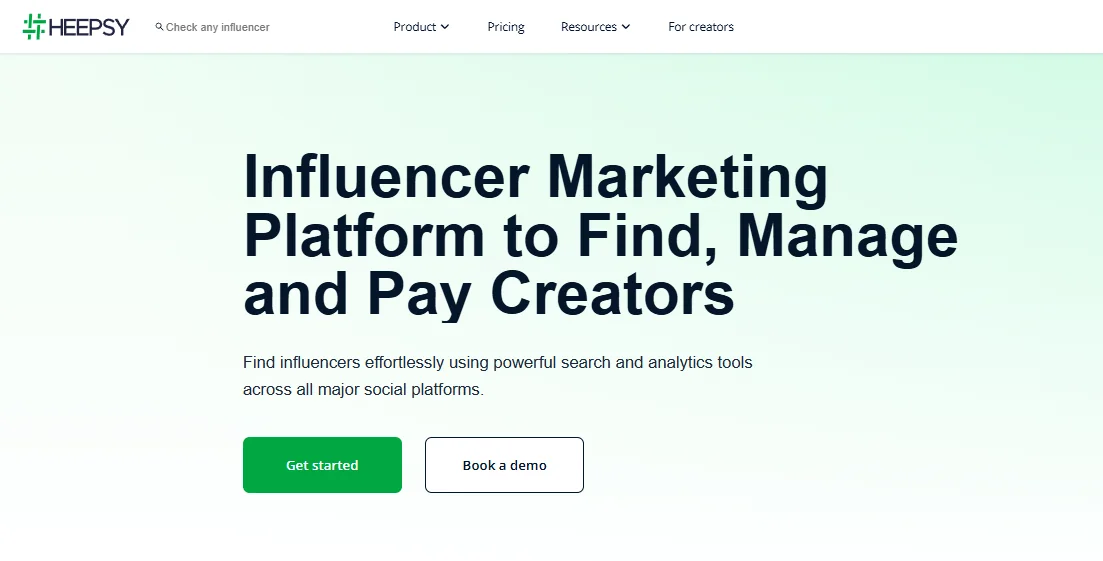
Heepsy is an influencer discovery and analytics platform founded in 2016 and based in Loiu, Spain. It gives brands a searchable index of creator profiles across Instagram, TikTok, and YouTube, with filters for location, category, follower count, engagement rate, and audience demographics.
The workflow is straightforward. You run a search, narrow it with filters, open profiles to check audience quality, save the ones you like into lists, and email them. Heepsy also runs a creator marketplace branded as Moonio, where brands post campaigns and creators apply.
It has built its reputation on being one of the cheapest ways into influencer discovery, which is why it shows up so often on shortlists for small brands and agencies running their first campaigns.
Affordable Influencer Discovery
Heepsy's entry price sits well below most of the discovery tools it competes with. For teams that mainly want a searchable database and don't need campaign management layered on top, that's a real advantage.
The filter set covers the basics well: platform, follower range, engagement rate, location, and category. Search results come back fast, and the interface is clean enough that a new user can find creators on day one without a training session.
Audience Vetting and Fake Follower Detection
This is where Heepsy earns its keep. Every profile gets an audience quality score from 1 to 100, plus a fake follower analysis that flags accounts with inflated numbers. You also get audience demographics: age, gender, and geography breakdowns.
For brands worried about paying for reach that doesn't exist, that vetting layer is genuinely useful, especially when you're evaluating Instagram micro influencers whose engagement looks strong on the surface.
Strong Coverage in Spanish and European Markets
Heepsy's index skews toward Spain and Europe, a reflection of where the company is based. If your campaigns target those regions, you'll find more relevant creators here than the raw database size suggests.
Where Heepsy Falls Short
The gating is aggressive. The Starter plan at $89/month caps you at roughly 15,000 search results, 50 profile analytics, and 50 outreach emails, and it locks out advanced filters like age, gender, and audience location. Shopify integration, affiliate links, and sales tracking sit on the Advanced plan at $369/month. The database also only indexes creators with 3,000+ followers, which cuts nano influencers out entirely, and reviewers on Capterra have flagged both the no-refund policy and the commission taken on creator payments.
What Is Afluencer?
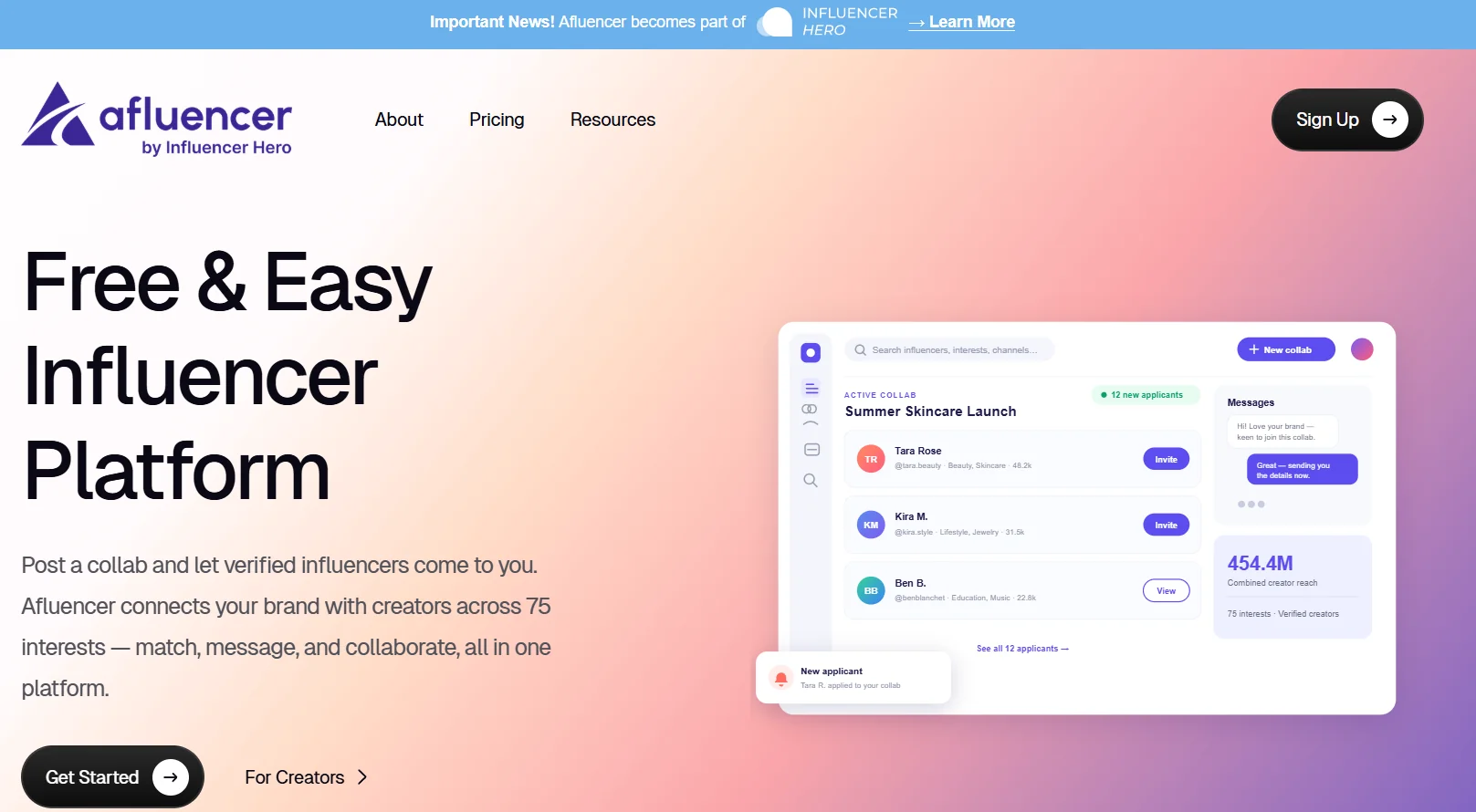
Afluencer flips the model. Instead of searching a database of creators who have no idea your brand exists, you post a Collab describing what you're offering, and creators browse and apply to it. Every creator on the platform signed up specifically to work with brands, which changes the tone of the entire conversation.
The platform covers Instagram, TikTok, YouTube, and Facebook, and every creator profile is verified before it goes live. You review applications, approve the ones that fit, and message people directly in-app.
Afluencer is also part of the same family as Influencer Hero, which matters later in this comparison: the Standard plan unlocks access to the Influencer Hero platform for brands that outgrow the marketplace.
Inbound Collab Applications
The core value here is response rate. Cold outreach to a scraped email address converts at low single digits on a good day. An application from a creator who read your Collab and chose to apply starts from a completely different place.
Our breakdown of how the platform matches creators with brands walks through how the filtering and matching side works in practice.
Verified, Active Creators
Afluencer's creator pool is smaller than Heepsy's index by design. These aren't scraped profiles, they're 7K+ verified creators who maintain active accounts and check the platform for opportunities.
Smaller and active beats larger and cold when your goal is a signed Collab rather than a spreadsheet of contacts. It also means nano and micro creators are fully represented, since there's no follower floor to get listed.
CreatorGPT for Matching and Strategy
CreatorGPT is Afluencer's AI assistant. You describe the campaign in plain language and it surfaces relevant creators and answers strategy questions, from what to offer to how to structure the Collab.
For a small team without a dedicated influencer manager, that shortens the gap between idea and live campaign considerably.
Where Afluencer Falls Short
If your campaign depends on targeting one specific creator you already have in mind, a marketplace is the wrong shape of tool. Afluencer works best when you're open to who applies. Deep audience analytics also aren't the focus here the way they are on a pure discovery platform.
Both of those gaps close on Influencer Hero, which is the upgrade path from Afluencer rather than a different vendor. It adds search-based discovery across Instagram, TikTok, and YouTube with fake follower detection and full audience breakdowns, so you can go after specific creators directly instead of waiting for applications. Brands on Afluencer's Standard plan get access to it, and there's more on how that works further down.
Heepsy vs Afluencer: Feature-by-Feature Breakdown
Influencer Discovery
Heepsy wins on raw volume and filter depth, with millions of indexed profiles and demographic filters that go granular. Afluencer wins on intent. You're not sorting through creators who may or may not respond, you're reviewing people who applied.
The practical question is how you'd rather spend your time: searching and vetting, or reviewing and approving.
Outreach and Communication
Heepsy's outreach is email-based and metered. Fifty emails a month on Starter goes quickly once you factor in typical reply rates, and you're writing cold, which means every message needs to earn attention from scratch. Our post on outreach techniques covers what actually moves the needle there.
Afluencer keeps the conversation in-app. Creators apply, you reply, and the thread stays in one place. You also get 60 invite credits a month on the Marketplace plan if you want to proactively reach out to someone you found in the directory.
Campaign Management and Tracking
Neither platform is a full campaign suite at its entry tier. Heepsy gives you lists, bulk email templates, and a media gallery for collected content on higher plans. Afluencer handles Collab management, applications, and messaging, then layers on product shipping and creator payments from the Standard plan.
If you're running one campaign at a time, either handles it. Running five simultaneously with deliverable tracking and content approvals is where both start to strain.
Ecommerce and Affiliate Tracking
This is the clearest split. Heepsy puts Shopify integration, affiliate link creation, and sales tracking exclusively on the Advanced plan at $369/month, which is a steep jump for a feature many brands consider table stakes.
Afluencer's route to affiliate tracking and sales attribution runs through Influencer Hero access on the Standard plan, which bundles it with outreach automation, CRM, and payments rather than selling it as a top-tier unlock.
Pricing: What You'll Actually Pay
Heepsy runs a free plan plus three paid tiers. Starter is roughly $89/month (€69), Plus is $249/month, and Advanced is $369/month. The free plan lets you search and see that profiles exist, but it withholds analytics and contact details, so it functions as a preview rather than a working plan. The real functionality most brands describe wanting sits on Plus or Advanced.
Afluencer starts at $49/month for the Marketplace plan, which includes 60 invitation credits a month, premium influencer filters, and phone, email, and live chat support. Standard is $649/month and adds 1,000 reach outs a month, product shipping, influencer payments, and access to the Influencer Hero platform. Pro is $1,049/month with 5,000 reach outs, a dedicated account manager, and three or more seats.
Here's the number that matters. If your total monthly influencer budget is $1,500, committing $369 to Heepsy's Advanced plan just to unlock Shopify tracking eats close to a quarter of it before a single creator gets paid. Starting at $49 and putting the difference into product and creator fees is the more sensible split at that stage.
Scaling Beyond the Marketplace: Where Influencer Hero Fits
There's a point where the marketplace model stops being enough. You're running multiple campaigns a month, managing dozens of creators, and tracking which ones actually drive revenue. That's the ceiling Afluencer is honest about, and it's exactly why Influencer Hero exists in the same family.
Influencer Hero is the step up from Afluencer. It covers discovery across Instagram, TikTok, and YouTube with fake follower detection, lookalike search, and brand follower detection, then adds automated outreach sequences, a full creator CRM, product gifting through Shopify and WooCommerce, affiliate links with sales attribution, automated creator payments, and creator storefronts. Integrations with Klaviyo, Zapier, DocuSign, and Slack keep it connected to the rest of your stack.
Pricing is public: Standard at $649/month for up to 1,000 creators, Pro at $1,049/month for up to 5,000, and Business at $2,490/month for up to 10,000. Brands on Afluencer's Standard plan get access to the Influencer Hero platform, so the upgrade path from marketplace to full workflow doesn't mean starting over with a new vendor.
If you're running enough volume that outreach, tracking, and payments all need to live in one system, it's worth seeing it against your own campaign setup. Book a demo with Influencer Hero.
Which Platform Is Right for You?
Heepsy does one job well and doesn't pretend otherwise. If your team wants to control who gets contacted, dig into audience demographics before committing, and screen for fake followers at scale, that's what the tool is built for. Brands targeting Spanish and European creators get particular value from how the index is weighted. If you already have a list of names and you're validating them, Heepsy answers that question directly.
Afluencer makes more sense when your bottleneck is response rate rather than search volume. You post once, interested creators apply, and you spend your time reviewing fits instead of writing cold emails that mostly go unanswered. At $49/month it's also the more forgiving place to test whether influencer marketing works for your product before you commit real budget to tooling. Our guide on choosing a platform covers the questions worth asking before you sign anything.
Influencer Hero becomes the right answer when the work outgrows both. If you need automated outreach at volume, a CRM that holds every creator relationship, affiliate links tied to actual sales, and payments running without manual transfers, that's the full workflow in one platform. It's the natural upgrade from Afluencer rather than a replacement for it, which is why Standard plan brands get access to it directly.
The Bottom Line
Heepsy is a magnifying glass and Afluencer is a bulletin board. One helps you find and inspect creators, the other brings interested creators to you, and neither is trying to do the other's job.
Pick based on where your friction actually sits. If it's finding people, Heepsy's filters and vetting earn their price. If it's getting replies, the marketplace model solves a problem no database can.
And when you're running enough campaigns that outreach, affiliate tracking, and creator payments all need to live in one system, Influencer Hero is where Afluencer brands go next.
Frequently Asked Questions
<details class="ih-faq"><summary>What's the main difference between Heepsy and Afluencer?</summary><div class="ih-faq-a">Heepsy is a search-based discovery database where you filter millions of profiles and reach out cold. Afluencer is a marketplace where you post a Collab and verified creators apply to it. Heepsy puts the work on your side of the table, Afluencer brings interested creators to you.</div></details><details class="ih-faq"><summary>Does Heepsy track affiliate sales?</summary><div class="ih-faq-a">Yes, but only on the Advanced plan at $369/month. Shopify integration, affiliate link creation, and sales tracking are all locked to that top tier. On Starter and Plus you can find and contact creators, but you can't attribute revenue to them inside the platform.</div></details><details class="ih-faq"><summary>Which platform works better for micro influencer campaigns?</summary><div class="ih-faq-a">Afluencer, mostly because there's no follower floor to join. Heepsy only indexes creators with 3,000+ followers, so nano influencers and smaller micro creators don't appear at all. If your strategy leans on high-engagement smaller accounts, that gap matters.</div></details><details class="ih-faq"><summary>How much does Heepsy cost per month?</summary><div class="ih-faq-a">Heepsy runs three paid tiers: Starter at around $89/month (€69), Plus at $249/month, and Advanced at $369/month. There's also a free plan, though it withholds analytics and contact details. Most brands find they need Plus or Advanced for the platform to be genuinely usable.</div></details><details class="ih-faq"><summary>Can I use Afluencer and Influencer Hero together?</summary><div class="ih-faq-a">Yes. Afluencer's Standard plan at $649/month includes access to the Influencer Hero platform, so you can keep sourcing creators through the marketplace while running outreach, affiliate tracking, and payments through Influencer Hero. They're separate products built for different stages, not competing tools.</div></details><script type="application/ld+json">{"@context":"https://schema.org","@type":"FAQPage","mainEntity":[{"@type":"Question","name":"What's the main difference between Heepsy and Afluencer?","acceptedAnswer":{"@type":"Answer","text":"Heepsy is a search-based discovery database where you filter millions of profiles and reach out cold. Afluencer is a marketplace where you post a Collab and verified creators apply to it. Heepsy puts the work on your side of the table, Afluencer brings interested creators to you."}},{"@type":"Question","name":"Does Heepsy track affiliate sales?","acceptedAnswer":{"@type":"Answer","text":"Yes, but only on the Advanced plan at $369/month. Shopify integration, affiliate link creation, and sales tracking are all locked to that top tier. On Starter and Plus you can find and contact creators, but you can't attribute revenue to them inside the platform."}},{"@type":"Question","name":"Which platform works better for micro influencer campaigns?","acceptedAnswer":{"@type":"Answer","text":"Afluencer, mostly because there's no follower floor to join. Heepsy only indexes creators with 3,000+ followers, so nano influencers and smaller micro creators don't appear at all. If your strategy leans on high-engagement smaller accounts, that gap matters."}},{"@type":"Question","name":"How much does Heepsy cost per month?","acceptedAnswer":{"@type":"Answer","text":"Heepsy runs three paid tiers: Starter at around $89/month (€69), Plus at $249/month, and Advanced at $369/month. There's also a free plan, though it withholds analytics and contact details. Most brands find they need Plus or Advanced for the platform to be genuinely usable."}},{"@type":"Question","name":"Can I use Afluencer and Influencer Hero together?","acceptedAnswer":{"@type":"Answer","text":"Yes. Afluencer's Standard plan at $649/month includes access to the Influencer Hero platform, so you can keep sourcing creators through the marketplace while running outreach, affiliate tracking, and payments through Influencer Hero. They're separate products built for different stages, not competing tools."}}]}</script>