.svg)
.png)
Heepsy vs Influencer Hero: A Detailed Comparison
Most influencer platform comparisons are written by the platforms themselves, which is why they all somehow reach the same conclusion.
This one has a simpler goal: show you where each tool actually fits. Heepsy and Influencer Hero both live in the influencer marketing software category, but they solve different halves of the same problem. Heepsy is a discovery engine. Influencer Hero runs the entire program.
So the real question isn't which one is better. It's whether you just need to find creators, or whether you need to find them, contact them, track them, and pay them without duct-taping five tools together.
By the end of this you'll know what each platform costs, what you actually get at each tier, and which one matches your brand's current stage. If you're still earlier than that, our guide on getting started with influencer marketing is the better first read.
Quick Comparison: Heepsy vs Influencer Hero vs Afluencer
What Is Heepsy?

Heepsy is a Spain-based influencer discovery and analytics platform that launched in 2016. Its database covers more than 11 million creator profiles across Instagram, TikTok, YouTube and LinkedIn, and the whole product is built around one core job: help you find creators and check whether they're worth contacting.
The workflow reflects that. You search, you filter, you open a profile report, you check the audience numbers, and then you email. Heepsy gives you four ways to search: AI search, text match, lookalike search, and direct handle lookup. Lookalike is the one most people underrate, since it lets you feed in a creator who already performed well and surface others with similar audiences.
It's popular with small and mid-sized ecommerce teams, and it has particularly strong coverage in Spanish and European markets. If your campaigns lean toward Spain, LATAM or Southern Europe, the database depth there is a real advantage over US-centric tools.
Fast, Filter-Heavy Creator Search
The search experience is the product's strongest piece. You can filter by location, category, follower count, engagement rate, and (on higher plans) audience age, gender and location. The interface is clean and most teams get productive within an hour, which matters more than people admit when you're the only person running influencer marketing at your company.
Audience Authenticity Analysis
Every profile includes a fake-follower estimate alongside engagement and growth data. It's sample-based, so treat it as a first-pass filter rather than gospel, but it does the job of catching obviously inflated accounts before you waste a gifting budget on them. If you're vetting creators you've never heard of, this is exactly the check you want. Our breakdown on how to find the perfect influencer covers what else to look at beyond the numbers.
Cost Estimates Per Post
Heepsy auto-generates an estimated post price for each creator based on follower count, engagement and its own benchmark data. Nobody should treat that as the final number, but it gives you an anchor before you open negotiations, and it makes bulk budgeting a lot less guessy.
Bulk Outreach With Templates
On Plus and above you can contact creators in bulk using email templates with custom fields. There's no AI writing the messages for you, so your copy has to carry the weight. If you already have outreach messaging that converts, the volume tools handle a few hundred contacts a month without complaint. Our post on influencer outreach techniques is worth a read before you load those templates.
Where Heepsy Falls Short
The gating is the recurring complaint, and it's fair. Audience demographic filters, the ones most brands consider basic, only unlock on Plus at $249/month. Shopify integration and affiliate sales tracking sit exclusively on Advanced at $369/month, which means the ecommerce brands most likely to need ROI attribution are the ones pushed to the top tier. There's also no public API, so you can't pipe creator data into your own dashboards, and Heepsy runs a strict no-refund policy that several reviewers have flagged after signing up and realizing the plan didn't fit.
What Is Influencer Hero?
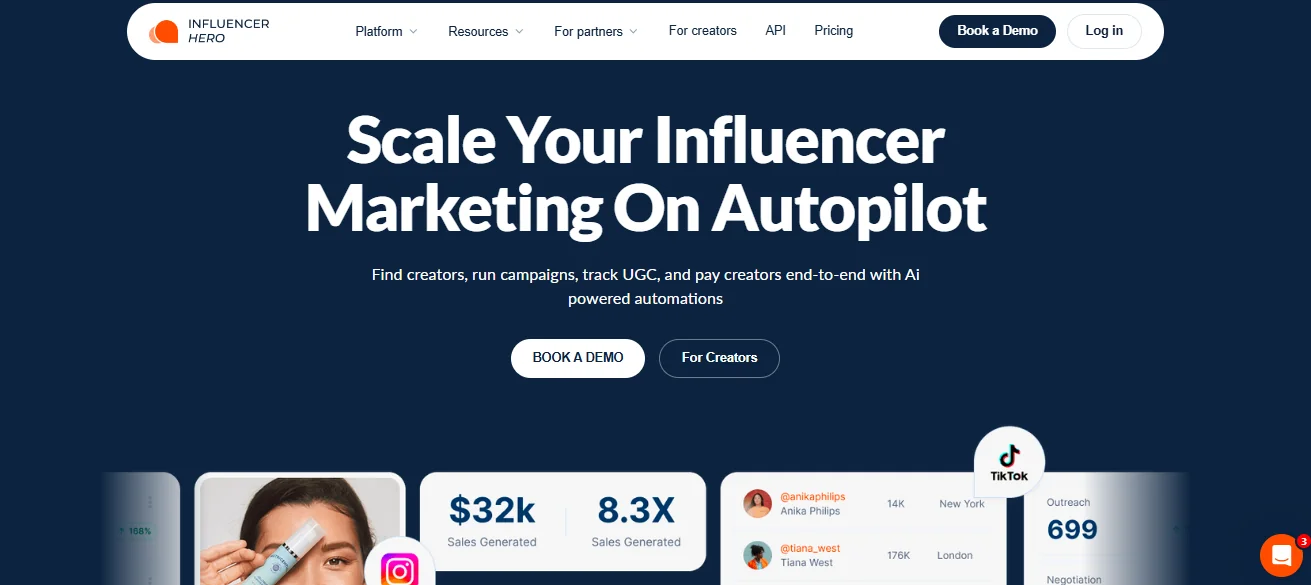
Influencer Hero is an all-in-one influencer marketing platform built for DTC brands and agencies that run creator programs as an ongoing channel, not a one-off campaign. It's also now part of the same family as Afluencer, which means the marketplace side and the software side connect rather than compete.
The scope is the main difference. Discovery is just the first step. From the same platform you handle outreach, creator relationships, gifting and seeding, contracts, affiliate links and discount codes, UGC storage, payments, and reporting. The database sits at 450M+ creators across eight platforms, with 20+ filters and fraud detection layered on top.
The workflow looks like this: search with plain-language AI queries, shortlist, launch an automated outreach sequence with follow-ups, move responders into the CRM, ship product, generate affiliate links, then watch revenue attribution roll in by creator. If you've been running that process across a spreadsheet, Gmail and three browser tabs, that consolidation is the entire pitch.
AI Search Across 450M+ Creators
You describe the creator you want in normal language and the platform applies the filters for you. It also handles lookalike search, audience overlap analysis, and brand collaboration history so you can see who a creator has already worked with, including your competitors. The database size means you can go deep on niches where smaller tools return twelve results and a shrug.
Automated Outreach With Personalized Follow-Ups
This is the part that separates it from discovery tools. Outreach sequences are AI-personalized per creator and follow-ups fire automatically when someone doesn't reply. Most of your responses come from follow-up two or three, and manual sending is exactly where that falls apart.
A Full Influencer CRM
Every creator relationship lives in one place with status, history, content, and performance attached. When you're managing 50 or 200 creators at once, spreadsheets stop being a system and start being a liability. This is also where gifting and product seeding run from, so you can dispatch product without leaving the platform.
Affiliate Links, Codes and Payments in One Place
Generate unique affiliate links and discount codes per creator, track conversions back to the individual, and pay everyone from the same dashboard. There's also AI-powered coupon code leakage detection, which matters more than most brands realize once codes start showing up on deal sites. If you're weighing which capabilities actually matter for your setup, our list of questions to ask when choosing an influencer marketing platform is a useful filter.
Ecommerce and Email Integrations
Shopify, WooCommerce, Magento, BigCommerce and Prestashop on the store side. Klaviyo, Mailchimp, Omnisend, Brevo and GetResponse on email. Plus Slack, Zapier, Gorgias and Docusign, with 45+ integrations total and an API if your team wants to build on top of the data.
Where Influencer Hero Falls Short
The entry price is $649/month with a three-month commitment, and there's no self-serve free trial. You book a demo to see the platform. For brands running one campaign a quarter or testing whether influencer marketing works at all, that's a bigger commitment than the stage justifies.
Heepsy vs. Influencer Hero: Feature-by-Feature Breakdown
Influencer Discovery
Both platforms search well, but at different scales. Heepsy's 11M profiles cover Instagram, TikTok, YouTube and LinkedIn with solid European depth. Influencer Hero's 450M+ across eight platforms gives you far more room in narrow niches and non-English markets. The bigger practical gap is filtering: Heepsy holds audience demographics back until the $249 tier, while Influencer Hero includes its full filter set from the entry plan. If you're hunting micro-influencers with specific audience profiles, that difference shows up on day one.
Outreach & Communication
Heepsy sends bulk emails from templates. Influencer Hero sends AI-personalized sequences with automatic follow-ups and tracks open and reply rates per sequence. If your outreach volume is 50 creators a month, the template approach is fine. At 500, follow-up automation stops being a nice-to-have and becomes the thing that determines your response rate.
CRM & Campaign Management
Heepsy doesn't really compete here, and it doesn't claim to. You get contact exports and campaign reporting on higher tiers, but relationship management mostly happens in your own tools. Influencer Hero has a purpose-built CRM covering status tracking, communication history, gifting logistics, contracts and content collection. This is the clearest structural difference between the two.
Campaign Tracking & Analytics
Heepsy tracks 100 posts a month on Plus and 300 on Advanced, with affiliate sales attribution only on Advanced. Influencer Hero tracks performance by campaign and by creator across all plans, including revenue attribution, ROI by creator, gifting cost reporting, and a breakdown of results by creator tier. If proving channel ROI to your CFO is part of the job, that gap matters.
Integrations
Heepsy connects to Shopify, but only on the top plan. Influencer Hero covers five ecommerce platforms, five email platforms, plus Slack, Zapier and an open API from the start. For a DTC brand, whether influencer revenue flows automatically into your store data is usually a bigger deal than any single feature on a comparison chart.
Pricing: What You'll Actually Pay
Heepsy runs a free plan plus three paid tiers: Starter at $89/month, Plus at $249/month, and Advanced at $369/month. Annual billing knocks roughly 20% off each. The free plan lets you run basic searches without analytics or outreach, so it's a look-around tier rather than something you'd run a program on. Worth noting: Heepsy often markets a "forever" discount, so the prices you see advertised are already the discounted ones.
Influencer Hero starts at $649/month for Lite, $1,049/month for Pro, and $2,490/month for Business, with a three-month minimum commitment. There's no free trial. You book a demo, see the platform, and pricing gets confirmed based on how many creators you're managing.
Afluencer gives brands a free trial, and posting a Collab to the marketplace costs nothing. Paid brand plans start at $49/month for Marketplace access. On the creator side, the Micro plan is free forever, which is why the marketplace stays active.
Here's the practical math. If your entire monthly influencer budget is $1,500, paying $369 for Heepsy Advanced eats a quarter of it before a single creator gets a product or a payment. Software should be a small slice of your influencer spend, not the main line item. That's the case for starting free on Afluencer, running a few collabs, learning what your offer and your creator profile actually look like, and moving to paid software once the channel is proven.
Which Platform Is Right for You?
Heepsy is genuinely good at what it's built for. If your bottleneck is finding creators and checking whether their audiences are real, the search engine is fast, the filters are sensible once you're on Plus, and the lookalike search is a legitimately smart way to scale a shortlist from one creator who worked. For teams targeting Spanish and European markets, the regional database depth is hard to match at that price. Plenty of brands run productive programs on Heepsy alone.
Influencer Hero makes more sense when discovery isn't the hard part anymore. If your problem is that you're running outreach in Gmail, tracking creators in a spreadsheet, generating discount codes manually in Shopify, and stitching together a report at the end of the month, that's a workflow problem rather than a search problem. IH covers outreach automation, CRM, gifting, affiliate tracking, payments and attribution end to end, without gating the ecommerce integration behind the top tier.
If that sounds like the setup you're trying to build, it's worth seeing in practice. Book a demo with Influencer Hero.
And if you're reading this thinking neither price tag makes sense yet, that's a completely reasonable place to be. Afluencer is where brands start before they're ready to commit to software. Post a Collab, get applications from creators who actively want to work with brands your size, and run a few campaigns without a subscription hanging over them. Sign up on Afluencer for free and see our Afluencer 101 guide for brands or our take on why brands starting small need influencers if you want the full picture first.
The Bottom Line
Heepsy solves the "I can't find good creators" problem. Influencer Hero solves the "I found them and now I'm drowning in admin" problem. Which one you need depends entirely on which of those sentences you've said out loud this month.
If you're not at either point yet, don't buy software to find out. Start with a free Collab on Afluencer, get real creators applying to your brand, and let the results tell you what to invest in next. When the volume gets heavy enough that spreadsheets start breaking, Influencer Hero is there.