
.svg)
.png)
Meltwater vs Influencer Hero: A Detailed Comparison
There's a specific kind of frustration that comes with researching enterprise software. You read the feature list, you get excited, you click "pricing," and you find a button that says "Talk to Sales."
Meltwater is that experience. Influencer Hero is closer to it than most people expect, though the numbers are at least public. Both platforms can run a serious influencer program, and neither one is going to let you swipe a card and start today.
The bigger question isn't which one has more features. It's whether you're buying an influencer marketing platform or a media intelligence suite that happens to include influencer marketing. Those are two different purchases with two very different price tags attached.
Here's what each one actually does, what each one actually costs, and how to tell which category you're shopping in. If you're still narrowing down the field, our list of questions to ask when choosing an influencer marketing platform is a good sanity check before any sales call.
Quick Comparison: Meltwater vs Influencer Hero vs Afluencer
What Is Meltwater?

Meltwater is a media intelligence company founded in 2001, serving more than 27,000 corporate customers across 120+ countries. Its original business was media monitoring, and it expanded over the years into social listening, consumer intelligence, PR analytics and influencer marketing.
The influencer piece runs on Klear, which Meltwater acquired in 2021 and folded fully into the Meltwater brand in April 2024. If you log in today you'll still see "Klear Connect" as the name of the collaboration portal, which tells you something about how the acquisition settled. When you buy Meltwater influencer marketing, you're buying Klear inside a much bigger media intelligence suite.
That structure shapes everything. The typical Meltwater customer isn't a DTC brand shopping for its first influencer tool. It's a comms or marketing team that already pays Meltwater for PR monitoring and wants creator campaigns living under the same login. Which is a genuinely good reason to buy it, if that's you.
True Reach Instead of Follower Counts
Meltwater's proprietary True Reach metric estimates how many people actually see a creator's content rather than how many technically follow them. It's one of the better answers to a problem every brand hits eventually, which is that follower count stopped meaning much years ago. If you've ever wondered which number to actually care about, our post on reach vs. impressions covers the same tension.
AI Discovery Across 60,000+ Topic Categories
The platform categorizes creators across tens of thousands of topics and surfaces lookalikes based on creators who already performed for you. It also runs brand safety analysis, scanning a creator's content history for anything that could turn into a reputational problem. For regulated industries and global brands, that check is not optional, and Meltwater does it properly. Our guide on how to find the perfect influencer covers the manual version of the same vetting process.
Klear Connect for Campaign Management
Klear Connect handles messaging, contracts, content approval and payments in one inbox. Set a campaign hashtag and the platform automatically aggregates every piece of creator content that uses it, including Instagram Stories, which most tools still miss. Campaign reporting flows from that automatically.
Ecommerce Tracking That Actually Exists
Meltwater connects to Shopify and WooCommerce, generates coupon codes and tracking links per creator, and reports clicks, conversions, conversion rate and revenue back against each one. There's a tracking pixel for stores on other platforms. This is a real affiliate workflow, not a checkbox.
PR and Social Listening in the Same Login
This is the structural advantage nothing else on this list has. Creator activity sits alongside earned media coverage, social conversation and competitive benchmarking. If your job includes reporting on brand presence across press, organic social and creators at once, that unified view is worth real money.
Where Meltwater Falls Short
The cost and the contract shape are the recurring problems. Pricing is quote-based, annual only, with implementation fees on top and a four to six week onboarding period before you're running. Seat and profile caps bite too: the mid-tier Suite package typically includes three users and access to 300 influencer profiles, which is thin if you're running gifting at volume. Capterra reviewers rate Meltwater's value for money at 3.4 out of 5, noticeably below the mid-market average, and buyer forums repeat the same line: powerful, but overkill unless you're using the whole suite.
What Is Influencer Hero?
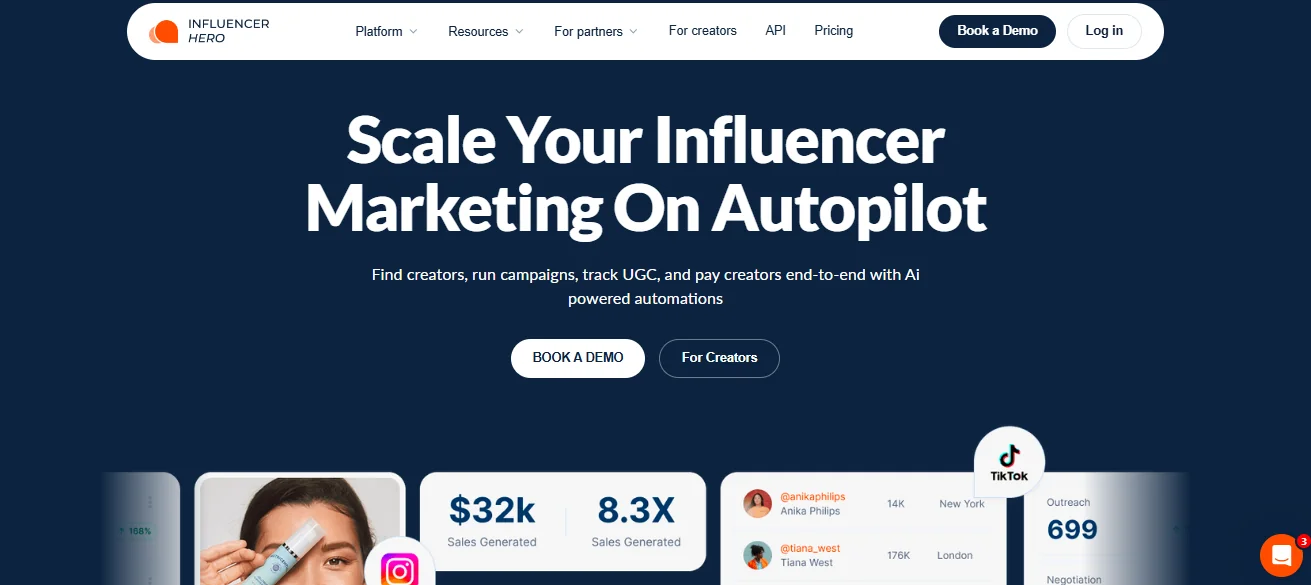
Influencer Hero is an all-in-one influencer marketing platform built for DTC brands and agencies that treat creators as an ongoing sales channel rather than a quarterly campaign. It's also part of the same family as Afluencer now, which means the marketplace and the software connect instead of competing for the same buyer.
The scope is deliberately narrower than Meltwater's and deeper inside influencer marketing specifically. No PR monitoring, no press clipping, no consumer intelligence layer. What you get instead is the full creator lifecycle: discovery across a 450M+ database on eight platforms, automated outreach, a CRM, gifting and seeding, contracts, affiliate links and codes, UGC storage, payments, and revenue attribution per creator.
In practice the workflow runs like this. Describe the creator you want in plain language, shortlist, fire an outreach sequence that follows up on its own, move responders into the CRM, ship product, generate their affiliate link, and watch the orders attribute back. If that whole chain currently lives across Gmail, a spreadsheet and your Shopify discount tab, consolidating it is the entire value proposition.
Search Depth at 450M+ Creators
The database is roughly 15 times the size of Meltwater's, with 20+ filters, fraud detection, audience overlap analysis and brand collaboration history so you can see who a creator has already worked with. In broad categories that difference doesn't matter much. In narrow niches and smaller markets, it's the difference between a usable shortlist and eleven results.
Outreach Sequences That Follow Up Without You
Meltwater gives you an inbox. Influencer Hero gives you AI-personalized sequences with automatic follow-ups and response tracking per sequence. Most creator replies land on the second or third touch, and manual follow-up is exactly the task that quietly stops happening in week three of a campaign. Worth pairing with our post on influencer outreach techniques so the messaging carries its weight.
No Profile Caps on Your Roster
Plans scale by the number of creators you manage rather than gating you to a fixed pool of profile views. For a brand seeding product to a few hundred nano and micro creators a month, that structural difference matters more than any single feature comparison.
Affiliate, Payments and Code Leakage in One Place
Unique links and codes per creator, conversion tracking down to the order, payouts from the same dashboard, and AI-powered detection when your discount codes start leaking onto coupon sites. That last one sounds niche until it happens to you during Black Friday.
45+ Integrations and an Open API
Shopify, WooCommerce, Magento, BigCommerce and Prestashop on the store side. Klaviyo, Mailchimp, Omnisend, Brevo and GetResponse on email. Plus Slack, Zapier, Gorgias and Docusign, with API access available rather than bundled into a top-tier enterprise contract.
Where Influencer Hero Falls Short
There's no free trial and no self-serve signup. Entry pricing is $649/month with a three-month minimum, and you book a demo before you see the platform. It also doesn't do PR monitoring or social listening, so if you need those, you'd be buying a second tool. For a brand running two campaigns a year, the commitment outpaces the need.
Meltwater vs. Influencer Hero: Feature-by-Feature Breakdown
Influencer Discovery
Meltwater's 30M profiles come with the best qualitative data in this comparison: True Reach, brand safety scoring, and topic categorization that's clearly had years of investment. Influencer Hero counters with raw scale at 450M+ and natural language search. If you're vetting a shortlist of 20 creators for a global campaign, Meltwater's depth wins the day. If you're building a list of 500 micro creators in a specific city, the bigger index does more for you.
Outreach & Communication
Meltwater centralizes conversations in Klear Connect and logs everything, which is solid relationship management. What it doesn't do is automate sequencing or personalize at volume. Influencer Hero automates both. The practical split: Meltwater suits teams contacting dozens of creators with high-touch messaging, Influencer Hero suits teams contacting hundreds.
CRM & Campaign Management
Both platforms have a real CRM, which makes this closer than most comparisons in the category. Meltwater's is built around campaign keyword tracking and content approval, with strong logging. Influencer Hero's is built around creator lifecycle stages, gifting logistics and repeat collaborations. Meltwater thinks in campaigns. Influencer Hero thinks in relationships that produce campaigns repeatedly.
Campaign Tracking & Analytics
Meltwater is excellent here, and it's worth saying plainly. True Reach, EMV, automatic Stories capture, and hashtag aggregation give you reporting most tools can't match, especially for earned media value. Influencer Hero reports harder on revenue: sales per creator, ROI by campaign, gifting cost against results, and performance split by creator tier. Media value versus dollars, essentially. Which one you need depends on who reads your monthly report.
Integrations
Meltwater covers Shopify and WooCommerce with a pixel fallback, and offers API access on enterprise contracts. Influencer Hero covers five ecommerce platforms and five email platforms out of the box, with API access available more broadly. For a DTC brand, whether creator revenue flows automatically into Klaviyo flows and store data is often the deciding line. This is one of the common mistakes brands make with influencer programs: buying discovery and forgetting the plumbing.
Pricing: What You'll Actually Pay
Meltwater doesn't publish list pricing at all. Contracts are annual, quote-based, and built around the modules you select, your seat count and your geographic coverage. Reported figures put entry-level Essentials packages around $15,000 to $30,000 per year, mid-tier Suite around $50,000, and enterprise deployments near $73,000, with discounting available at quarter end. Most contracts also carry a one-time implementation fee. Median contract value across the whole platform sits near $25,000 annually.
Influencer Hero publishes its numbers: $649/month for Lite, $1,049/month for Pro, $2,490/month for Business, with a three-month minimum commitment. Annualized, the entry plan lands around $7,800, which is roughly half of Meltwater's cheapest reported package.
Afluencer gives brands a free trial and lets you post a Collab to the marketplace at no cost. Paid brand plans start at $49/month. Creators join free on the Micro plan, which is what keeps the marketplace busy.
The thing to weigh isn't just the number, it's the shape of the commitment. Meltwater locks a year of budget before you know whether the channel works for your brand. Even Influencer Hero's three-month minimum assumes you already know creators drive sales for you. If you haven't proven that yet, the sensible order is to prove it cheaply first and buy software second.
Which Platform Is Right for You?
Meltwater earns its position in a way that's easy to miss when you only look at price. True Reach is a better vetting metric than most of the industry uses, the brand safety scanning is genuinely thorough, and the ability to see creator campaigns alongside press coverage and social conversation in one dashboard is something no standalone influencer tool offers. For a comms team at a global brand reporting to a CMO who cares about total brand presence, that consolidation is the product. Nothing else in this comparison replaces it.
Influencer Hero makes more sense when the report you need to produce says "revenue," not "share of voice." If your influencer program is a sales channel, if you're managing hundreds of creator relationships rather than dozens, and if you need outreach, gifting, affiliate links, payments and order-level attribution running without manual work between steps, that full workflow is what the platform is built around. It also doesn't cap you at 300 profiles or ask for a twelve month signature before you start.
Curious how that looks with your own store connected? Book a demo →
And if both of those price points feel premature, that's useful information rather than a problem. Afluencer exists for exactly that stage. Post a Collab, get applications from creators who already want to work with brands your size, and run a handful of campaigns without a contract attached to any of it. Sign up on Afluencer for free, and if you want the lay of the land first, our Afluencer 101 guide for brands and our take on why smaller brands need influencers are both worth ten minutes.
The Bottom Line
Both of these platforms are built for teams that already know influencer marketing works for them. Meltwater is the answer when creators are one line in a much bigger brand presence report. Influencer Hero is the answer when creators are a revenue line and the bottleneck is operational.
If you're not sure which of those describes you yet, that uncertainty is the real signal. Run a few collabs through Afluencer first, find out what your program actually looks like at small scale, and let that shape the software conversation instead of the other way round. When the operations get heavy, Influencer Hero is the natural next step.