.svg)
.png)
- Modash vs Captiv8 vs Influencer Hero: A Detailed Comparison
- Quick Comparison: Modash vs Captiv8 vs Influencer Hero vs Afluencer
- What Is Modash?
- What Is Captiv8?
- What Is Influencer Hero?
- Modash vs. Captiv8 vs. Influencer Hero: Feature-by-Feature Breakdown
- Pricing: What You'll Actually Pay
- Which Platform Is Right for You?
- The Bottom Line
Modash vs Captiv8 vs Influencer Hero: A Detailed Comparison
Comparing influencer marketing platforms is genuinely annoying. Half the tools hide their pricing behind a demo call, the other half publish a number that turns out to be the floor rather than the ceiling, and almost every comparison article you find was written by one of the vendors.
This one is written by Afluencer, so let's be upfront: we have a horse in this race. What follows is still an honest read on three platforms that get shortlisted together a lot, even though they're built for very different companies. Modash is a discovery-first tool with a huge database. Captiv8 is enterprise software owned by Publicis. Influencer Hero sits in between, covering the full workflow for DTC brands.
By the end you'll know what each one actually does, what it costs, and which stage of brand it fits. If you're still early and figuring out whether the channel works for you at all, our guide on getting started with influencer marketing is a better first read than any software comparison.
Quick Comparison: Modash vs Captiv8 vs Influencer Hero vs Afluencer
What Is Modash?
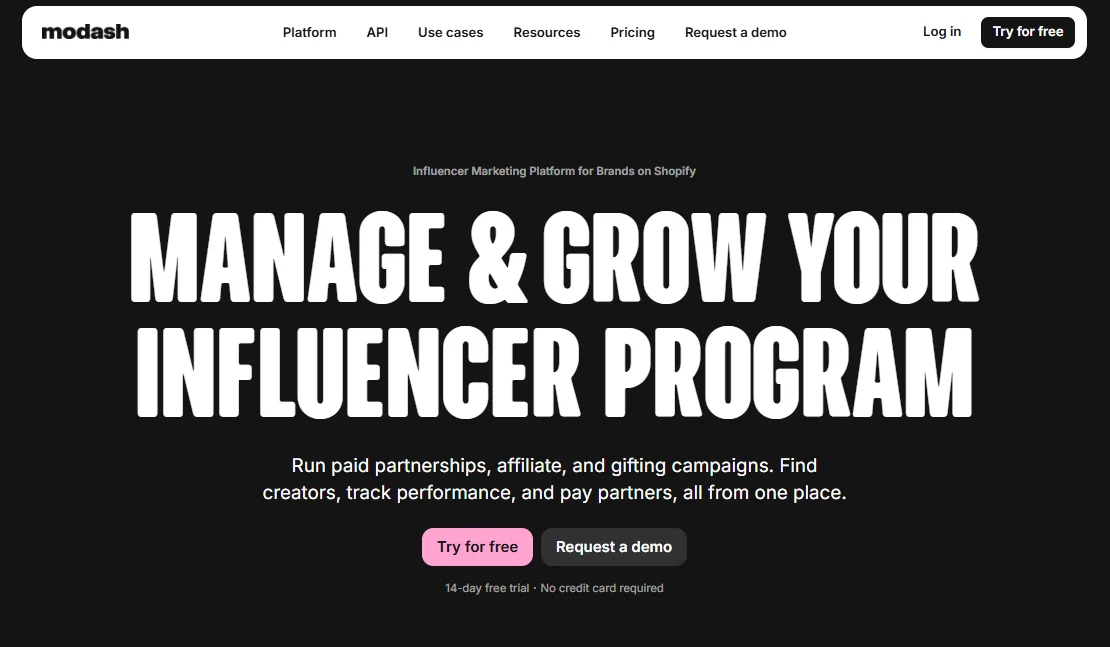
Modash is an influencer marketing platform built around discovery. Founded in 2018 and based in Estonia, it indexes over 350 million public creator profiles across Instagram, TikTok, and YouTube. The pitch is simple: if a creator has a public account, Modash has them, and you can filter your way to the right ones.
The workflow is discovery first, everything else second. You search the database, vet audience quality, unlock verified emails, run outreach from a built-in inbox, and track posts once campaigns go live. Brands like Google, Victoria's Secret, and NordVPN use it, but the core user base is growing B2C and ecommerce brands, especially on Shopify.
AI-Powered Creator Discovery
This is the reason people buy Modash. The database is the biggest in the category by a wide margin, and the AI search lets you describe what you want in plain language rather than stacking filters manually. If you're a furniture brand looking for creators with a specific interior style, that matters more than it sounds. The audience analysis is solid too, with fake follower detection built in, which is the part most brands skip and then regret. If you're still working out what to filter for in the first place, our breakdown on finding the right influencer covers the criteria that actually predict performance.
Shopify and Sales Tracking
Modash includes native Shopify integration on every plan, no upsell. Product gifting, discount codes, and sales attribution all connect back to creator activity. For an ecommerce brand, this is the feature that turns "the post got 40K views" into "the post drove $3,200."
Creator Payments
Payments are bundled into one invoice and go out to creators in 180+ countries, with no commission taken from the creator's payout. On the Performance plan you get 0% fees up to $10,000 in annual payout volume, then 5% above that.
Where Modash Falls Short
Outreach is the weak spot. The inbox has templates and some automation, but it isn't a CRM, and brands running heavy outreach as their primary workflow tend to outgrow it and end up managing relationships somewhere else. The usage limits also bite: 300 profile opens and 150 email unlocks a month on Essentials sounds generous until you realize a single 50-creator shortlist can eat 200 profile opens.
What Is Captiv8?
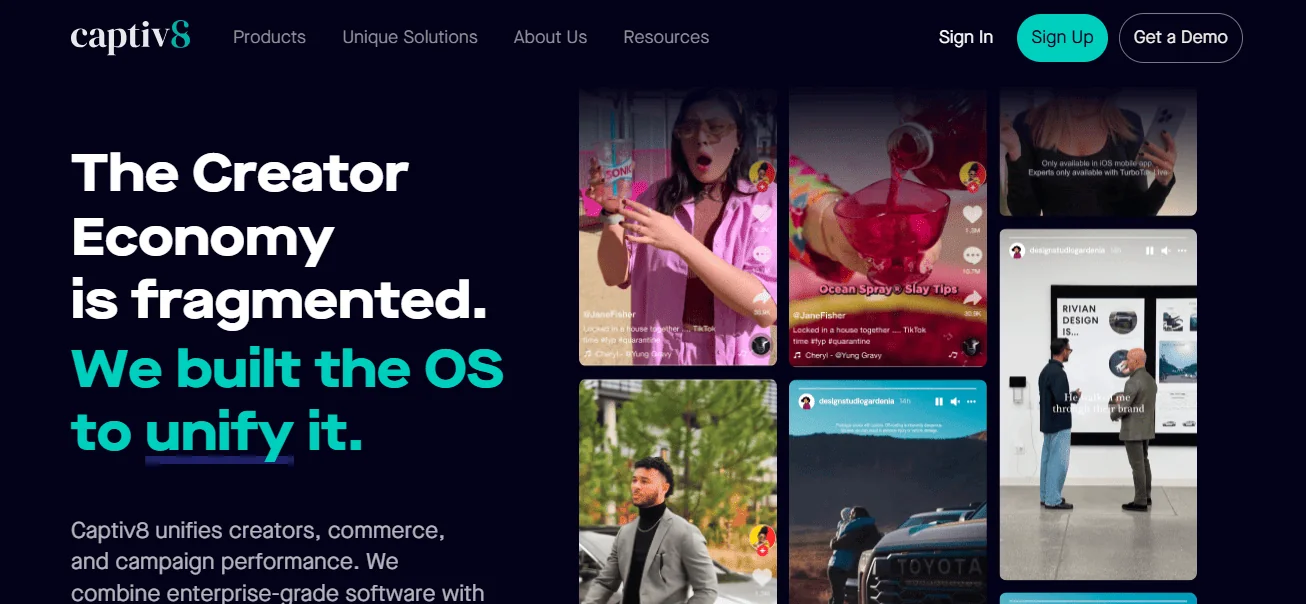
Captiv8 is enterprise influencer marketing software, owned by Publicis Groupe. It started in 2015 as a social listening tool and grew into a full branded content platform. Today it covers 15 million creator profiles across Instagram, TikTok, YouTube, Facebook, Pinterest, Snapchat, X, and Twitch, which is the broadest network coverage of the three.
Its customers are names like Honda and Walmart. The pitch is end-to-end campaign management for large teams: discovery, contracting, content review, paid amplification, payments, and reporting, all with role-based permissions so twelve people can work in the same campaign without stepping on each other.
Social Listening and Audience Insights
This is Captiv8's origin story and still its edge. Insights gives you real-time audience data and lets you run global post search to find creators organically talking about your category, not just creators who match a filter. You get 500+ search filters and the Influencer Velocity Index, a proprietary score that ranks creators by predicted campaign performance instead of follower count. If your team argues about which metrics to report on, our piece on reach vs. impressions is worth passing around before you build the dashboard.
Paid Amplification and Whitelisting
Captiv8 integrates with Meta and TikTok Ads APIs, so you can whitelist creator handles and push their organic posts as paid ads without leaving the platform. For brands treating creator content as ad creative, this closes a real gap.
Enterprise Reporting and Collaboration
Custom dashboards, custom formulas, segmentation by paid versus organic, and shareable reports built in minutes. Combine that with multi-team approval flows and it's clear who this is for. Captiv8 holds a 4.7/5 on G2 across 500+ reviews, one of the higher scores in the category.
Where Captiv8 Falls Short
Price and access. There's no public pricing, no self-serve signup, and no monthly billing. Reviews put the entry point around $25,000 a year plus a $3,000 onboarding fee, on an annual contract. Users also flag a steep learning curve and, more seriously, recurring reports of delayed creator payments, which is the kind of thing that damages your reputation with creators rather than the platform's.
What Is Influencer Hero?
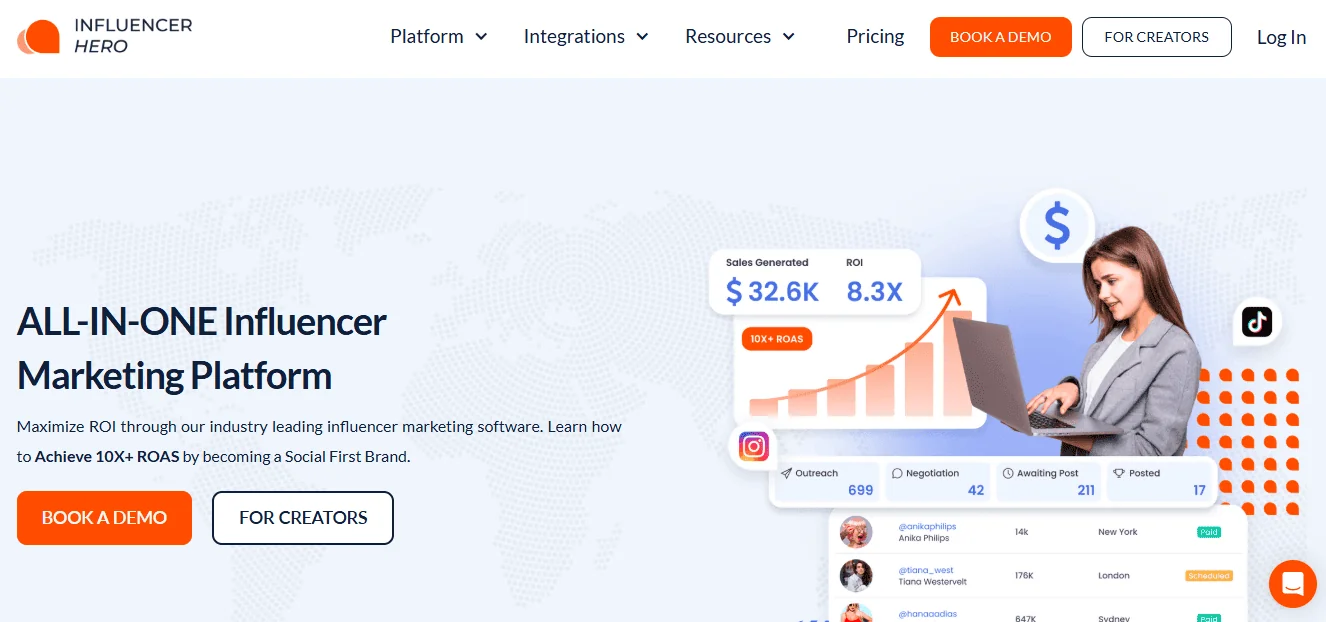
Influencer Hero is an all-in-one influencer marketing platform built for DTC brands and agencies, and it's now part of the Afluencer ecosystem. It covers discovery, outreach, CRM, affiliate tracking, payments, and UGC management in a single system, with a 200M+ creator database across the major networks.
The design philosophy is different from Modash and Captiv8. Modash optimizes for finding creators. Captiv8 optimizes for coordinating large teams. Influencer Hero optimizes for the operational reality of a small DTC team that has to find creators, email 200 of them, track who replied, ship product, collect content, and attribute revenue, all with two people.
Outreach Automation and CRM
Outreach runs as sequenced campaigns with automated follow-ups, and every creator sits in a CRM with their status, history, and content attached. That's the piece Modash brands usually bolt on separately. The automation doesn't replace good writing, though. Our guide to influencer outreach techniques covers the messaging side that no tool will do for you.
Affiliate Tracking Included
Affiliate links, discount codes, and commission tracking are part of the standard product, not a higher tier or an add-on. For brands where the creator program is expected to drive attributable revenue rather than awareness, that's the difference between reporting and guessing.
UGC Content Library
Creator content flows into a central library with usage rights attached, ready to repurpose into ads, product pages, and email. Brands increasingly treat influencer programs as content engines first and reach plays second, and this is built for that.
Where Influencer Hero Falls Short
It's not the cheapest way to test the channel. Standard starts at $649/month, which is real money if you haven't proven influencer marketing works for your brand yet. And if all you need is a database to search once a quarter, you're paying for a lot of workflow you won't touch.
Modash vs. Captiv8 vs. Influencer Hero: Feature-by-Feature Breakdown
Influencer Discovery
Modash wins on raw volume with 350M+ profiles, but only across three networks. Captiv8 covers eight networks with 15M profiles, which is a curated index rather than a scrape, plus the deepest filtering at 500+ options and natural language search via its Perplexity partnership. Influencer Hero sits between them with 200M+ profiles and AI search across the major platforms. The practical question isn't database size, it's whether the creators you need are findable and whether you can tell a good audience from an inflated one. All three handle that. If Instagram is your main channel, our walkthrough on finding influencers on Instagram covers the manual method that still works alongside any of these tools.
Outreach and Communication
This is where the three genuinely diverge. Modash gives you an inbox with templates and light automation. Captiv8 gives you in-platform briefs, partnership terms, and contracts, built for teams negotiating deals rather than sending 300 gifting emails. Influencer Hero gives you sequenced outreach with automated follow-ups and reply tracking. Pick based on whether your bottleneck is volume, negotiation, or both.
CRM and Campaign Management
Captiv8 is the strongest on multi-team coordination, with role-based permissions and approval workflows that exist because Fortune 500 brands need them. Influencer Hero's CRM is built for a smaller team managing many relationships rather than many people managing one campaign. Modash is the lightest here, which is deliberate. If you're not sure which of these you actually need, our list of key questions to ask when choosing a platform is a decent filter before you sit through three demos.
Campaign Tracking and Analytics
Captiv8 goes deepest, with custom formulas and dashboards you can segment however you like. Modash tracks posts and stories across Instagram, TikTok, and YouTube and ties them to Shopify sales, which covers most DTC needs. Influencer Hero tracks content and revenue together with affiliate attribution included at every tier. The gap between them narrows a lot once you're past the enterprise reporting requirement.
Integrations
All three integrate with Shopify. Captiv8 goes further with Amazon, TikTok Shop, Refersion, and the Meta and TikTok Ads APIs for whitelisting. Modash keeps it focused on Shopify. Influencer Hero covers Shopify plus the affiliate and payment infrastructure natively rather than through a partner tool.
Pricing: What You'll Actually Pay
Modash publishes its pricing. Essentials is $199/month on annual billing or $299/month monthly, covering 2 team members, 300 profile opens, 150 email unlocks, and 100 tracked creators. Performance is $499/month annual or $599/month monthly, with 5 seats and higher limits, and it's the tier where affiliate management and payments unlock. Enterprise is custom, with public estimates starting around $14,700/year. There's a 14-day free trial, no card required.
Captiv8 publishes nothing. You book a demo and get a quote. Reviews consistently put the entry point around $25,000/year on an annual contract, plus a $3,000 onboarding fee, with the mid-tier climbing well past that once TikTok Shop and affiliate modules are added. Enterprise deals can run into six figures.
Influencer Hero lists its pricing publicly: Standard at $649/month, Pro at $1,049/month, and Business at $2,490/month. No demo required to see the number, and affiliate tracking is included from the first tier rather than gated behind an upgrade.
Afluencer starts at $49/month for the Marketplace plan, which gets you access to 7,000+ verified, active creators who opted in to hear from brands.
Here's the practical math. If your total monthly influencer budget is $1,500, spending $199 to $649 of it on software means somewhere between 13% and 43% of the budget never reaches a creator. That ratio only makes sense once you know the channel converts for you. Below that threshold, the software is the experiment rather than the campaign, which is backwards.
Which Platform Is Right for You?
Give Captiv8 its due: if you're running multi-market creator programs with a team of five or more, and creator content feeds your paid social spend, nothing on this list matches its reporting depth or its whitelisting workflow. The social listening heritage shows up in insights the other two just don't produce. Modash, meanwhile, is the most efficient discovery engine in the category, and if your gap is genuinely "I can't find the right creators," it solves that at a price that's hard to argue with. The 350M database and the Shopify attribution are a strong pairing for an ecommerce brand that already has outreach handled.
Influencer Hero makes more sense when the bottleneck isn't finding creators, it's everything after that. If your team is small, your outreach volume is high, you need affiliate revenue attributed properly, and you want the resulting content sitting somewhere usable, that whole chain runs in one place here rather than across three tools and a spreadsheet. Publicly listed pricing helps too if you'd rather not sit through a sales call to learn whether you can afford it.
Curious how this plays out in practice? Book a demo with Influencer Hero today.
If you're not at that stage yet, don't force it. Afluencer starts at $49/month and connects you with creators who have already raised their hand to work with brands, which is a very different starting point from cold-emailing a scraped database. Get started on Afluencer and prove the channel before you buy the infrastructure.
The Bottom Line
Three tools, three different problems: Modash solves discovery, Captiv8 solves enterprise coordination, and Influencer Hero solves the messy middle where outreach, affiliate revenue, and content all have to live together. Match the tool to your actual bottleneck and the choice gets a lot easier than any comparison table suggests. If the full DTC workflow is what you're missing, Influencer Hero covers it end to end. And if you're still testing whether influencer marketing earns a line in your budget at all, start on Afluencer from $49/month and let the results make the case.
Frequently Asked Questions
<details class="ih-faq"><summary>Which platform is best for small brands?</summary><div class="ih-faq-a">None of these three, honestly. Modash is the most accessible at $199/month annually, but for brands still testing the channel, that's a big chunk of a small budget. Afluencer at $49/month gets you access to opted-in creators without committing to software you may not need yet.</div></details><details class="ih-faq"><summary>What's the main difference between Modash and Captiv8?</summary><div class="ih-faq-a">Scale and access. Modash is self-serve, publicly priced from $199/month, and built around a 350M creator database for discovery. Captiv8 is demo-only enterprise software running roughly $25K/year, built for large teams that need approval workflows, paid amplification, and custom reporting.</div></details><details class="ih-faq"><summary>Does Modash track affiliate sales?</summary><div class="ih-faq-a">Yes, but not on every plan. Affiliate management unlocks on the Performance annual tier and Enterprise, not on Essentials. Influencer Hero includes affiliate tracking from its Standard tier at $649/month, which matters if commission-based programs are core to how you work with creators.</div></details><details class="ih-faq"><summary>Can I use Afluencer and Influencer Hero together?</summary><div class="ih-faq-a">Yes, and plenty of brands do. Afluencer is where you find and connect with opted-in creators, which works well for gifting and early-stage programs. Influencer Hero handles the workflow once you're running enough campaigns that spreadsheets stop coping. They're part of the same ecosystem.</div></details><details class="ih-faq"><summary>Do any of these platforms have free plans?</summary><div class="ih-faq-a">No. Modash offers a 14-day free trial with no card required. Captiv8 and Influencer Hero both require a paid plan, though Influencer Hero lists its pricing publicly while Captiv8 quotes after a demo. Afluencer's entry plan starts at $49/month.</div></details><script type="application/ld+json">{"@context":"https://schema.org","@type":"FAQPage","mainEntity":[{"@type":"Question","name":"Which platform is best for small brands?","acceptedAnswer":{"@type":"Answer","text":"None of these three, honestly. Modash is the most accessible at $199/month annually, but for brands still testing the channel, that's a big chunk of a small budget. Afluencer at $49/month gets you access to opted-in creators without committing to software you may not need yet."}},{"@type":"Question","name":"What's the main difference between Modash and Captiv8?","acceptedAnswer":{"@type":"Answer","text":"Scale and access. Modash is self-serve, publicly priced from $199/month, and built around a 350M creator database for discovery. Captiv8 is demo-only enterprise software running roughly $25K/year, built for large teams that need approval workflows, paid amplification, and custom reporting."}},{"@type":"Question","name":"Does Modash track affiliate sales?","acceptedAnswer":{"@type":"Answer","text":"Yes, but not on every plan. Affiliate management unlocks on the Performance annual tier and Enterprise, not on Essentials. Influencer Hero includes affiliate tracking from its Standard tier at $649/month, which matters if commission-based programs are core to how you work with creators."}},{"@type":"Question","name":"Can I use Afluencer and Influencer Hero together?","acceptedAnswer":{"@type":"Answer","text":"Yes, and plenty of brands do. Afluencer is where you find and connect with opted-in creators, which works well for gifting and early-stage programs. Influencer Hero handles the workflow once you're running enough campaigns that spreadsheets stop coping. They're part of the same ecosystem."}},{"@type":"Question","name":"Do any of these platforms have free plans?","acceptedAnswer":{"@type":"Answer","text":"No. Modash offers a 14-day free trial with no card required. Captiv8 and Influencer Hero both require a paid plan, though Influencer Hero lists its pricing publicly while Captiv8 quotes after a demo. Afluencer's entry plan starts at $49/month."}}]}</script>