.svg)
.png)
Modash vs Influencer Hero: A Detailed Comparison
Comparison shopping for influencer software is a mess. Half the "reviews" you find are affiliate pages pushing whatever tool pays the biggest commission, and the pricing is buried behind a "book a demo" button. So if you're weighing Modash against Influencer Hero, you deserve a straight answer, not a sales pitch.
Both tools live in the same category but solve slightly different problems. Modash is a discovery powerhouse built around one of the biggest creator databases on the market. Influencer Hero is a full end-to-end platform that takes you from finding creators all the way through outreach, affiliate tracking, and payouts. Which one you need depends less on which is "better" and more on where the bottleneck is in your program right now.
By the end of this you'll know exactly what each platform does well, where each one gets thin, what you'll actually pay, and which fits your brand's stage. If you're earlier in the journey and not ready to commit to a paid tool yet, we'll cover a free starting point too. New to the channel entirely? Start with our guide on getting started with influencer marketing before you spend a dollar on software.
Quick Comparison
What Is Modash?
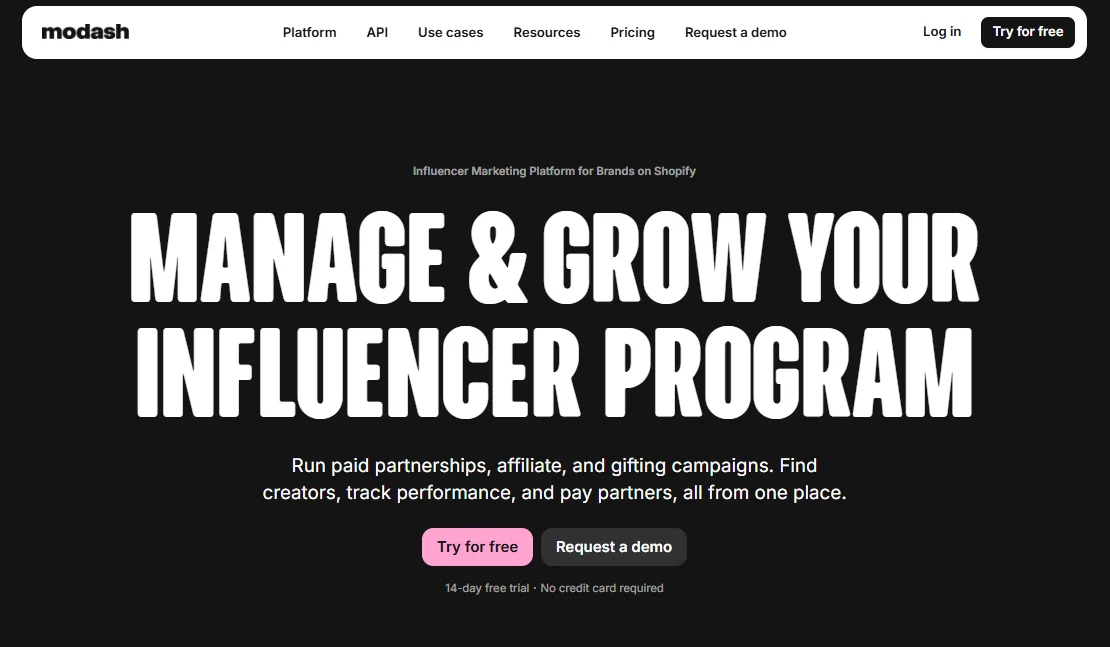
Modash is a creator discovery and campaign tracking platform founded in 2018 and based in Estonia. Its whole reputation is built on the size and quality of its database. It indexes public creator data rather than relying on opt-ins, which means you can surface creators most other tools never see, including tiny nano accounts with a thousand followers.
The typical Modash user is a DTC or ecommerce brand, usually on Shopify, that needs to find and vet a lot of creators quickly and then track what those creators drive in sales. It's used by names like Google, Victoria's Secret, and Airbnb, so it holds up at scale. The workflow is straightforward: search the database, vet the audience, unlock emails, run outreach, and track performance against your Shopify store.
AI-Powered Discovery
This is Modash's headline feature and it earns it. With 350M+ public profiles across Instagram, TikTok, and YouTube, the database is one of the largest in the category. The AI search lets you describe the kind of creator you want in plain language, and filters cover audience demographics, engagement benchmarks, location, niche, and estimated fake-follower percentage. If your single biggest problem is "I can't find enough of the right creators," Modash fixes that fast. For the manual side of the same problem, our breakdown of finding the right influencer pairs well with any discovery tool.
Audience Vetting
Built-in fake-follower detection analyzes audience authenticity so you avoid paying creators with bot-inflated numbers. For brands burned by vanity metrics before, this is a genuine trust-builder and one of the reasons Modash gets recommended for micro-influencer scale.
Shopify Commerce Tracking
Modash's Shopify integration is one of the strongest in the category. It generates discount codes in bulk, syncs them to your store, and pulls sales data back to show revenue and ROAS per creator. For a Shopify brand, that closes the loop from "found the creator" to "here's what they sold."
Where Modash Falls Short
Modash is a discovery engine first, and everything downstream is lighter. Outreach and CRM are functional but shallow, so outreach-heavy or contract-heavy programs tend to outgrow the messaging tools and end up running follow-ups in a separate system. The commerce tracking is also Shopify-only, so if you're on WooCommerce, Magento, or Amazon, a big part of the ROI story disappears. And the profile-analysis caps on lower plans burn faster than you'd expect once you're vetting for multiple campaigns at once.
What Is Influencer Hero?
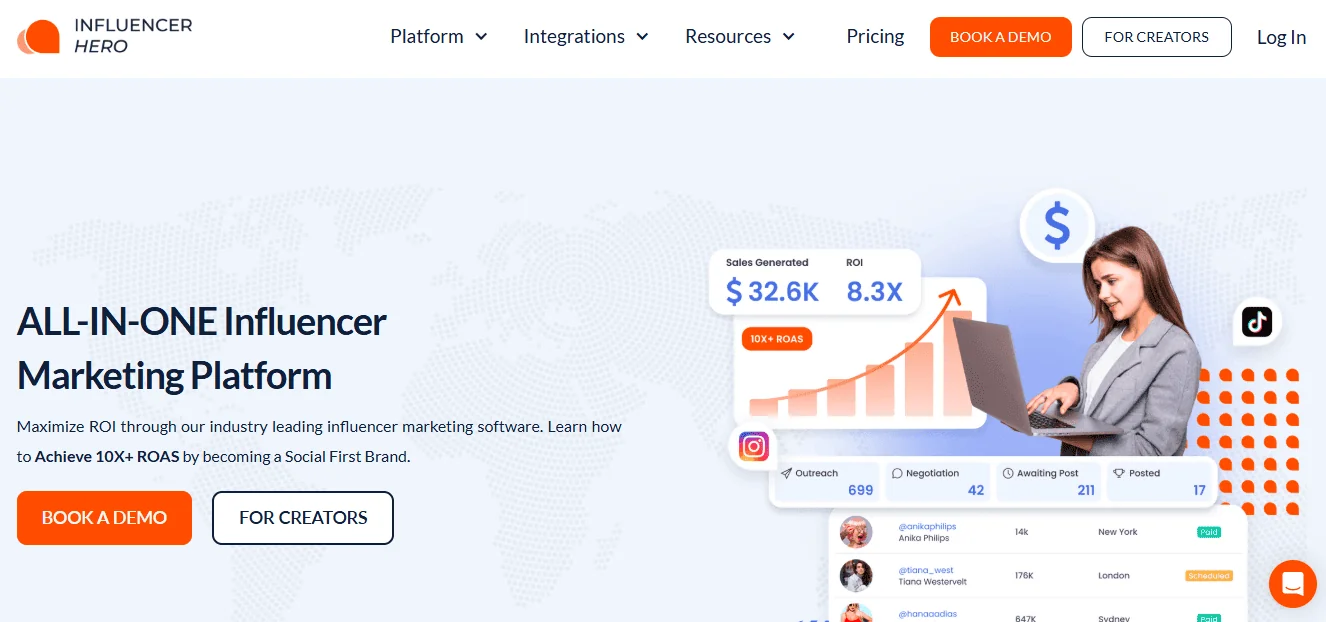
Influencer Hero is an all-in-one influencer marketing platform built for D2C brands, ecommerce teams, and agencies that want to run their entire program in one place instead of stitching together a discovery tool, an outreach tool, an affiliate platform, and a spreadsheet. It's now part of the Afluencer ecosystem, which is worth knowing if you're already inside our world and thinking about scaling up.
Where Modash stops at discovery and tracking, Influencer Hero carries the whole workflow: creator discovery across eight platforms, automated outreach, a CRM where every creator gets a deal page, product gifting, affiliate link and code generation, a UGC library, and ROI reporting. The philosophy is that discovery is only the first step, and the real time-sink is everything that happens after you find someone.
End-to-End Workflow
This is the core difference. Each creator gets a deal page that holds communication history, product send-outs, affiliate links or codes, performance metrics, and collected content in one view. You're not exporting from one tool and importing into another. Once a creator is active, the CRM becomes your system of record. If your program keeps stalling in the handoffs between tools, this is where the hours come back.
Outreach Automation
Outreach is treated as a pipeline, not a one-off blast. Automated drip sequences, AI-assisted personalization, and follow-ups do the heavy lifting while keeping messages human, and deliverability is built into the value prop so your emails actually land. If outreach is your bottleneck, it's worth brushing up on the fundamentals too. Our post on outreach techniques covers what separates a reply from a delete.
Affiliate Tracking and Payouts
Affiliate tracking is a first-class feature here, not an upsell. Brands generate links and discount codes, track conversions, and process creator payouts at scale, and each creator gets a branded dashboard to see their own clicks, conversions, and earnings. That transparency cuts down the reconciliation back-and-forth that eats up affiliate programs.
Broad Integrations
With 40+ integrations spanning Shopify, Amazon, WooCommerce, Magento, Squarespace, Klaviyo, Gmail, Outlook, and Zapier, Influencer Hero runs inside your existing stack instead of forcing you onto one ecommerce platform. For brands that aren't on Shopify, that flexibility is a real advantage.
Modash vs. Influencer Hero: Feature-by-Feature Breakdown
Influencer Discovery
Both platforms are strong here, and it's the closest race. Modash has 350M+ profiles across three networks with excellent AI search and vetting. Influencer Hero has 450M+ across eight platforms, including Facebook, Pinterest, Snapchat, X, and Twitch, plus a "Find Your Fans" feature that scans your own customer list for existing brand fans. If you only care about Instagram, TikTok, and YouTube, Modash's depth is more than enough. If you need creators on the less obvious networks or want to activate people who already buy from you, Influencer Hero covers more ground. Either way, pairing a database with smart filtering beats manual hunting, and our guide to finding influencers on Instagram shows what good filtering looks like in practice.
Outreach and Communication
This is where the two diverge. Modash includes an inbox with templates and basic automation, which works but is designed to keep you from blasting too many creators too fast. Influencer Hero builds its whole model around outreach at volume: drip campaigns, AI personalization, automated follow-ups, and deliverability tooling. If outreach is a side task, Modash is fine. If it's the engine of your program, Influencer Hero is built for it.
CRM and Campaign Management
Modash's relationship management is often described as less deep than dedicated CRM tools. Influencer Hero's deal-page model is the opposite of an afterthought. Every creator interaction, asset, and metric lives in one place, and you can run bulk actions across many deals at once, like emailing every creator over $100 in sales in a single move. For anyone juggling more than a handful of active creators, that difference adds up fast. If you're still deciding what to prioritize in a tool, our list of questions to ask is a good gut-check.
Campaign Tracking and Analytics
Modash's tracking is excellent but tied to Shopify. It reports revenue, ROAS, and EMV per creator by pulling directly from your store. Influencer Hero tracks the same performance data through its own CRM and affiliate system, so attribution isn't dependent on a single ecommerce platform. Both give you clear per-creator ROI. The question is just whether your commerce lives on Shopify or somewhere else.
Integrations
Modash integrates directly with Shopify for commerce workflows and not much beyond that. Influencer Hero connects with 40+ tools across ecommerce, email, affiliate, and workflow categories. If your stack is Shopify and only Shopify, this won't matter to you. If it's anything broader, it matters a lot.
Pricing: What You'll Actually Pay
Modash starts at $199/month on annual billing, or $299/month if you pay monthly, for the Essentials plan. That gets you the full database, AI search, Shopify integration, two team seats, and tracking for up to 100 creators. The Performance plan jumps to $499/month annual ($599 monthly) and adds payments, affiliate management, and higher limits. Enterprise is custom-quoted. There's a 14-day free trial with no credit card, but no free plan after that.
Influencer Hero is publicly listed at $649, $1,049, and $2,490 per month across its tiers. No demo wall to see the price, which is more than you can say for a lot of the category. For that you get the full end-to-end platform, not just discovery, so the comparison isn't quite apples to apples. You're paying for outreach automation, CRM, affiliate tracking, and payouts bundled together rather than assembling them from separate tools.
Afluencer, for context, is free to start. And here's the practical read: if your total monthly influencer budget is under a few hundred dollars, committing $200 to $300 a month just to the software is a big chunk of it before a single creator gets paid. That's exactly why testing the channel free on Afluencer first makes sense before you lock into any paid platform.
Which Platform Is Right for You?
Modash is genuinely excellent at what it's built for. If your single biggest need is discovery, finding and vetting large volumes of creators, especially micro and nano accounts, across Instagram, TikTok, and YouTube, few tools do it better. The database size and audience authenticity checks are best-in-class, and for a Shopify brand that already has outreach and tracking handled elsewhere, it slots in cleanly as the discovery layer.
Influencer Hero makes more sense when the bottleneck isn't finding creators, it's everything after. If your brand needs outreach automation, a real CRM, affiliate tracking, and payouts working together in one workflow, and you don't want that workflow chained to Shopify, that's what Influencer Hero is built to cover end to end. It's less "a better search tool" and more "the whole program in one place," which is the right fit if you're scaling past the point where spreadsheets and separate tools hold up.
Curious how that plays out for your brand? Book a demo with Influencer Hero
And if you're not at the paid-platform stage yet, there's no rush. Afluencer is free to start, which makes it the low-risk way to test whether influencer marketing moves the needle for you before you invest in heavier software.
The Bottom Line
These two tools aren't really competing for the same job. Modash wants to be the best place to find and vet creators, and it largely is. Influencer Hero wants to run your entire program from discovery through payout in one system.
Pick based on where your time actually goes: if it's spent hunting for creators, Modash; if it's spent managing everything after you find them, Influencer Hero has more of that covered in one place.