.svg)
.png)
- Social Cat vs Afluencer: A Detailed Comparison
- Quick Comparison: Social Cat vs Afluencer vs influencer Hero
- What Is Social Cat?
- What Is Afluencer?
- Social Cat vs Afluencer: Feature by Feature
- Pricing: What You'll Actually Pay
- Scaling Beyond the Marketplace: Where Influencer Hero Fits
- Which Platform Is Right for You?
- The Bottom Line
Social Cat vs Afluencer: A Detailed Comparison
Comparison shopping for influencer platforms is exhausting. Every tool's website says the same three things: find creators fast, manage campaigns easily, track results. Then you sign up and find out the "creator database" is 4,000 people in one country, or the tracking is a spreadsheet export.
Social Cat and Afluencer both sit at the accessible end of the market, which is exactly why people compare them. Neither one costs enterprise money. Both connect brands with micro-influencers on Instagram and TikTok. But they work differently underneath, and the difference matters a lot depending on whether you're testing influencer marketing for the first time or already running collabs every month.
This breakdown covers what each platform actually does, where each one gets weak, what you'll really pay, and which one fits your situation right now. If you're brand new to the channel, it's worth reading 5 steps to get started with influencer marketing first so the feature talk lands better.
One note before we start: Afluencer is now part of Influencer Hero, so this comparison also covers what happens when you outgrow a marketplace and need a full campaign workflow.
Quick Comparison: Social Cat vs Afluencer vs influencer Hero
What Is Social Cat?

Social Cat is a micro-influencer marketplace built around gifting. You list a product, creators apply, you approve the ones you like, you ship the product, they post. The whole model is designed for brands that want content and awareness without negotiating four-figure rates with every creator.
The platform focuses tightly on Instagram and TikTok. That's a deliberate choice, not a gap. Social Cat isn't trying to be a discovery engine for YouTube or blogs, it's trying to make product seeding fast for small e-commerce brands. Every creator on the marketplace gets manually vetted before they can apply to campaigns, which cuts down the "is this account real?" problem that eats time on open databases.
Brands pay a flat monthly subscription based on how many collabs they want, plus the cost of whatever products they send. There's no per-creator fee and no commission. Social Cat also added a managed service option, so brands that don't want to run campaigns themselves can hand the whole thing over.
Vetted Micro-Influencer Marketplace
Social Cat's creator pool is manually reviewed, and that review step is the main reason brands stick around. You're not filtering through millions of profiles hoping the engagement is real. You post a campaign, creators apply, and the applicants have already cleared a quality check.
The catch, and it's a fair trade, is that this is an inbound model. You're picking from who applies rather than hunting down a specific creator you already have in mind. For most small brands that's actually faster, since finding the right influencer is usually the step where campaigns stall.
Content Usage Rights Included
Every Social Cat plan includes content usage rights on everything creators produce for you. That's a genuinely good detail. A lot of platforms leave licensing as a separate negotiation, and brands find out after the fact that they can't run a creator's Reel as a paid ad.
With Social Cat, the UGC you collect is yours to reuse across paid social, email and your product pages. For a brand treating gifting as a content engine rather than a reach play, that changes the math on what each collab is worth.
Contracts and Content Library Built In
Contracts, private notes, an inbox, a content library and creator reviews all come standard, even on the $99 plan. You're not paying extra to get the basic operational layer. For a team of one or two people running a handful of collabs a month, that's enough structure to keep things from turning into a mess of DMs and Google Drive folders.
Where Social Cat Falls Short
The ceiling comes fast. Even the $299 Pro plan caps you at 30 collaborations a month, and the platform doesn't do affiliate tracking, discount code attribution or revenue reporting. You'll know how many pieces of content you got, but not how much money the program made. It's also Instagram and TikTok only, so if YouTube or a blog partnership is part of your plan, you're running that separately.
What Is Afluencer?
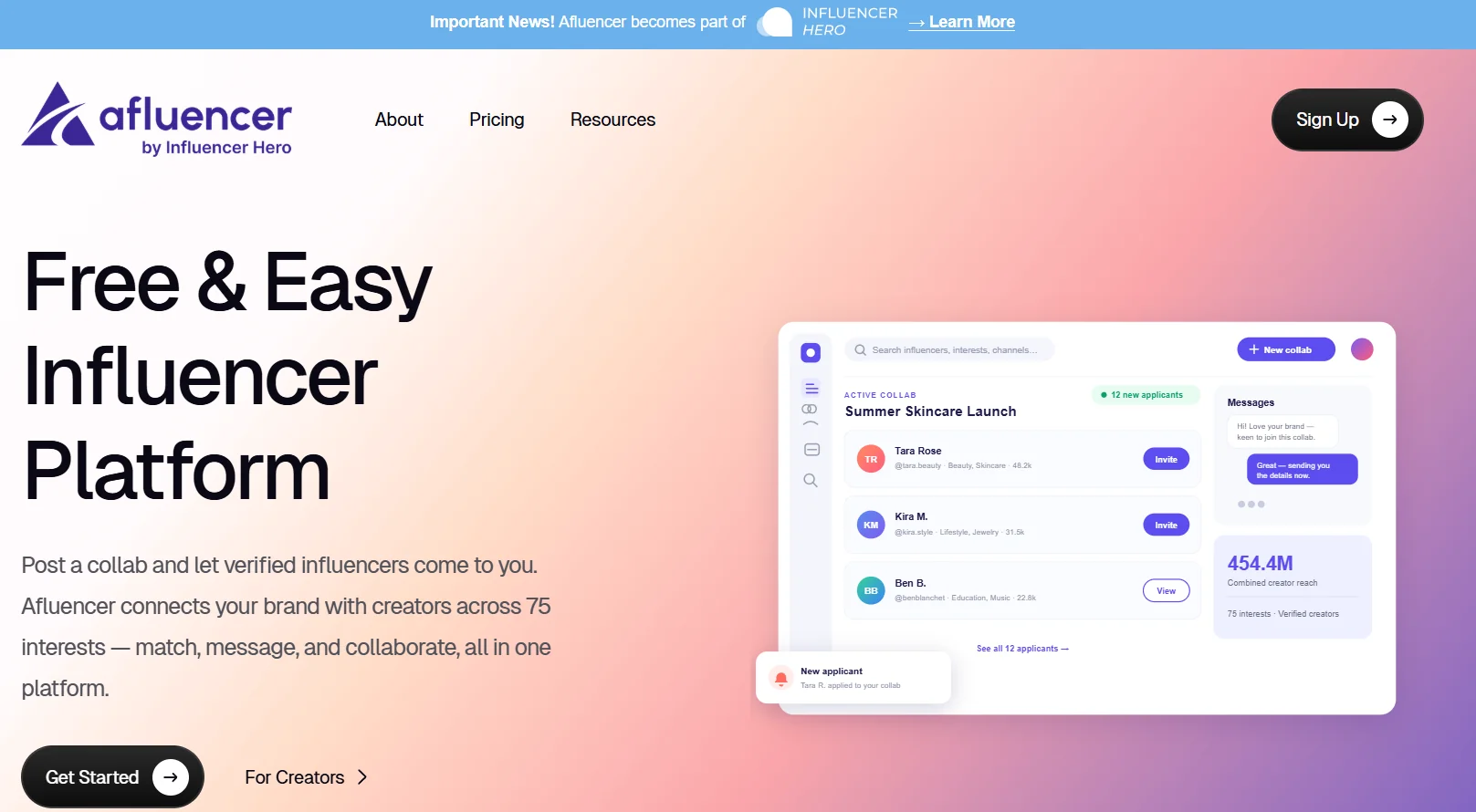
Afluencer is a creator marketplace where brands post Collabs and verified influencers apply to join them. The network is 24,000+ vetted creators across Instagram, TikTok, YouTube and Facebook, and the model is deliberately simple: describe what you want, publish it, review applications, start talking.
The thing that makes Afluencer different from most platforms in this price range is the free entry point. Creators use Afluencer free forever. Brands can post a Collab and start a free trial without putting a card down first, which means you can find out whether creators in your niche are actually interested before you commit to a monthly subscription. That's a real advantage when you're not yet sure influencer marketing is going to work for your product.
Afluencer is now part of Influencer Hero, and that connection matters for the upgrade path. The Marketplace plan at $49/month keeps you in self-serve marketplace mode. From the Standard plan up, you get access to the full Influencer Hero platform, which is where automated outreach, affiliate tracking and payouts live. So you're not switching tools when you scale, you're moving up a tier inside the same ecosystem.
Creators Come to You
Posting a Collab and letting influencers apply flips the hardest part of the process. Instead of sending 200 cold DMs and hearing back from six people, you publish what you're offering and the people who actually want it raise their hand. Interested creators show up already knowing your product, your terms and your compensation.
That's a big deal for smaller brands, because cold outreach response rates are brutal when nobody's heard of you. If you'd rather learn the outbound approach anyway, these influencer outreach techniques cover what actually gets replies.
Genuinely Free to Start
Brands can create a profile, post a Collab and start a free trial without a subscription. Nobody else in this comparison lets you validate demand before paying. You'll find out in a week whether creators in your category respond to your offer, and that's information worth having before you sign up for anything monthly.
Multi-Platform Creator Network
Afluencer covers Instagram, TikTok, YouTube and Facebook rather than locking you into two channels. If your product does better in long-form (skincare routines, tech unboxings, anything that needs explaining), having YouTube creators in the same pool matters. It also means you're not running a separate process for each platform.
Built-In Filters and Direct Messaging
Premium filters on the paid plans let you narrow by niche, audience size, location and channel, and you message creators directly inside the app. There's also a Shopify app and a BigCommerce app if you want collabs connected to your store. Small brands especially benefit from the micro-influencer skew of the network, where engagement tends to beat reach.
Where Afluencer Falls Short
On the Marketplace plan, Afluencer is a marketplace, not a campaign management system. There's no affiliate tracking, no automated outreach sequences and no revenue attribution at that tier. You get discovery, messaging and Collab management, and you handle reporting yourself. That's fine when you're running four collabs a quarter. It stops being fine when you're running forty.
Social Cat vs Afluencer: Feature by Feature
Influencer Discovery
Both platforms are inbound-first, but the pools are shaped differently. Social Cat gives you a larger vetted pool (100K+ creators, with search across a much wider set of profiles) concentrated on Instagram and TikTok. Afluencer's network is smaller at 24,000+ but spans four channels including YouTube and Facebook.
Neither runs AI-powered search. You're filtering and reviewing applications, not asking a model to find lookalikes of your best performer. If AI matching is a requirement, that's an Influencer Hero feature, not something you'll find at this price point.
Outreach and Communication
Social Cat gives you monthly invitation credits (1,000 on Essentials, up to 5,000 on Pro) plus an inbox and private notes. Afluencer gives you invitation credits on paid plans (60/month on Marketplace) plus direct in-app messaging.
The numbers look wildly different, but they're measuring different things. Social Cat invitations are lightweight nudges into a large pool. Afluencer's credits are aimed at a more targeted list. What matters more is that neither one automates follow-ups. If a creator doesn't reply, you're the one remembering to chase them. Automated sequences start at the Influencer Hero tier.
CRM and Campaign Management
Social Cat is stronger here at the low end. Contracts, content library, creator reviews and campaign limits are all built into every plan, and the Pro tier gives you 10 team seats. Afluencer's Marketplace plan keeps campaign management lighter, focused on posting Collabs and managing applicants.
The gap closes fast on the Afluencer side once you move to Standard, which unlocks the full Influencer Hero CRM: deal pages per creator, status tracking, product send-outs and payment handling. Before you commit either way, these questions to ask when choosing an influencer marketing platform are worth running through.
Campaign Tracking and Analytics
This is where both marketplaces show their limits. Social Cat tracks collab status and collects content. Afluencer's Marketplace tier tracks Collab activity. Neither one attributes revenue to a specific creator, generates trackable affiliate links or tells you your cost per acquisition.
If proving ROI is the point of the program, both will frustrate you eventually. Influencer Hero handles this layer with affiliate links, discount codes, real-time conversion tracking and per-creator revenue reporting. Worth knowing the difference between reach and impressions too, since marketplace-level reporting mostly gives you the softer metrics.
Integrations
Social Cat integrates with Shopify for gifted and paid campaigns. Afluencer has both a Shopify app and a BigCommerce app. Influencer Hero goes wider with Shopify, WooCommerce, Magento and BigCommerce, plus email and DM connectivity, which matters if your store isn't on Shopify.
Pricing: What You'll Actually Pay
Social Cat runs $99/month for Essentials (5 collabs, 1 campaign, 1 seat), $199/month for Performance (15 collabs, 3 campaigns, 5 seats) and $299/month for Pro (30 collabs, unlimited campaigns, 10 seats and priority support). Annual billing gets you two months free. There's a 7-day free trial and no long-term contract. Add the cost of products you ship on top.
Afluencer starts free. Creators pay nothing on the Micro plan, and brands can post a Collab and run a free trial before paying. Paid brand plans start at $49/month for Marketplace (60 invitation credits, premium filters, phone and live chat support). Standard is $649/month and Pro is $1,049/month, and both of those unlock the Influencer Hero platform underneath, with 1,000 and 5,000 reach outs a month respectively.
Here's the practical bit. If your entire influencer budget is $1,000 a month including product costs and creator fees, spending $299 of it on Social Cat's Pro plan means nearly a third of your budget goes to software before a single creator gets paid. At $99 you're capped at five collabs a month, which is a slow way to learn what works. Starting free on Afluencer lets you find out whether creators want to work with you at all, then put the money into the collabs instead of the subscription. Once the program's earning, upgrading makes sense.
Scaling Beyond the Marketplace: Where Influencer Hero Fits
Afluencer is part of Influencer Hero, so there's a clear next step when a marketplace stops being enough. From the Standard plan up, you also get the full Influencer Hero platform.
That's where things scale for brands running serious creator volume: AI-powered discovery across Instagram, TikTok and YouTube, automated multi-step outreach sent from your own domain, a full creator CRM, gifting connected to your store, affiliate links that attribute sales to individual creators, and creator storefronts. You get the end-to-end setup you'd expect from an enterprise platform, but built around driving revenue instead of measuring earned media value.
Pricing is public too. Standard is $649 per month, Pro is $1,049 and Business is $2,490, so you don't need to sit through a sales call or sign an annual contract just to find out what it costs. If you want to see how affiliate tracking and outreach automation would work with your store, book a demo.
Which Platform Is Right for You?
Social Cat is genuinely good at the thing it's built for. If your goal is a steady stream of licensed UGC from vetted micro-creators on Instagram and TikTok, and you want contracts and content rights handled without a separate legal conversation, it does that cleanly at a predictable price. The included usage rights on every plan are better than what a lot of pricier platforms offer, and the manual vetting saves real hours. For gifting-led brands running under 30 collabs a month, it's a solid fit.
Where the picture shifts is when the program stops being about content volume and starts being about revenue. If you need automated outreach sequences that follow up on their own, affiliate links and discount codes tied to each creator, commission payouts, a CRM that tracks every relationship from first contact to repeat collab, and reporting that ties creator activity to actual sales, Influencer Hero covers that end to end. It makes more sense when you're managing dozens of creator relationships at once and need to know which ones are worth renewing.
Curious how that looks with your product and your store? Book a demo with Influencer Hero.
And if you're not there yet, don't force it. Afluencer is the free way to find out whether this channel works for your brand before anything monthly hits your card. Post a Collab, see who applies, run a few gifted partnerships and learn what your creators actually respond to. The Afluencer 101 guide for brands walks through the setup, and why brands starting small need influencers is a good read if you're still deciding whether it's worth the effort. Start free on Afluencer.
The Bottom Line
These two platforms solve different halves of the same problem. Social Cat solves "I need licensed content from vetted creators and I don't want to negotiate," and it solves that well. Afluencer solves "I don't know if influencer marketing works for my brand yet and I'm not paying to find out," which is the question most brands are actually asking first.
Brands that need the full workflow, outreach automation, affiliate tracking, payouts and revenue reporting in one place, will end up looking at Influencer Hero sooner or later. But there's no reason to start there. Sign up on Afluencer for free, post a Collab, and let the results tell you what you need next.
Frequently Asked Questions
<details class="ih-faq"><summary>Which is better for small brands, Social Cat or Afluencer?</summary><div class="ih-faq-a">It depends on your budget and stage. Afluencer is free to start, so brands testing influencer marketing can post a Collab and see who applies before paying anything. Social Cat starts at $99/month and is better once you know you want consistent gifted UGC every month.</div></details><details class="ih-faq"><summary>What's the main difference between Social Cat and Afluencer?</summary><div class="ih-faq-a">Social Cat is a paid gifting marketplace focused on Instagram and TikTok with content rights included on every plan. Afluencer is a free-to-start Collab marketplace covering four channels, with an upgrade path into the Influencer Hero platform for brands that need automation and tracking.</div></details><details class="ih-faq"><summary>Does Social Cat track affiliate sales?</summary><div class="ih-faq-a">No. Social Cat handles collab management, contracts and content collection, but it doesn't generate affiliate links, track discount codes or attribute revenue to individual creators. If you need to prove ROI per creator, you'll need a platform with built-in affiliate tracking like Influencer Hero.</div></details><details class="ih-faq"><summary>Can I use Afluencer and Influencer Hero together?</summary><div class="ih-faq-a">Yes, and that's the intended path. Afluencer is part of Influencer Hero, so the Marketplace plan handles discovery and Collabs, and the Standard plan and up unlock the full Influencer Hero platform with outreach automation, affiliate tracking and payouts. Same ecosystem, no migration.</div></details><details class="ih-faq"><summary>Do these tools have free plans?</summary><div class="ih-faq-a">Afluencer does. Creators use it free forever, and brands can post a Collab and start a free trial without paying. Social Cat has a 7-day free trial but no free tier. Need help writing your Collab brief?<a href="https://creatorgpt.ai" target="_blank"> </a><a href="https://creatorgpt.ai" target="_blank">CreatorGPT</a> can draft it for you.</div></details><script type="application/ld+json">{"@context":"https://schema.org","@type":"FAQPage","mainEntity":[{"@type":"Question","name":"Which is better for small brands, Social Cat or Afluencer?","acceptedAnswer":{"@type":"Answer","text":"It depends on your budget and stage. Afluencer is free to start, so brands testing influencer marketing can post a Collab and see who applies before paying anything. Social Cat starts at $99/month and is better once you know you want consistent gifted UGC every month."}},{"@type":"Question","name":"What's the main difference between Social Cat and Afluencer?","acceptedAnswer":{"@type":"Answer","text":"Social Cat is a paid gifting marketplace focused on Instagram and TikTok with content rights included on every plan. Afluencer is a free-to-start Collab marketplace covering four channels, with an upgrade path into the Influencer Hero platform for brands that need automation and tracking."}},{"@type":"Question","name":"Does Social Cat track affiliate sales?","acceptedAnswer":{"@type":"Answer","text":"No. Social Cat handles collab management, contracts and content collection, but it doesn't generate affiliate links, track discount codes or attribute revenue to individual creators. If you need to prove ROI per creator, you'll need a platform with built-in affiliate tracking like Influencer Hero."}},{"@type":"Question","name":"Can I use Afluencer and Influencer Hero together?","acceptedAnswer":{"@type":"Answer","text":"Yes, and that's the intended path. Afluencer is part of Influencer Hero, so the Marketplace plan handles discovery and Collabs, and the Standard plan and up unlock the full Influencer Hero platform with outreach automation, affiliate tracking and payouts. Same ecosystem, no migration."}},{"@type":"Question","name":"Do these tools have free plans?","acceptedAnswer":{"@type":"Answer","text":"Afluencer does. Creators use it free forever, and brands can post a Collab and start a free trial without paying. Social Cat has a 7-day free trial but no free tier. Need help writing your Collab brief? CreatorGPT can draft it for you."}}]}</script>