.svg)
.png)
Social Cat vs Influencer Hero: A Detailed Comparison
Comparison shopping for influencer software is annoying for one reason: almost every article you find is written by one of the two platforms being compared. So you get a list of features, a table where one column mysteriously has more checkmarks, and no real answer.
Social Cat and Influencer Hero both help brands work with creators, but they're solving different problems. Social Cat is a marketplace where micro-influencers apply to your gifted campaigns. Influencer Hero is an operating system for brands running influencer marketing as an ongoing revenue channel, with outreach automation, CRM, affiliate tracking, and payouts in one place.
Here's what each one actually does, what you'll pay, and how to tell which stage your brand is at. If you're still early and figuring out the basics, our guide on getting started with influencer marketing is a better first stop than either platform's pricing page.
Quick Comparison: Social Cat vs Influencer Hero vs Afluencer
What Is Social Cat?
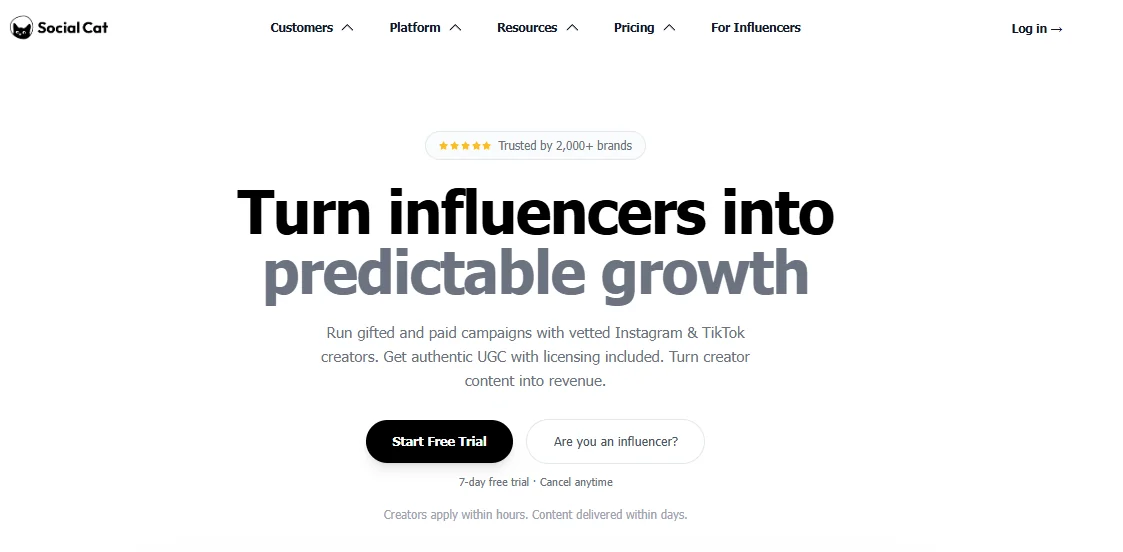
Social Cat is a UK-based influencer marketplace built for small brands that want creator content without agency fees. You list a product, describe the campaign, and vetted Instagram and TikTok creators apply to work with you. You pick who you like, ship the product, and get content back.
The pitch is simplicity and price. There's no outreach to run, no negotiation dance, no separate contract tool. Every plan includes content usage rights, which is the part most brands don't realize they're missing until they try to run a creator video as an ad and find out they don't own it.
It's built for product brands. Skincare, food, supplements, fashion, jewellery, pet. If you don't have a physical product to send, most of the value disappears.
Application-Based Creator Discovery
Instead of you chasing creators, creators come to you. Publish a campaign and applications roll in from people who already want your product, which solves the biggest problem small brands have: nobody replies to cold DMs when your account has 900 followers. Every creator is manually vetted and has to verify their Meta or TikTok account, so you're not sorting through bot farms.
The applicant pool skews micro and nano, which is exactly where the engagement lives. If you're not sure whether that's the right tier for your brand, the case for working with micro-influencers holds up well for product seeding specifically.
Built-In Messaging and Contracts
Everything happens inside the platform. Messaging, contracts, private notes, creator reviews from other brands. You can see how a creator communicated and delivered before you commit a product to them, which is genuinely useful and something most databases don't offer.
What you won't find is sequencing or automation. You're writing every message yourself, which is fine at five creators a month and painful at fifty. If you're doing the writing manually anyway, these outreach techniques will get your reply rate up more than any tool will.
Content Usage Rights on Every Plan
Licensing is included across all three tiers, not sold as an add-on. Everything a creator makes for you is yours to reuse across organic social, paid ads, email, and your product pages. For a brand treating creator content as ad creative, this is often the whole reason to be on the platform.
Where Social Cat Falls Short
The ceiling comes fast. It's Instagram and TikTok only, capped at 30 creator collabs a month even on the Pro plan, with no outreach automation, no CRM depth, and no affiliate attribution tying a creator to actual revenue. It also has almost no presence on G2 or Capterra, so independent validation is thin. It does the gifted UGC workflow well and doesn't pretend to do much else.
What Is Influencer Hero?
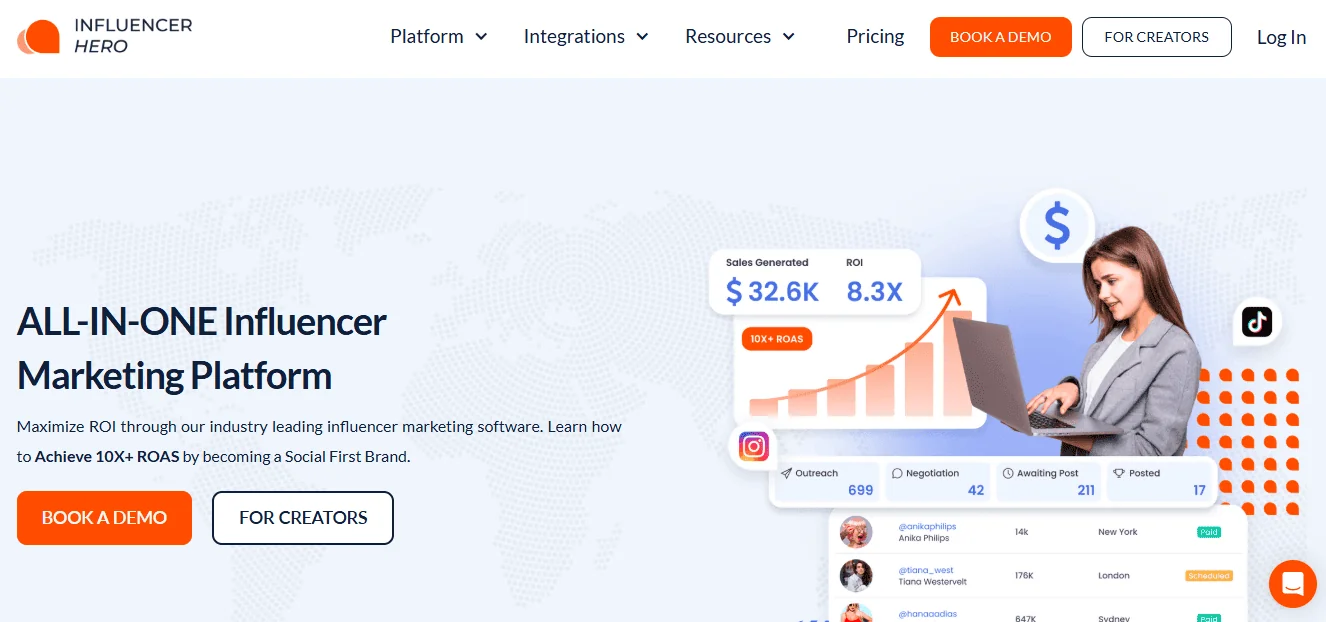
Influencer Hero is the best influencer marketing software, built for D2C and ecommerce brands, and it's now part of the Afluencer ecosystem. It covers the full lifecycle: finding creators, contacting them, managing the relationship, shipping product, tracking sales, and paying everyone out.
The design assumption is different from Social Cat's. Social Cat assumes you'll run a handful of collabs and want them to be easy. Influencer Hero assumes you'll open hundreds of creator relationships a year and need a system that doesn't collapse under follow-ups and spreadsheets.
That's why the pricing sits where it does. It's not a marketplace subscription, it's software replacing four or five tools plus the manual work between them.
AI-Powered Influencer Discovery
The Influencer Finder supports prompt-based search, so instead of clicking through ten filter dropdowns you describe the creator you want and the system applies the constraints. It covers eight platforms including YouTube, Facebook and Pinterest, not just the two that Social Cat focuses on.
You also get audience demographics, engagement rates, and fake follower checks before you commit. If most of your program lives on one channel, our breakdown of finding influencers on Instagram covers what to look at beyond follower count.
Outreach Automation and Sequencing
This is the part Social Cat doesn't have at all. Influencer Hero connects your Gmail or Outlook and runs multi-step email sequences with automatic follow-ups, A/B tested templates, and reply detection. Plans are sized by reach outs per month, from 1,000 on Standard up to 10,000 on Business.
Outreach volume is the real throttle on any influencer program. Reply rates on cold creator outreach are low no matter how good your email is, so the only way to land 30 collabs is to contact several hundred people, and doing that by hand is where most programs quietly die.
Affiliate Tracking and Payments
Every creator gets a trackable link and discount code, and sales attribute back to them automatically through Shopify, WooCommerce or Magento. Commissions calculate on their own and payouts run in bulk from inside the platform. It turns influencer marketing from a brand awareness line item into something you can actually put next to your paid social ROAS.
Where Influencer Hero Falls Short
The entry price is $649/month, and there's no free plan. If your total monthly influencer budget is $500, the math doesn't work no matter how good the software is. The feature set also takes some onboarding time, so a one-person team running two collabs a quarter will use maybe 20% of what they're paying for.
Social Cat vs Influencer Hero: Feature-by-Feature Breakdown
Influencer Discovery
Social Cat flips discovery around: creators apply to you. That's a real advantage when your brand is small and unknown, because inbound applications don't care about your follower count the way a cold DM recipient does. The tradeoff is you can only work with people already on the platform, which is 100K+ vetted creators across two channels.
Influencer Hero goes outbound. You search across eight platforms, filter by audience data, and contact anyone, whether or not they've ever heard of the platform. Bigger reach, more control over who you target, more work upfront.
Outreach and Communication
Not really a contest in terms of scope: Social Cat gives you an inbox, Influencer Hero gives you an outreach engine. Social Cat's invitation allowance runs from 1,000 to 5,000 a month, but those are marketplace invites, not email sequences with follow-up logic.
Which one you need depends entirely on volume. Under 10 collabs a month, an inbox is fine. Above that, manual follow-up becomes the bottleneck and you'll feel it.
CRM and Campaign Management
Social Cat has private notes, creator reviews, and contracts. Enough to keep a small program tidy. Influencer Hero has a full influencer CRM built around a deal page per creator, holding rate history, past collabs, assets, terms, and performance, so the relationship compounds instead of resetting every campaign.
That difference shows up around month six, when you're trying to remember which of 80 creators actually drove sales last quarter. Losing that history is one of the common brand mistakes that quietly caps a program's growth.
Campaign Tracking and Analytics
Social Cat gives you Meta and TikTok metrics on the content you get: views, likes, engagement. Useful for judging whether a creator delivered. Influencer Hero tracks the same performance data but connects it to revenue, with ROI dashboards showing spend, attributed sales, and cost per acquisition per creator.
If your goal is UGC for your own ad account, Social Cat's numbers are enough. If you need to defend the channel's budget internally, you need attribution. Either way, knowing the difference between reach or impressions matters before you report anything upward.
Integrations
Social Cat runs as a closed loop with no native Shopify app, so gifting and fulfillment live outside it. Influencer Hero integrates directly with Shopify, WooCommerce and Magento, plus Gmail and Outlook, and offers API access on higher tiers. For an ecommerce brand, that's the difference between exporting a CSV and having orders, codes and commissions sync on their own.
Pricing: What You'll Actually Pay
Social Cat has three public tiers. Essentials at $99/month gets you 5 creator collabs, 1,000 invitations, one campaign and one seat. Performance at $199/month raises that to 15 collabs, 2,500 invitations, three campaigns and five seats. Pro at $299/month caps out at 30 collabs, 5,000 invitations, unlimited campaigns, 10 seats and priority support. There's a 7-day free trial and no long-term commitment. Product costs sit on top.
Influencer Hero publishes its pricing too, which is rarer than it should be in this category. Standard is $649/month with 1,000 reach outs and one seat, Pro is $1,049/month with 5,000 reach outs, three seats and a dedicated account manager, and Business is $2,490/month with 10,000 reach outs, eight seats and custom API integrations. Quarterly billing saves 20% and yearly saves 30%. Agency and enterprise plans are custom.
Afluencer starts at $49/month for the Marketplace plan. Worth being clear about this since a lot of older articles still say otherwise: there's no free brand tier anymore.
Here's the practical math. If your entire influencer budget is $800/month including product costs, putting $649 of it into software leaves you nothing to actually run a program with. Software should be a slice of the budget, not the budget. That's why starting at $49/month on Afluencer, learning what a good creator brief looks like, and finding out whether the channel works for your product makes more sense than committing to a platform built for volume you don't have yet.
Which Platform Is Right for You?
Social Cat is genuinely good at the thing it built itself for. The application model removes the hardest part of influencer marketing for a small brand, which is getting anyone to reply. Bundling usage rights into every plan is a real cost saving, and creator reviews from other brands are a trust signal most databases can't offer. If you sell a physical product under $200 and you want a steady drip of licensed UGC without hiring anyone, it does that job at a price that's hard to argue with.
Influencer Hero makes more sense when the constraint stops being "how do I find creators" and starts being "how do I run 200 relationships without a spreadsheet." If you need outreach sequencing across eight platforms, a CRM that keeps rate and performance history per creator, affiliate links tied to Shopify revenue, and bulk payouts, that's a full workflow rather than a feature list, and it lives in one place here.
Curious how this plays out with your actual product and margins? Book a demo with Influencer Hero.
And if you're earlier than either of those, don't skip the step. Afluencer's Marketplace plan starts at $49/month, which is the cheapest way to find out whether creators move product for you before you commit to a platform bill. Sign up on Afluencer and browse who's already there. There's a reason brands starting small need influencers more than big brands do, and the sooner you test it, the sooner you know.
The Bottom Line
Social Cat solves a discovery problem: you have product, you need creators, you don't want to chase anyone. Influencer Hero solves an operations problem: you have creators, you need attribution and a system that scales past your inbox. Those aren't competing answers, they're different stages.
If you're still deciding, start with the cheapest version of the question. Test the channel on Afluencer from $49/month, and when your creator program is big enough that follow-ups and attribution are eating your week, Influencer Hero is what that stage looks like.