.svg)
.png)
- Sprout Social vs Influencer Hero: A Detailed Comparison
- Quick Comparison: Sprout Social vs Influencer Hero vs Afluencer
- What Is Sprout Social?
- What Is Influencer Hero?
- Sprout Social vs. Influencer Hero: Feature-by-Feature Breakdown
- Pricing: What You'll Actually Pay
- Which Platform Is Right for You?
- The Bottom Line
Sprout Social vs Influencer Hero: A Detailed Comparison
Here's the thing most people don't find out until they're on the sales call: paying for Sprout Social does not get you Sprout Social's influencer marketing.
The influencer platform is a separate product with separate pricing, sold on top of whatever you're already paying per seat. Plenty of brands go into that conversation assuming creator discovery is bundled with the plan they've been using to schedule posts, and it isn't.
That single fact reshapes this whole comparison. Sprout Social is a social media management platform that added influencer marketing. Influencer Hero is an influencer marketing platform, full stop. Whether the first one makes sense for you depends almost entirely on whether you already need the social suite underneath it.
Below is what each one includes, what the real annual number looks like, and how to figure out which side of that line you're on. If you're earlier in the process, our list of questions to ask when choosing an influencer marketing platform will save you a few discovery calls.
Quick Comparison: Sprout Social vs Influencer Hero vs Afluencer
What Is Sprout Social?
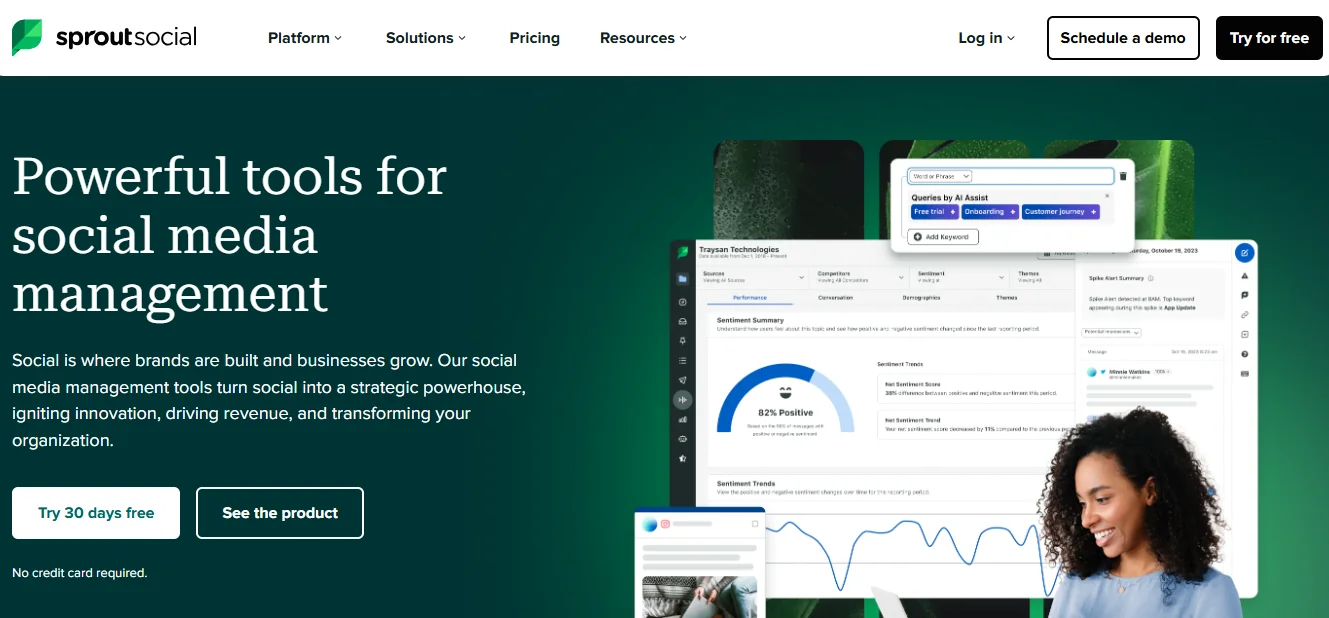
Sprout Social is one of the best known social media management platforms in the world. Publishing, scheduling, inbox management, social listening, reporting. If your team runs organic social at any scale, you've either used it or evaluated it.
The influencer side came from Tagger Media, which Sprout acquired in August 2023 for $140 million and has since rebranded as Sprout Social Influencer Marketing. Tagger was a serious standalone platform before the acquisition, and that pedigree shows. It was named a Leader in the 2025-26 IDC MarketScape for influencer marketing platforms serving large enterprises, which is not a badge you get for a bolt-on feature.
The natural customer is a brand already running publishing, listening and reporting through Sprout, where adding creator campaigns to the same environment removes a login and unifies the reporting. If that's your setup, this is a strong argument. If you'd be buying Sprout purely to reach the influencer module, the math gets harder fast.
Topic-Led AI Discovery
Rather than making you guess at filter combinations, the search works semantically by topic across a very large index of social accounts. You describe the space you're in, it surfaces creators genuinely operating there, and Creator Suggestions then finds more like the ones you shortlist. If most of your sourcing happens on one platform, our guide on finding the right influencers on Instagram covers the manual approach worth knowing anyway.
Brand Fit Score and Safety Vetting
Every creator gets scored against your brand values, with a brand safety report reviewing their content history for anything that could turn into a problem. For a large brand with legal and comms stakeholders in the approval chain, this is the feature that gets the tool approved internally. It's one of the strongest brand safety implementations in the category.
Workspaces for Complex Teams
You can segment campaigns by brand, region, product or team, with workspace-specific safety rules, scoring and creator lists. Agencies managing multiple clients, and global brands running different rules in different markets, get real value from this. Most mid-market tools have nothing comparable.
Recruit Pages for Inbound Creators
Branded application pages let creators apply to you instead of you chasing all of them. Building an inbound funnel is the least talked about upgrade in influencer marketing, because the creators who raise their hand tend to convert better than the ones you cold email. Pairs well with our post on why micro-influencers are worth the effort, since inbound skews micro.
Enterprise-Grade Reporting
EMV, competitive benchmarking, real-time dashboards and stakeholder-ready exports. If your monthly report goes to a CMO who wants creator performance sitting beside organic social and paid, the unified reporting is the actual product you're buying.
Where Sprout Social Falls Short
Cost structure is the main one. Reported pricing puts two seats on the influencer module around $2,200/month with a twelve month minimum, roughly $26,400 committed before your first outreach email, and that sits on top of core Sprout seats running $199 to $399 per user per month. There's also no native UGC rights management, so licensing creator content for paid ads still means negotiating contracts manually. And gifting and affiliate workflows lean heavily toward Shopify, which leaves WooCommerce, Magento and custom storefronts with a thinner experience.
What Is Influencer Hero?
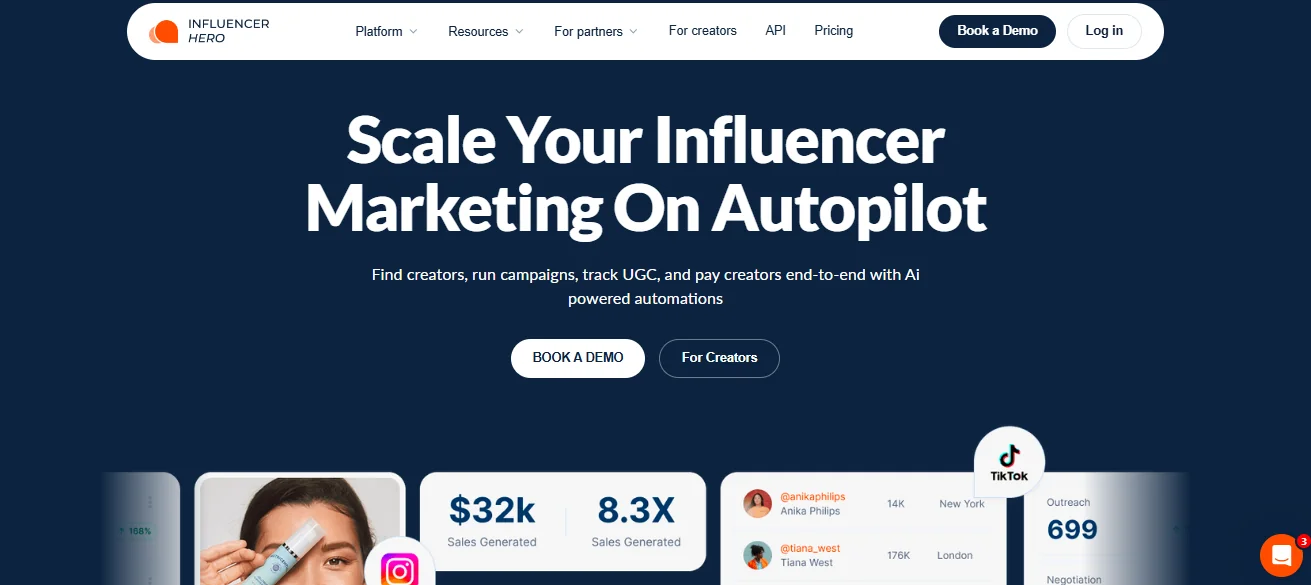
Influencer Hero is an all-in-one influencer marketing platform built for DTC brands and agencies that run creator programs as a revenue channel. It's part of the same family as Afluencer now, so the marketplace and the software feed each other rather than competing.
There's no social media scheduler, no publishing calendar, no community inbox. That's intentional. Everything the platform does sits inside the creator lifecycle: discovery across 450M+ profiles on eight platforms, AI outreach, CRM, gifting and seeding, contracts, UGC collection and reuse, affiliate links and codes, payments, and revenue attribution per creator.
The day-to-day looks like this. Search in plain language, shortlist, launch a sequence that follows up on its own, move responders into the CRM, ship product, generate their code, collect the content into a library you can actually license from, and watch which creators drive orders. If your current version of that involves a spreadsheet and a lot of tab switching, that's the pitch.
Outreach That Runs Without You
Sprout gives you Gmail integration, proposal templates and conversation tracking, which is solid but still fundamentally manual. Influencer Hero sends AI-personalized sequences with automated follow-ups and tracks response rates per sequence. Since most creator replies come on touch two or three, automating that step tends to move response rates more than anything else you can change. Worth reading alongside our influencer outreach techniques so the copy pulls its weight.
UGC Rights and Reuse Built In
This is the gap Sprout openly has. Influencer Hero collects creator content into a library, categorizes what performs, and handles reuse with creator consent so you can push winning UGC into paid without a separate contract negotiation each time. For DTC brands treating creator content as ad creative, that's not a nice-to-have.
Ecommerce Coverage Beyond Shopify
Shopify, WooCommerce, Magento, BigCommerce and Prestashop natively, plus Klaviyo, Mailchimp, Omnisend, Brevo and GetResponse on email, and Slack, Zapier, Gorgias and Docusign around the edges. If you're not on Shopify, this is the single biggest practical difference between the two platforms.
Revenue Attribution Per Creator
Unique links and codes, order-level tracking, ROI by campaign and by creator, gifting cost against results, and AI detection when discount codes start leaking to coupon sites. The reporting answers "which creators made us money," which is a different question from "what was our earned media value."
Pricing You Can Read Before the Call
$649/month for Lite, $1,049/month for Pro, $2,490/month for Business. Still demo-gated to get access, but at least you know the number going in and the commitment is measured in months rather than a year.
Where Influencer Hero Falls Short
No free trial and no self-serve signup, so you book a demo before you see anything. It also doesn't touch social media management, so if you need publishing, scheduling, a unified social inbox or listening, you're buying a second tool regardless. And for a brand running one campaign a quarter, even the entry plan is more platform than the workload justifies.
Sprout Social vs. Influencer Hero: Feature-by-Feature Breakdown
Influencer Discovery
Both search well with different philosophies. Sprout leans on semantic topic search and Brand Fit scoring, which is excellent when brand safety is a gating requirement. Influencer Hero leans on raw index size and natural language queries with 20+ filters, fraud detection and brand collaboration history. For a regulated category vetting 30 creators carefully, Sprout's approach fits. For sourcing 500 micro creators across niches, the bigger index does more work.
Outreach & Communication
Sprout centralizes conversations and connects to Gmail and Outlook with proposal templates. Influencer Hero automates the sequence itself. The dividing line is volume: at 40 creators a month, a shared inbox with good templates is fine. At 400, follow-up automation is the difference between a full campaign and a half-finished one.
CRM & Campaign Management
Sprout's strength here is structural, with Workspaces separating brands, regions and teams alongside approval routing built for organizations with many stakeholders. Influencer Hero's strength is lifecycle depth: creator stages, gifting logistics, contracts, repeat collaborations and content collection in one thread per creator. Sprout organizes people around campaigns. Influencer Hero organizes campaigns around creators.
Campaign Tracking & Analytics
Sprout reports on EMV, engagement and competitive benchmarking, which is what enterprise reporting cycles ask for. Influencer Hero reports on clicks, conversions, affiliate revenue and ROI per creator, which is what an ecommerce P&L asks for. Neither is better in the abstract. Look at who reads your monthly deck and pick accordingly.
Integrations
Sprout's gifting and affiliate workflows are built around Shopify and get noticeably thinner elsewhere. Influencer Hero covers five ecommerce platforms and five email platforms with API access available. If your store runs on WooCommerce or something custom, this line alone probably decides it for you.
Pricing: What You'll Actually Pay
Sprout Social publishes its core social plans: Essentials at $79 per seat per month, Standard at $199, Professional at $299, Advanced at $399, all billed annually per user, with Enterprise custom-quoted. The influencer marketing module is not on that list. It's quoted separately, and reported figures put two seats near $2,200/month on a twelve month minimum, or about $26,400 for the year. Contracts auto-renew with a 30 day cancellation window, which is worth putting in a calendar the day you sign.
Influencer Hero runs $649/month for Lite, $1,049/month for Pro and $2,490/month for Business with a three-month minimum. Annualized, Lite lands near $7,800, which is roughly a third of what a two-seat Sprout influencer setup commits you to before you add the core social seats underneath it.
Afluencer gives brands a free trial and lets you post a Collab at no cost. Paid brand plans open at $49/month. Creators join free on the Micro plan, which is why there are active creators to apply to your Collabs in the first place.
The useful question isn't which price is lower, it's what you're paying for twice. If you already run Sprout for social management, the influencer module adds one line to an existing relationship and the consolidation is real. If you don't, you'd be buying a social suite you didn't need in order to reach the creator tools you did. That's the trap worth avoiding, and it's related to a broader pattern we cover in the most common brand mistakes in influencer marketing.
Which Platform Is Right for You?
Sprout Social has built something genuinely impressive on the influencer side, and the IDC MarketScape recognition wasn't decoration. Brand Fit Score and safety vetting are among the most rigorous in the category. Workspaces solve a real organizational problem that most tools ignore entirely. And for a brand where creator campaigns, organic social and listening all get reported together, having one system produce that view is worth paying for. If your social team already lives in Sprout, adding the influencer module is the path of least resistance and the least retraining.
Influencer Hero makes more sense when creator marketing is the job rather than one workstream inside social. If you need outreach that scales past what a person can send, UGC rights handled inside the platform so content can go straight into paid, affiliate tracking that works on WooCommerce as well as Shopify, and reporting that shows revenue per creator, the full workflow is what the platform is designed around. The shorter commitment matters too when you're still calibrating spend.
If that workflow sounds like what you need, it's worth a look. Book a demo with Influencer Hero →
For brands where either commitment feels early, there's a cheaper way to learn the same lessons. Afluencer is built for testing the channel before you buy software for it. Post a Collab, review applications from creators who already want brand work at your size, and run a few campaigns with no contract in sight. Sign up on Afluencer for free, then use our 5 steps to get started with influencer marketing as the playbook for your first few.
The Bottom Line
Sprout Social is the answer when influencer marketing is one chapter of a bigger social story your team already tells. Influencer Hero is the answer when creators are the story and the reporting needs to end in revenue.
Not sure which one you're building yet? Don't commit twelve months of budget to find out. Run a handful of collabs through Afluencer, see what your program actually looks like when creators are real people replying to you, and buy software once you know what it needs to do. Influencer Hero will still be there when the volume demands it.
Frequently Asked Questions
<details class="ih-faq"><summary>Is influencer marketing included in a Sprout Social plan?</summary><div class="ih-faq-a">No, and this trips up a lot of buyers. Sprout Social Influencer Marketing is a separate product with its own custom pricing, sold on top of your core Sprout seats. A Standard or Professional subscription gets you publishing, listening and reporting, not creator discovery or campaign management.</div></details><details class="ih-faq"><summary>Is Sprout Social Influencer Marketing the same as Tagger?</summary><div class="ih-faq-a">Yes. Sprout acquired Tagger Media in August 2023 for $140 million and rebranded it as Sprout Social Influencer Marketing. Older reviews of Tagger are reviewing the same underlying product, though the platform has been developed further since the acquisition.</div></details><details class="ih-faq"><summary>Which is better for a Shopify store?</summary><div class="ih-faq-a">Both integrate with Shopify, so it comes down to the rest of your stack. Sprout's gifting and affiliate workflows are built around Shopify specifically. Influencer Hero covers Shopify plus WooCommerce, Magento, BigCommerce and Prestashop, which matters if you sell across more than one storefront.</div></details><details class="ih-faq"><summary>Can I try either platform for free?</summary><div class="ih-faq-a">Not really. Sprout offers a 30-day free trial on its core social management suite, but the influencer module requires a demo and a custom quote. Influencer Hero is demo-only too. Afluencer gives brands a free trial and free Collab posting, which is the closest thing to testing before committing.</div></details><details class="ih-faq"><summary>Does Sprout Social handle UGC rights?</summary><div class="ih-faq-a">Not natively. Sprout manages content approvals well, but licensing creator content for paid ads or owned channels still requires negotiating usage rights outside the platform. If repurposing UGC into ad creative is central to your program, that manual step adds up quickly.</div></details><script type="application/ld+json">{"@context":"https://schema.org","@type":"FAQPage","mainEntity":[{"@type":"Question","name":"Is influencer marketing included in a Sprout Social plan?","acceptedAnswer":{"@type":"Answer","text":"No, and this trips up a lot of buyers. Sprout Social Influencer Marketing is a separate product with its own custom pricing, sold on top of your core Sprout seats. A Standard or Professional subscription gets you publishing, listening and reporting, not creator discovery or campaign management."}},{"@type":"Question","name":"Is Sprout Social Influencer Marketing the same as Tagger?","acceptedAnswer":{"@type":"Answer","text":"Yes. Sprout acquired Tagger Media in August 2023 for $140 million and rebranded it as Sprout Social Influencer Marketing. Older reviews of Tagger are reviewing the same underlying product, though the platform has been developed further since the acquisition."}},{"@type":"Question","name":"Which is better for a Shopify store?","acceptedAnswer":{"@type":"Answer","text":"Both integrate with Shopify, so it comes down to the rest of your stack. Sprout's gifting and affiliate workflows are built around Shopify specifically. Influencer Hero covers Shopify plus WooCommerce, Magento, BigCommerce and Prestashop, which matters if you sell across more than one storefront."}},{"@type":"Question","name":"Can I try either platform for free?","acceptedAnswer":{"@type":"Answer","text":"Not really. Sprout offers a 30-day free trial on its core social management suite, but the influencer module requires a demo and a custom quote. Influencer Hero is demo-only too. Afluencer gives brands a free trial and free Collab posting, which is the closest thing to testing before committing."}},{"@type":"Question","name":"Does Sprout Social handle UGC rights?","acceptedAnswer":{"@type":"Answer","text":"Not natively. Sprout manages content approvals well, but licensing creator content for paid ads or owned channels still requires negotiating usage rights outside the platform. If repurposing UGC into ad creative is central to your program, that manual step adds up quickly."}}]}</script>