.svg)
.png)
- Upfluence vs CreatorIQ vs Influencer Hero: A Detailed Comparison
- Quick Comparison: Upfluence vs CreatorIQ vs Influencer Hero vs Afluencer
- What Is Upfluence?
- What Is CreatorIQ?
- What Is Influencer Hero?
- Feature-by-Feature Breakdown
- Pricing: What You'll Actually Pay
- Which Platform Is Right for You?
- The Bottom Line
Upfluence vs CreatorIQ vs Influencer Hero: A Detailed Comparison
Every influencer platform comparison you find online has the same problem. It's either written by one of the platforms, or by an affiliate site that gets paid when you click. So you end up reading three "objective" reviews that all somehow reach different conclusions.
Upfluence, CreatorIQ, and Influencer Hero get compared constantly because they sit in overlapping territory. All three handle discovery, outreach, and campaign management. But they were built for very different budgets and very different team sizes, and that gap only shows up once you're on a sales call.
We'll be upfront about one thing: Influencer Hero and Afluencer are part of the same brand family. That's public. What follows is still an honest look at where each platform actually leads, including the parts where Upfluence and CreatorIQ do things the others don't.
By the end you'll know what each platform costs, what you're locked into, and which one matches the stage your brand is at right now. If you're earlier in the process and still figuring out the basics, our guide to getting started is a better first stop.
Quick Comparison: Upfluence vs CreatorIQ vs Influencer Hero vs Afluencer
What Is Upfluence?

Upfluence is an influencer and affiliate marketing platform aimed mostly at ecommerce brands and agencies. It indexes millions of public creator profiles and layers search, outreach, campaign management, and payments on top of that database.
The thing that makes Upfluence distinct is how it's sold. Instead of tiered plans, you buy modules: Search and Contact for discovery and outreach, a campaign module for tracking and affiliation, and Upfluence Pay for creator payouts. You pick what you need and pay per seat on top.
Its other differentiator is Live Capture, which scans your own customer base and flags shoppers who happen to have a following. For a Shopify brand with decent order volume, that's a real source of warm creators who already bought from you.
AI-Powered Discovery and the Chrome Extension
Upfluence's search covers the major social platforms with filters for audience size, location, engagement, and niche. Its AI assistant, Jaice, handles natural-language search so you can describe a creator profile instead of stacking filters manually.
The Chrome extension is the underrated part. You can pull audience stats on any creator profile while you're browsing Instagram or TikTok, which is how a lot of teams actually work when they're vetting people one at a time rather than running bulk searches. If you're doing that kind of manual sourcing, our breakdown of finding influencers on Instagram covers the signals worth checking before you reach out.
Ecommerce Integrations and Product Seeding
Upfluence connects natively to Shopify, WooCommerce, and Amazon. That means one-click product gifting, discount code generation, and sales attribution tied back to individual creators without exporting anything to a spreadsheet.
For a brand whose whole program runs on gifting and affiliate codes, this is the strongest part of the product. Orders, codes, and creator performance stay in one system.
Campaign Management and Creator CRM
The IRM (influencer relationship management) side keeps lists, tags, campaign status, and notes attached to each creator. You can export to CSV, add your own columns, and pull the data back in, which teams with existing spreadsheets tend to appreciate.
Outreach templates and follow-up sequences run from the same place, so discovery and first contact aren't split across two tools. Getting that first message right still matters more than the tooling, and these outreach techniques are a good sanity check before you automate anything.
Where Upfluence Falls Short
The modular model cuts both ways. Buying only Search and Contact means you can't run campaigns or process payments, and most brands end up needing all three modules anyway, which pushes the real cost well past the $478 entry figure quoted on review sites. Add the 12-month minimum contract, the per-seat fees, and the onboarding fee, and the number you sign for is usually a lot higher than the number you were first quoted.
What Is CreatorIQ?
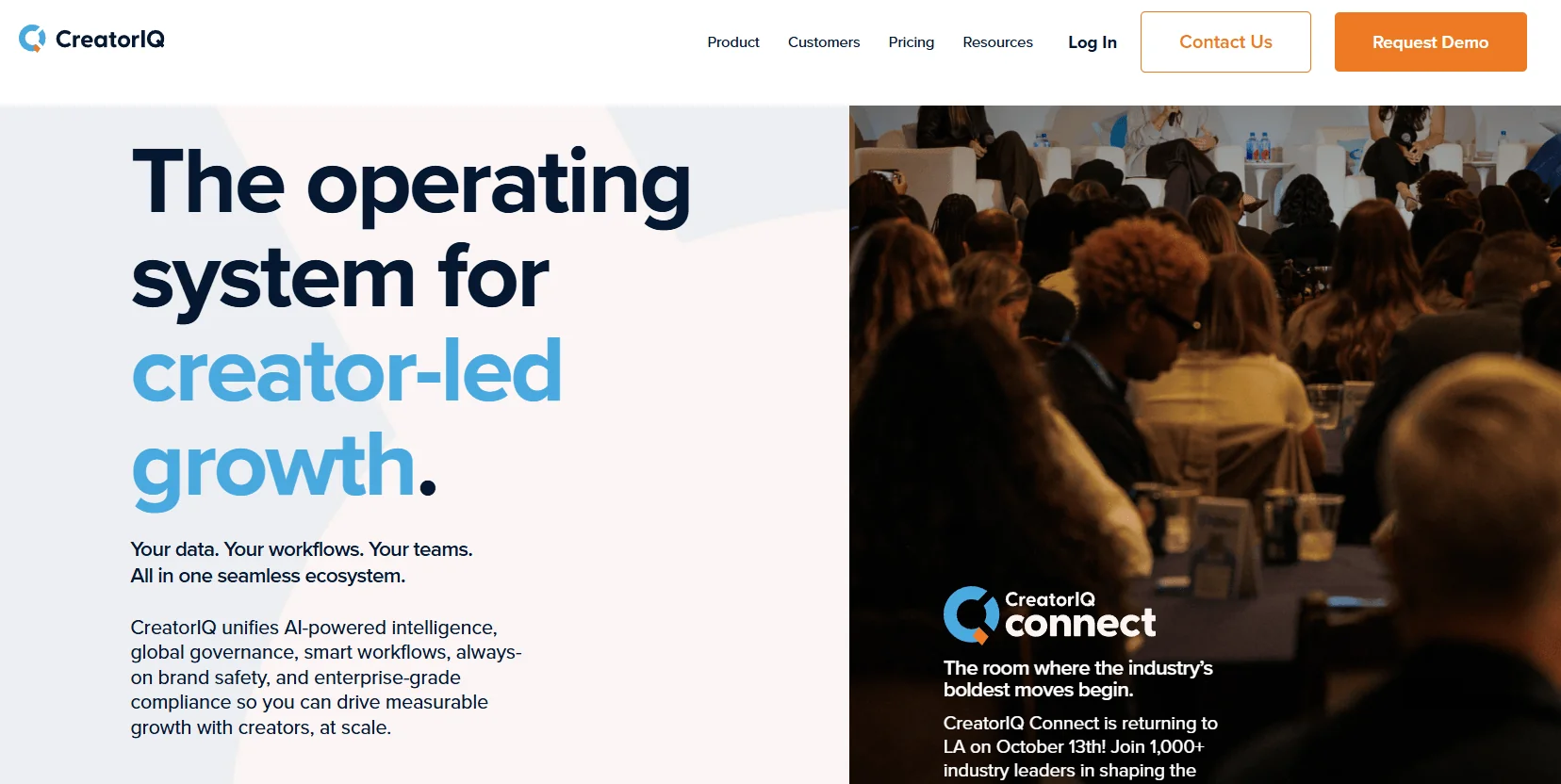
CreatorIQ is an enterprise creator marketing platform. It's used by companies like Disney, Sephora, Unilever, and LVMH, and by more than 1,300 brands overall. That customer list tells you most of what you need to know about who it's designed for.
The platform runs on direct API integrations with the major social networks rather than scraped data, which gives it more reliable first-party metrics on connected creators. Its database holds over 20 million creator profiles, and its reporting layer includes EMV measurement inherited from its Tribe Dynamics acquisition.
Where it really separates from the rest of the market is governance. Multi-brand structures, regional teams, permission controls, compliance workflows, and white-labeling for agencies managing several clients. If five teams in four countries all run creator programs under one parent company, this is the category CreatorIQ owns.
Enterprise-Grade Measurement
CreatorIQ's reporting is built for people who present to a CMO, not just to a marketing manager. EMV, share of voice, brand health, and creator performance roll up across brands and regions into a single view.
That kind of measurement depth is genuinely hard to replicate. It's also the reason many mid-market teams find it heavy: the reports answer questions they aren't being asked yet. If your reporting still lives at the campaign level, our take on whether reach or impressions matters more is a more useful starting point.
Creator Data Quality
Because CreatorIQ works through official API connections, the audience data on opted-in creators is more accurate than what you get from public scraping. Fraud detection and audience credibility scoring are built in.
For brands spending six or seven figures a year on creators, that accuracy is worth paying for. Bad audience data at that spend level is expensive in a way it simply isn't at $5,000 a month.
Agency and Multi-Brand Support
White-labeling lets agencies present the platform under their own branding, and the multi-brand architecture keeps client or regional data properly separated. Larger contract tiers unlock more of this.
Where CreatorIQ Falls Short
Cost and setup time are the barriers. Entry contracts start around $30,000 a year, there's no monthly billing and no free tier, and implementation commonly runs six to eight weeks before your team is productive. For a brand running its first few campaigns, that's a commitment made long before you know whether the channel works for you.
What Is Influencer Hero?
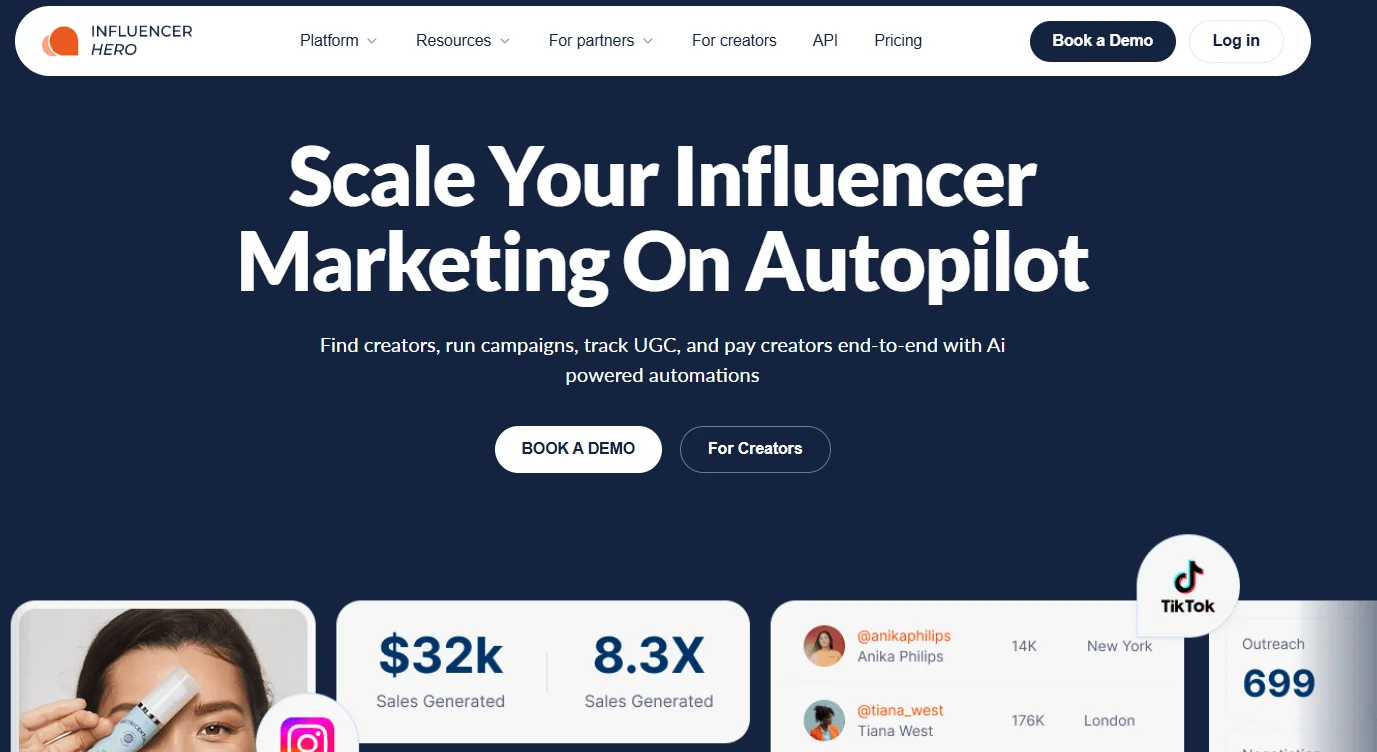
Influencer Hero is an all-in-one influencer marketing platform built primarily for DTC brands and the agencies serving them. It's part of the same family as Afluencer, and it's the natural step up once a brand outgrows a marketplace and needs outreach, tracking, and payments running as one system.
Discovery covers Instagram, TikTok, and YouTube with AI matching, lookalike search, fake follower detection, and a Chrome extension. There's also brand-follower search, which surfaces creators already following you or a competitor, so your first outreach list is made of people who already know the brand.
From there the workflow stays in one place: automated email sequences, a creator CRM, product gifting through Shopify and WooCommerce, affiliate links and discount codes with sales attribution, automated payouts, UGC management, and creator storefronts. Pricing is published on the site rather than hidden behind a demo, which is unusual in this category.
Outreach Automation That Runs Itself
Multi-step email sequences with automatic follow-ups handle the part of influencer marketing that quietly kills programs: nobody replies to the first message, and nobody has time to chase 200 creators manually.
Sequences run from your own domain, replies land in the CRM, and creator status moves through the pipeline as conversations progress. If you're picking between platforms right now, these key questions are worth answering before you sit through any demo.
Affiliate Tracking and Automated Payments
Every creator can get a unique affiliate link and discount code, with sales attributed back to them automatically. Commission calculation and payouts run inside the platform instead of through a separate affiliate app plus manual PayPal transfers.
For a DTC brand where creator content is expected to drive revenue rather than awareness, this is the piece that changes how the program is managed. You see which creator generated which order, and you pay them on that basis.
Reporting Tied to Sales
Campaign reporting covers content performance, engagement, EMV, and revenue in one dashboard. Because affiliate and ecommerce data flow into the same system, the ROI number doesn't need to be assembled by hand at the end of the month.
Where Influencer Hero Falls Short
There's no free trial, and the feature set is broad enough that new teams need a couple of weeks to use all of it well. If you only need creator discovery and nothing else, you'd be paying for a lot of workflow you're not using yet.
Feature-by-Feature Breakdown
Influencer Discovery
CreatorIQ has the deepest data on opted-in creators thanks to its API connections, and the largest indexed database of the three. Upfluence is strong on ecommerce-flavored discovery, especially Live Capture pulling creators out of your own customer list. Influencer Hero's angle is intent: lookalike search and brand-follower search build lists of creators with an existing connection to your brand, which tends to lift reply rates more than raw database size does.
Outreach and Communication
Upfluence includes email outreach in its search module, so discovery and contact stay together. CreatorIQ's outreach is built around large team workflows with approvals and permissions layered on. Influencer Hero runs full automated sequences with follow-ups from your domain, which matters most for small teams contacting hundreds of creators without a dedicated coordinator.
CRM and Campaign Management
All three keep creator relationships in a CRM. CreatorIQ's version is the most configurable and the most governed, which is exactly what a multi-brand organization needs and exactly what a five-person marketing team doesn't. Upfluence's IRM is practical and export-friendly. Influencer Hero's sits closer to the sales pipeline model, with creators moving through stages from contacted to content live to paid.
Tracking and Analytics
CreatorIQ leads on brand-level and portfolio-level measurement, including EMV across regions. Upfluence tracks campaign performance and affiliate sales inside its campaign module. Influencer Hero reports content and revenue in the same view, which suits brands whose main question is what the channel returned this month.
Integrations
Upfluence's Shopify, WooCommerce, and Amazon connections are its calling card, and the Amazon piece is something the other two don't match. CreatorIQ connects into enterprise stacks, including Docusign, PayPal, and analytics tools. Influencer Hero covers Shopify, WooCommerce, custom stores, Klaviyo, Slack, Zapier, and DocuSign, which is the stack most DTC brands are actually running.
Pricing: What You'll Actually Pay
Upfluence doesn't publish pricing. Modules start around $478 a month for Search and Contact, but a usable setup with campaigns and payments plus one seat lands closer to $1,300 a month, or roughly $14,000 to $16,000 a year. Extra seats run about $79 a month each, onboarding is a separate fee, and the minimum contract is 12 months.
CreatorIQ also quotes privately. Reported entry contracts start around $30,000 a year, with a median near $39,000 and larger programs running $60,000 and up. There's no monthly billing and no free tier, so the smallest commitment available is a full year.
Influencer Hero lists its pricing publicly: $649 a month for Standard (up to 1,000 creators), $1,049 a month for Pro (up to 5,000), and $2,490 a month for Business (up to 10,000), with custom and agency plans above that. You can compare it against your budget before you ever book a call, which is not the norm here.
Afluencer starts at $49 a month on the Marketplace plan, with Standard at $649 and Pro at $1,049. Here's the practical part: if your entire influencer budget is $1,500 a month, committing $1,300 of it to software leaves almost nothing for the creators themselves. Starting at the marketplace level and moving up once the channel proves out is the cheaper mistake to make. That logic is why smaller brands usually get further with a lean setup than with an enterprise contract.
Which Platform Is Right for You?
Upfluence and CreatorIQ both lead in specific places, and neither one is a fallback option. If you sell on Amazon as well as Shopify, or you want to mine your own customer list for creators who already buy from you, Upfluence does that better than anything else in this comparison. If you're a global brand with regional teams, agency partners, and a board that wants EMV reported across a portfolio, CreatorIQ is the platform built for that job and the setup time is the price of that depth.
Influencer Hero makes more sense when your program lives or dies on execution volume. If you need to find creators, contact hundreds of them without a dedicated coordinator, manage the replies, ship product, track affiliate sales down to the order, and pay everyone automatically, that whole chain works end to end in one place.
The published pricing helps too, since you can decide whether it fits your budget before a sales conversation rather than after. Curious how that workflow would look with your own product catalog? Book a demo with Influencer Hero.
And if you're not at platform stage yet, don't force it. Afluencer starts at $49 a month, connects you with verified creators who apply to your Collabs directly, and gives you a few campaigns' worth of real experience before you commit to anything bigger. Sign up on Afluencer and post your first Collab this week.
The Bottom Line
These three platforms solve three different problems: Upfluence for ecommerce-native gifting and affiliate mechanics, CreatorIQ for enterprise measurement and multi-brand governance, and Influencer Hero for DTC brands that need discovery, outreach, affiliate tracking, and payouts running as one workflow. The question isn't which is strongest, it's which problem is yours right now.
If you're still deciding, start where the risk is lowest. Post a Collab on Afluencer, run two or three campaigns, see what creators actually do for your revenue, and let that data pick your platform for you.
Frequently Asked Questions
<details class="ih-faq"><summary>What's the main difference between Upfluence and CreatorIQ?</summary><div class="ih-faq-a">Scale and structure. Upfluence is a modular ecommerce platform where you buy discovery, campaigns, and payments separately, typically landing around $14,000 to $16,000 a year. CreatorIQ is enterprise software with API-based creator data, multi-brand governance, and EMV reporting, starting near $30,000 a year on annual contracts.</div></details><details class="ih-faq"><summary>Which platform fits a small DTC brand best?</summary><div class="ih-faq-a">If you're spending under $2,000 a month on creators total, neither Upfluence nor CreatorIQ makes budget sense yet. Afluencer at $49 a month is the realistic entry point, and Influencer Hero at $649 a month fits once you're running consistent campaigns and need affiliate tracking and payouts automated.</div></details><details class="ih-faq"><summary>Does Influencer Hero track affiliate sales?</summary><div class="ih-faq-a">Yes. Every creator gets a unique affiliate link and discount code, and sales attribute back to them automatically through Shopify, WooCommerce, or a custom store. Commissions calculate inside the platform and payouts run from there, so you're not reconciling a separate affiliate app against manual transfers.</div></details><details class="ih-faq"><summary>Can I use Afluencer and Influencer Hero together?</summary><div class="ih-faq-a">Plenty of brands do. Afluencer brings inbound applications from verified creators who choose to work with you, which is a different sourcing motion than cold outreach. Influencer Hero then handles the outreach volume, CRM, affiliate tracking, and payments once your program grows past what manual management can cover.</div></details><details class="ih-faq"><summary>Do Upfluence and CreatorIQ publish their pricing?</summary><div class="ih-faq-a">Neither does. Both require a demo call before you see a number, and both run on annual contracts, 12 months minimum for Upfluence. Influencer Hero publishes its tiers at $649, $1,049, and $2,490 a month, and Afluencer's brand plans start at $49 a month.</div></details><script type="application/ld+json">{"@context":"https://schema.org","@type":"FAQPage","mainEntity":[{"@type":"Question","name":"What's the main difference between Upfluence and CreatorIQ?","acceptedAnswer":{"@type":"Answer","text":"Scale and structure. Upfluence is a modular ecommerce platform where you buy discovery, campaigns, and payments separately, typically landing around $14,000 to $16,000 a year. CreatorIQ is enterprise software with API-based creator data, multi-brand governance, and EMV reporting, starting near $30,000 a year on annual contracts."}},{"@type":"Question","name":"Which platform fits a small DTC brand best?","acceptedAnswer":{"@type":"Answer","text":"If you're spending under $2,000 a month on creators total, neither Upfluence nor CreatorIQ makes budget sense yet. Afluencer at $49 a month is the realistic entry point, and Influencer Hero at $649 a month fits once you're running consistent campaigns and need affiliate tracking and payouts automated."}},{"@type":"Question","name":"Does Influencer Hero track affiliate sales?","acceptedAnswer":{"@type":"Answer","text":"Yes. Every creator gets a unique affiliate link and discount code, and sales attribute back to them automatically through Shopify, WooCommerce, or a custom store. Commissions calculate inside the platform and payouts run from there, so you're not reconciling a separate affiliate app against manual transfers."}},{"@type":"Question","name":"Can I use Afluencer and Influencer Hero together?","acceptedAnswer":{"@type":"Answer","text":"Plenty of brands do. Afluencer brings inbound applications from verified creators who choose to work with you, which is a different sourcing motion than cold outreach. Influencer Hero then handles the outreach volume, CRM, affiliate tracking, and payments once your program grows past what manual management can cover."}},{"@type":"Question","name":"Do Upfluence and CreatorIQ publish their pricing?","acceptedAnswer":{"@type":"Answer","text":"Neither does. Both require a demo call before you see a number, and both run on annual contracts, 12 months minimum for Upfluence. Influencer Hero publishes its tiers at $649, $1,049, and $2,490 a month, and Afluencer's brand plans start at $49 a month."}}]}</script>