.svg)

.png)
- 10 Best Influencer Marketing Tools That Integrate With Shopify, Slack & More in 2026
- Quick Comparison: Integrations and Pricing at a Glance
- The Top 10 Influencer Marketing Tools That Integrate With Your Stack in 2026
- How to Choose the Right Integrated Influencer Marketing Tool in 2026
- Wire the Stack, Not Just the Campaign
10 Best Influencer Marketing Tools That Integrate With Shopify, Slack & More in 2026
Your influencer platform is only as useful as the tools it talks to. If creator sales never land in Shopify, if discount codes get built by hand, and if nobody on the team hears about a post until the Monday stand-up, you are still running influencer marketing on manual mode.
That is why integrations have quietly become the deciding factor for most buyers in 2026. Brands now run creators next to Klaviyo flows, Zapier automations, a support inbox and a Slack channel where the whole team watches results land. If you are shopping specifically inside the ecommerce ecosystem, our roundup of Shopify influencer apps is a useful companion read.
So this list compares 10 platforms on what they actually connect to, not on feature-page promises. For each one you get the ecommerce integrations, whether Slack is native or bolted on with Zapier, and current pricing checked this session against official sources.
Let's break them down one by one.
Quick Comparison: Integrations and Pricing at a Glance
The Top 10 Influencer Marketing Tools That Integrate With Your Stack in 2026
Integration depth splits this category more cleanly than any feature list does. Some tools plug into a dozen systems and fire alerts wherever your team already works. Others do one thing well and expect you to bridge the rest with Zapier.
We checked every price this session against official pricing pages and current sources, so the numbers below reflect 2026 rather than last year's blog posts. Here they are, ranked by how much of your stack they can actually reach.
1. Influencer Hero
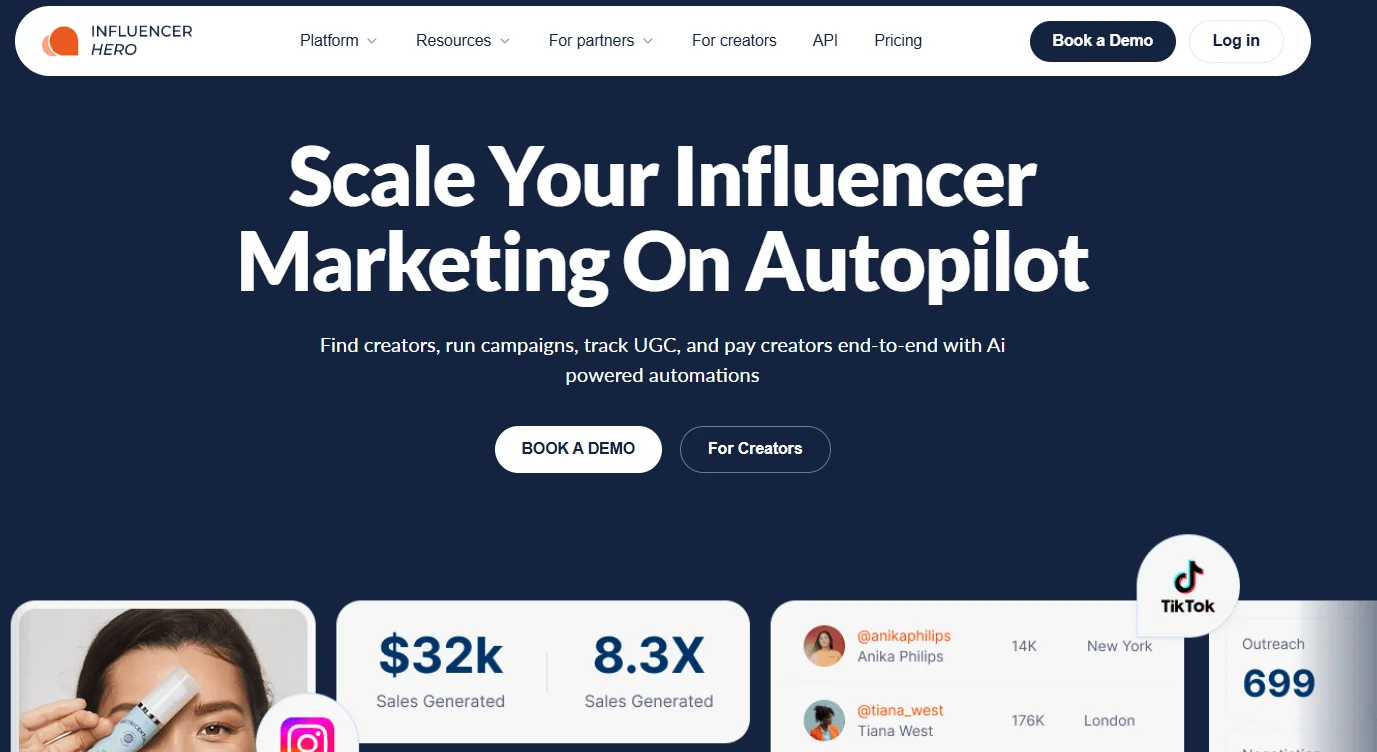
Influencer Hero is an all-in-one influencer marketing platform covering discovery, automated outreach, CRM, gifting, affiliate tracking, payments and UGC. On integrations specifically, it has the widest surface area on this list. The platform supports 45-plus integrations across ecommerce, email, contracts, support and workflow automation.
Where Influencer Hero separates itself is the surface area around the store. Integrations break down into five groups:
- Ecommerce: Shopify, Magento, WooCommerce, Amazon, BigCommerce, Squarespace, Webflow, Wix. On Shopify you can create $0 influencer orders, track fulfillment, generate discount codes and affiliate links, and attribute revenue at the order level without touching a spreadsheet.
- Team alerts and automation: Slack, Zapier, Google Sheets. Slack alerts fire in real time when a creator replies, posts or drives a sale, so your team sees activity without logging in. Zapier pushes those events to hundreds of other apps, and Google Sheets syncs performance and commission data into shared dashboards.
- Email and CRM: Klaviyo, Mailchimp, Brevo. Influencer contacts and creator-driven revenue flow straight into the lists you already segment on.
- Customer support: Gorgias, Zendesk. Incoming tickets get flagged when they belong to a known creator, so support doesn't treat a partner like a cold shopper.
- Contracts and signatures: DocuSign, PandaDoc, BoldSign. Agreements get sent, signed and stored without leaving the campaign.
The automation engine is what ties it together. You build trigger, condition and action rules, and a Slack alert is one of the available actions alongside sending a contract, generating a discount code or moving a creator between campaign stages. Discovery runs across Instagram, TikTok and YouTube.
The numbers: Pricing is published on the site, no demo required to see it. Standard is $649/month for up to 1,000 creators, Pro is $1,049/month for up to 5,000, and Business is $2,490/month for up to 10,000, with custom and agency plans above that.
Want to see how it connects to your specific stack? Book a demo with the Influencer Hero team.
2. Afluencer
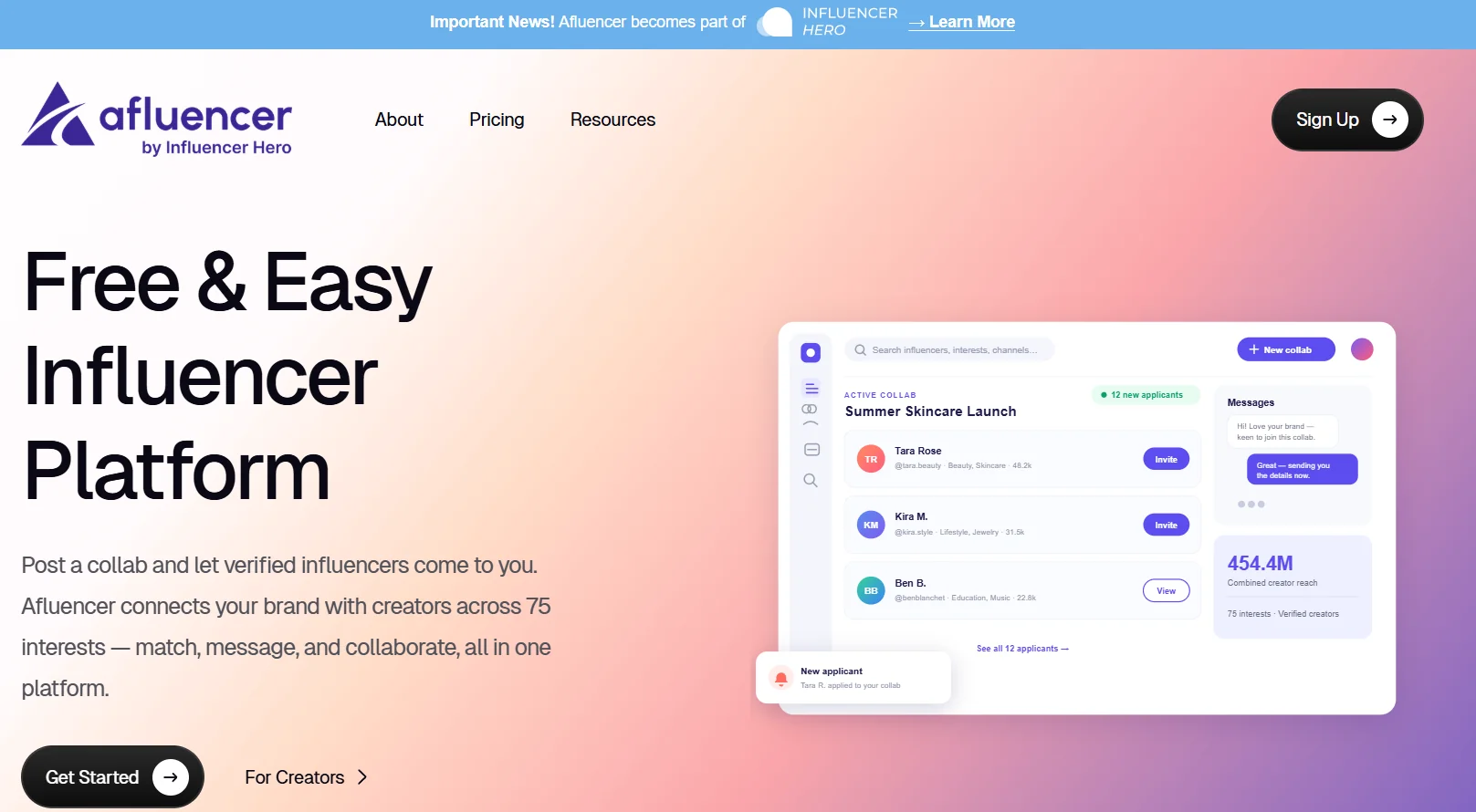
Afluencer works from the opposite direction. Instead of searching a database and cold-emailing strangers, you post a Collab describing what you want, and verified creators apply to you. That inbound model solves the part most brands find hardest: building a creator list in the first place.
The Shopify app is where the integration lives. Install it from the Shopify App Store, connect your store under My Account and then Sales Channels, and your product listings sync across so creators can pick items straight from your catalog. Shipping a gifted product then takes a few clicks instead of a manual order and a follow-up email. There is a BigCommerce app too. Our gifting playbook walks through the workflow end to end.
The numbers: Brand plans start at $49/month on the Marketplace tier, which includes 60 invitation credits a month, premium influencer filters and full phone, email and live chat support. Standard runs $649/month with 1,000 reach-outs, product send-outs and influencer payments, and Pro is $1,049/month with 5,000 reach-outs and a dedicated account manager. Billing is monthly with no annual lock-in. The Shopify app holds a 4.5-star rating across 35 reviews.
Be clear about what it is. Afluencer is a sourcing and collaboration layer, not a full operations stack, so there is no Slack integration or Klaviyo sync. For small and mid-sized brands that mainly need the right creators to show up, that trade is usually worth $49 a month.
Chat with CreatorGPT to map out your campaign, or post a Collab and see who applies.
3. GRIN

GRIN built its reputation on ecommerce depth, and the integration list backs it up. It connects natively to Shopify and Shopify Plus, WooCommerce, Magento, BigCommerce and Salesforce Commerce Cloud, so product seeding, fulfillment and revenue attribution run inside one dashboard. Klaviyo handles creator email templates, Gmail and Outlook plug into the shared inbox, and PayPal covers payouts.
Slack is a first-class integration here, not an afterthought. You route important updates about creators, campaigns and program activity to any channel you choose, which keeps the wider marketing team in the loop without extra seats.
The numbers: GRIN restructured its pricing in 2026, which is a real change from its old custom-quote days. It now publishes five self-serve monthly plans running from $0 to $1,500. Every tier is month to month with no annual contract, the Free plan needs no card and has no trial clock, and GRIN takes no percentage of creator-driven revenue.
The catch sits in what those tiers include. The lower plans are built around AI assistant credits, and the hands-on creator CRM workspace only arrives from the mid tier upward, so read the plan comparison carefully before you assume the entry price buys the full workflow. If the model does not fit, our roundup of GRIN alternatives covers where brands go instead.
4. Aspire

Aspire pairs a creator marketplace with campaign process, which makes it a fit for teams juggling briefs, deliverables, approvals and product sends across multiple stakeholders. You publish a campaign page, set eligibility rules and review inbound applications, then run the whole lifecycle inside the platform.
Its integration set leans operational: Shopify and WooCommerce for commerce, Klaviyo for email, Salesforce for CRM, Gorgias for support, Gmail and Outlook for inbox, PayPal for payouts, and Slack for team notifications. Impact.com and ShareASale connect the affiliate side if you already run one.
The numbers: Aspire does not publish platform pricing, and the purchase path leads to a demo. Reported figures from buyers put the annual license around $27,588 with a $2,000 onboarding fee, so a realistic year one lands near $29,588. Treat those as indicative rather than a rate card, since they come from customer reports rather than an official page.
The trade-off is commitment. You buy on an annual agreement before you can test the workflow with your own program, and you cannot compare cost without booking a call first.
5. Modash

Modash is the discovery specialist of the group. Its database covers creators across Instagram, TikTok and YouTube with genuinely granular filters, including audience demographics, city-level location, engagement rate and fake-follower scores. Content tracking then captures posts, Reels and Stories tied to your campaign automatically.
The Shopify integration is included free on every tier and handles product gifting, discount codes and sales tracking, which is why you see Modash inside so many ecommerce stacks. Affiliate management sits on the Performance Annual and Enterprise plans.
The numbers: Essentials is $199/month on annual billing or $299 monthly. Performance is $499/month annual or $599 monthly. Enterprise starts at $14,700 per year. There is a 14-day free trial on both public tiers with no card required. Payouts are fee-free up to a yearly limit, and a 5% fee applies only above it.
Two limits matter for this list. Shopify is the only deep commerce integration, so on WooCommerce or a custom stack you lose most of the attribution value. And Slack is not native here, so team alerts run through Zapier or the API, and API access is priced on top of your subscription.
6. SARAL
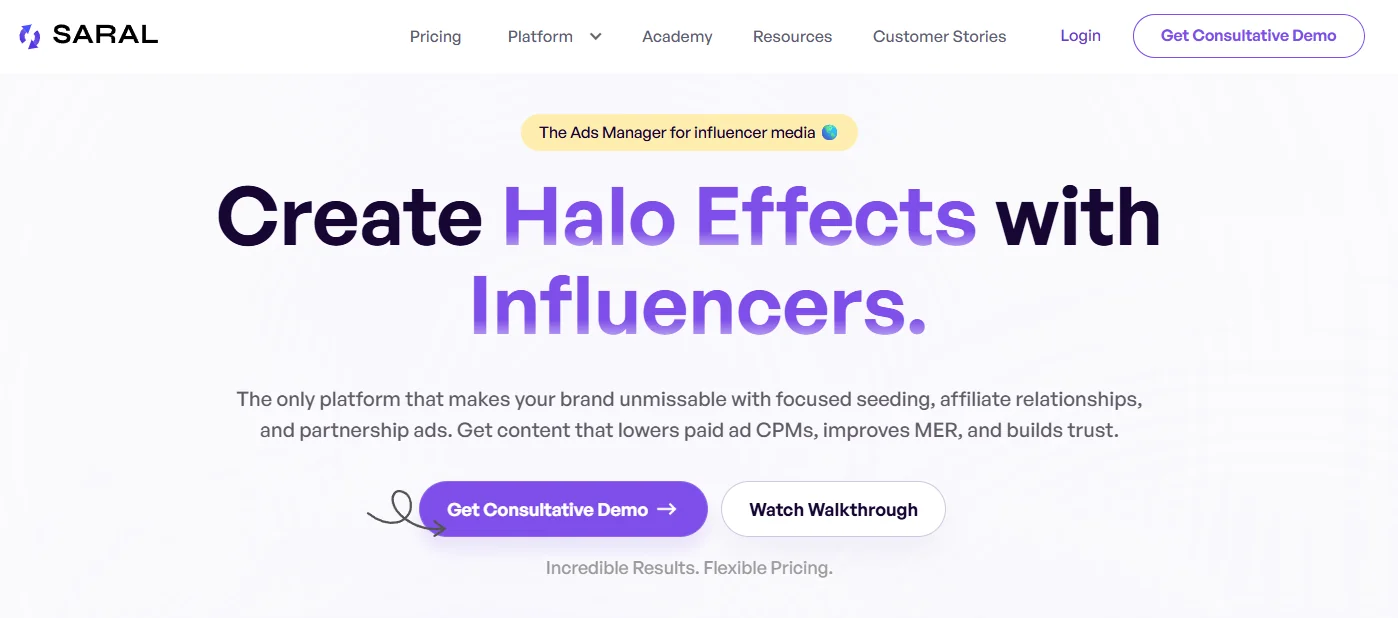
SARAL positions itself as an influencer operating system for emerging DTC brands. The pitch is simplicity: a clean CRM with custom stages and fields, an inbox with keyboard shortcuts, and templates that replace spreadsheet chaos. Most teams get set up in a few days without technical help.
Its integration list is short but well chosen for the job. Shopify and WooCommerce ship products and track sales, Klaviyo runs influencer newsletters, PayPal handles payments, GoAffPro and Sendlane cover affiliate and email, and Slack carries the regular updates. Reviewers specifically call out delivery notifications landing in Slack as a favorite detail.
The numbers: SARAL's cheapest plan is $12,000 per year, billed quarterly or annually upfront. It holds a 4.7 rating on G2, with users praising how quickly it replaces manual tracking.
That upfront commitment is the real friction. Plans also cap how many influencers you can save each month and how many active partnerships you can run per tier, so growth can push you up a tier faster than expected. If the entry price is the blocker, our list of SARAL alternatives covers cheaper routes to the same workflow.
7. Social Snowball
Social Snowball is an affiliate and referral engine rather than a discovery tool. Its signature move is auto-enrolling customers as affiliates after purchase, so your existing buyers become your creator roster. For brands with an engaged customer base, that skips the sourcing problem entirely.
Integration-wise it is deliberately Shopify-first. The Shopify connection is the richest one, with native Klaviyo and Postscript integrations layered on top so affiliate events can trigger email and SMS flows. Anything else routes through Zapier. Payouts cover 700-plus methods.
The numbers: Social Snowball moved to a two-tier, quote-based model in 2026, with published floors rather than flat rates. Snow Day starts at $249/month plus 3% of affiliate-generated revenue. Blizzard starts at $899/month with no commission fees. It holds 4.5 stars across 187 Shopify App Store reviews.
Worth flagging: the Slack access people mention is an enterprise support channel, not a product integration, so it will not push campaign alerts. The bigger caveat is the 3% cut, which scales against you as the program grows. Once affiliate revenue climbs, the flat-fee tier usually costs less.
8. Shopify Collabs
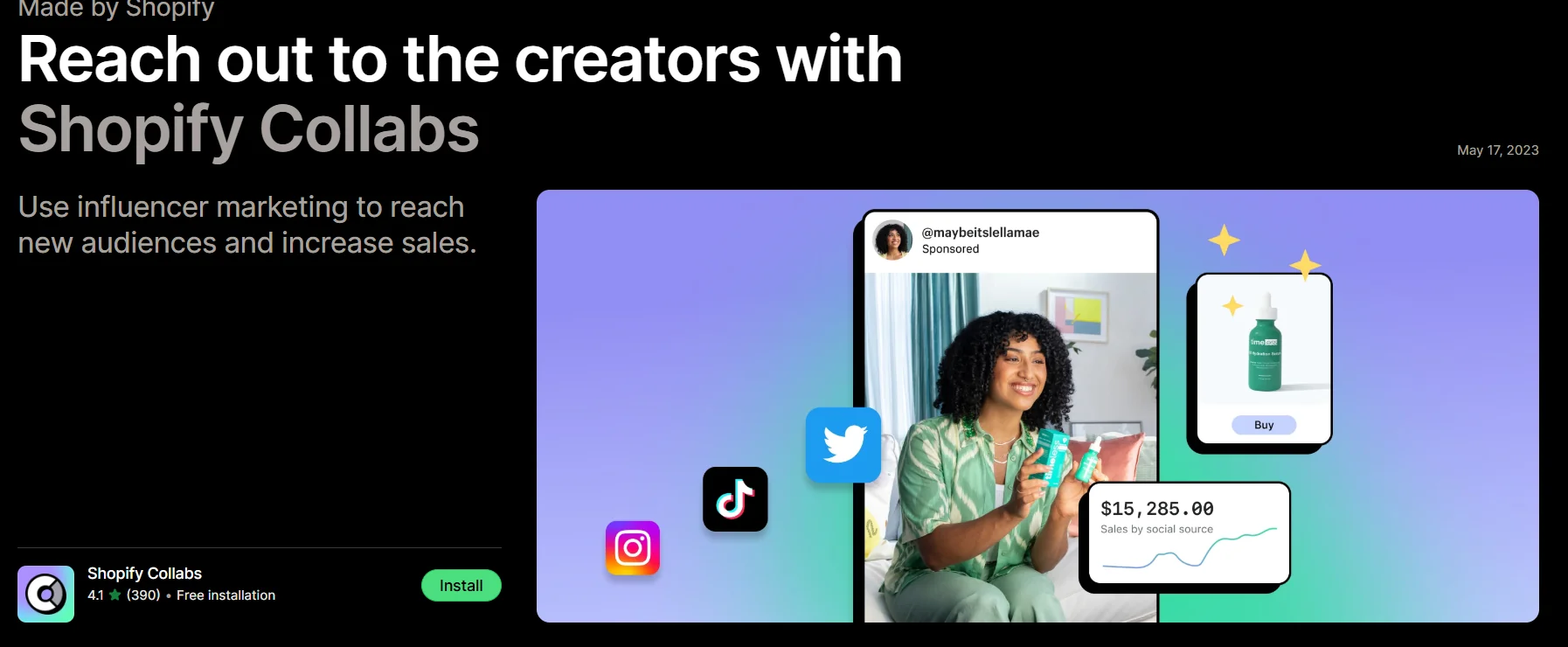
Shopify Collabs wins the integration question by not needing one. It lives inside your Shopify admin, so attribution, order tracking and commission payouts pull straight from store data with nothing to connect and nothing to reconcile. You can list your store in the Collabs Network for open applications or run an invite-only program.
The numbers: The app is free to install with no subscription. You pay a 2.9% processing fee on every automatic commission payout, plus a foreign exchange fee if you pay a creator in another currency. To appear in the open Collabs Network your store needs at least $10,000 in trailing 12-month sales, a priced product and auto-payouts enabled. Creators need 1,000-plus followers and US, Canada or UK residency. It holds 3.4 stars on the Shopify App Store.
The limitation is the flip side of the strength. It integrates with Shopify because it is Shopify, and with nothing else. There is no Slack, no Klaviyo sync and no CRM layer. New creator signups have also been paused, which shrinks the discoverable pool. Plenty of brands start here and then move on, which is why we keep a list of Shopify Collabs alternatives.
9. CreatorIQ
CreatorIQ plays at the top of the market, and its integration story reflects that. Alongside Shopify for seeding, discount codes and affiliate tracking, it connects to Salesforce, WooCommerce and Adobe Commerce, plus PayPal, Tipalti, DocuSign, Google Drive, Slack and major BI tools like Looker and Tableau. Its ExchangeIQ API pipes creator data into CRMs and data warehouses.
That last part is the real differentiator. If your reporting has to live in a warehouse and roll up to a global marketing dashboard, few tools on this list can feed it as cleanly. Multi-brand workspaces also keep data siloed between accounts, which agencies with competing clients need.
The numbers: CreatorIQ does not publish pricing anywhere. Procurement data puts contracts starting around $30,000 per year, with a median closer to $39,250 and higher-end deals reaching $59,500 or more. Every deal is annual, with no monthly option. G2 data points to roughly two months of implementation.
So the caveat writes itself. Unless you have a large ongoing program and the headcount to run it, this is a lot of platform to pay for while you are still proving the channel works.
10. impact.com
impact.com treats creators as one partner type inside a bigger portfolio that also covers affiliates, publishers and referral partners. If your team already manages those relationships separately, consolidating them is the appeal.
Its Shopify integration is a certified Shopify Plus app and installs as a no-code plugin, handling conversion tracking, attribution and order data sync, with a separate setup path for product gifting. WooCommerce, BigCommerce and Adobe Commerce connect through the API, and there are supported flows for Shopify stores running Recharge or Bold subscriptions.
The numbers: The Starter plan begins at $30/month or 3% of monthly affiliate revenue, whichever is higher, with a 30-day trial period. Mid-market brands generally land between $500 and $2,500 a month on the Essential and Pro tiers, and Enterprise is custom. A 2.5% fee applies to commissions generated through the platform on top of the subscription.
Two honest notes. impact.com does not publish a native Slack integration, so team alerts usually get wired through the API. And the percentage fee stacking on top of a subscription means your real cost rises with program success, which is worth modelling before you sign.
How to Choose the Right Integrated Influencer Marketing Tool in 2026
The best tool here is the one that fits the systems you already run. Work through these five questions before you book a single demo.
- Your store platform If you are on Shopify, almost everything on this list works. If you run WooCommerce, Magento, BigCommerce or a headless setup, the field narrows fast. Influencer Hero, GRIN and CreatorIQ cover the widest range of stores, while Modash, Social Snowball and Shopify Collabs are effectively Shopify-only for attribution purposes.
- How your team finds out A Slack integration sounds cosmetic until you have 30 creators live and nobody knows a post went up. Native Slack alerts come with Influencer Hero, GRIN, Aspire, SARAL and CreatorIQ. Everyone else needs Zapier or an API, which means more setup and one more thing that can break.
- Where attribution has to land Decide whether you need click-level, order-level or SKU-level revenue data before you shortlist. Order-level attribution inside your store is the difference between reporting on reach and reporting on revenue, and it is the single feature most brands regret skipping.
- Native versus Zapier A Zapier connection is fine for notifications and simple handoffs. It is not fine for syncing product catalogs, generating discount codes or reconciling payouts. Ask which of your must-haves are native and which are workarounds.
- What your program costs as it grows Flat subscriptions, per-creator caps and percentage fees behave very differently at scale. A 3% cut is cheap at $5,000 in affiliate revenue and expensive at $100,000. Model your expected volume, not today's.
One more thing worth settling early: the collaboration formats you plan to run. A gifting-heavy program needs catalog sync and fulfillment tracking, while an affiliate-heavy one needs codes, links and payouts. There is no single best platform here, only the one that matches your stack, your stage and your budget.
Wire the Stack, Not Just the Campaign
Influencer marketing stopped being a standalone channel a while ago. It sits between your store, your email platform, your support desk and your team chat, and the tools that acknowledge that are the ones that save real hours.
You do not need all 10 of these. Most brands need one platform that connects to their store properly and one clear way to get creators in the door. Start with the integration you cannot live without, then judge everything else against it.
Ready to get creators applying to you? Post a Collab on Afluencer and see who raises their hand, or chat with CreatorGPT to plan the campaign first.
Frequently Asked Questions
<details class="ih-faq"><summary>Which influencer marketing tools integrate with Shopify?</summary><div class="ih-faq-a">Most of the major platforms do, but the depth varies. Influencer Hero, GRIN, Aspire, Modash, SARAL, CreatorIQ and impact.com all offer native Shopify integrations covering product seeding, discount codes and sales attribution. Afluencer has a Shopify app that syncs your product catalog for gifting, and Shopify Collabs runs inside the admin itself.</div></details><details class="ih-faq"><summary>Do influencer marketing platforms integrate with Slack?</summary><div class="ih-faq-a">Fewer than you would expect. Influencer Hero, GRIN, Aspire, SARAL and CreatorIQ offer native Slack notifications for creator replies, posts, shipments and sales. Modash and impact.com do not publish a native Slack integration, so those alerts run through Zapier or an API. Shopify Collabs and Afluencer have no Slack connection at all.</div></details><details class="ih-faq"><summary>Can I connect an influencer marketing platform to Klaviyo?</summary><div class="ih-faq-a">Yes, and it is one of the most common integrations in the category. Influencer Hero, GRIN, Aspire, SARAL and Social Snowball all connect to Klaviyo, letting you sync creator contacts, attribute email and SMS revenue to specific influencers, and trigger flows based on affiliate activity. Setup is usually a guided connection rather than custom development.</div></details><details class="ih-faq"><summary>Is a native integration better than a Zapier connection?</summary><div class="ih-faq-a">For anything involving data sync, yes. Native integrations handle catalog syncing, discount code generation, order-level attribution and payout reconciliation reliably. Zapier is well suited to notifications and simple handoffs between apps, but it adds a dependency and often a cost. Check which of your must-haves are native before you commit.</div></details><details class="ih-faq"><summary>What should a Shopify brand budget for an influencer tool in 2026?</summary><div class="ih-faq-a">It depends entirely on program stage. Sourcing-focused marketplaces like Afluencer start at $49/month, discovery tools like Modash sit around $199 to $499/month, and full operating systems like Influencer Hero start at $649/month. Enterprise platforms such as CreatorIQ start near $30,000 per year. Percentage-based tools cost less upfront and more as you scale.</div></details><script type="application/ld+json">{"@context":"https://schema.org","@type":"FAQPage","mainEntity":[{"@type":"Question","name":"Which influencer marketing tools integrate with Shopify?","acceptedAnswer":{"@type":"Answer","text":"Most of the major platforms do, but the depth varies. Influencer Hero, GRIN, Aspire, Modash, SARAL, CreatorIQ and impact.com all offer native Shopify integrations covering product seeding, discount codes and sales attribution. Afluencer has a Shopify app that syncs your product catalog for gifting, and Shopify Collabs runs inside the admin itself."}},{"@type":"Question","name":"Do influencer marketing platforms integrate with Slack?","acceptedAnswer":{"@type":"Answer","text":"Fewer than you would expect. Influencer Hero, GRIN, Aspire, SARAL and CreatorIQ offer native Slack notifications for creator replies, posts, shipments and sales. Modash and impact.com do not publish a native Slack integration, so those alerts run through Zapier or an API. Shopify Collabs and Afluencer have no Slack connection at all."}},{"@type":"Question","name":"Can I connect an influencer marketing platform to Klaviyo?","acceptedAnswer":{"@type":"Answer","text":"Yes, and it is one of the most common integrations in the category. Influencer Hero, GRIN, Aspire, SARAL and Social Snowball all connect to Klaviyo, letting you sync creator contacts, attribute email and SMS revenue to specific influencers, and trigger flows based on affiliate activity. Setup is usually a guided connection rather than custom development."}},{"@type":"Question","name":"Is a native integration better than a Zapier connection?","acceptedAnswer":{"@type":"Answer","text":"For anything involving data sync, yes. Native integrations handle catalog syncing, discount code generation, order-level attribution and payout reconciliation reliably. Zapier is well suited to notifications and simple handoffs between apps, but it adds a dependency and often a cost. Check which of your must-haves are native before you commit."}},{"@type":"Question","name":"What should a Shopify brand budget for an influencer tool in 2026?","acceptedAnswer":{"@type":"Answer","text":"It depends entirely on program stage. Sourcing-focused marketplaces like Afluencer start at $49/month, discovery tools like Modash sit around $199 to $499/month, and full operating systems like Influencer Hero start at $649/month. Enterprise platforms such as CreatorIQ start near $30,000 per year. Percentage-based tools cost less upfront and more as you scale."}}]}</script>