
.svg)
.png)
.png)
10 Best Rakuten Advertising Alternatives in 2026
If you are searching for Rakuten Advertising alternatives in 2026, something big probably prompted it. Rakuten Advertising stopped operating its own tracking software. Its advertisers and publishers are migrating to impact.com's platform, while Rakuten keeps the parts of the business built on people: program strategy, managed services and Rakuten Rewards.
It is not an acquisition and no money changed hands, but for brands the practical effect is the same. The dashboard you signed up for is not the dashboard you will be using. Still, brands were already shopping around before the announcement. Pricing was never public, there is no free trial, quotes come with setup fees and a network cut on top of every commission you pay, and reviewers regularly flag the dated dashboard and slow reporting.
The good news is that the category has moved fast. Some of the strongest influencer marketing platforms now handle discovery, outreach, commissions and payouts in one place, at prices you can actually see before a sales call. Others are pure enterprise networks that do what Rakuten did, only with a roadmap you can count on.
Below are the 10 best Rakuten Advertising alternatives in 2026, with pricing we checked this session. Let's get into them.
10 Best Rakuten Advertising Alternatives in 2026
1. Afluencer
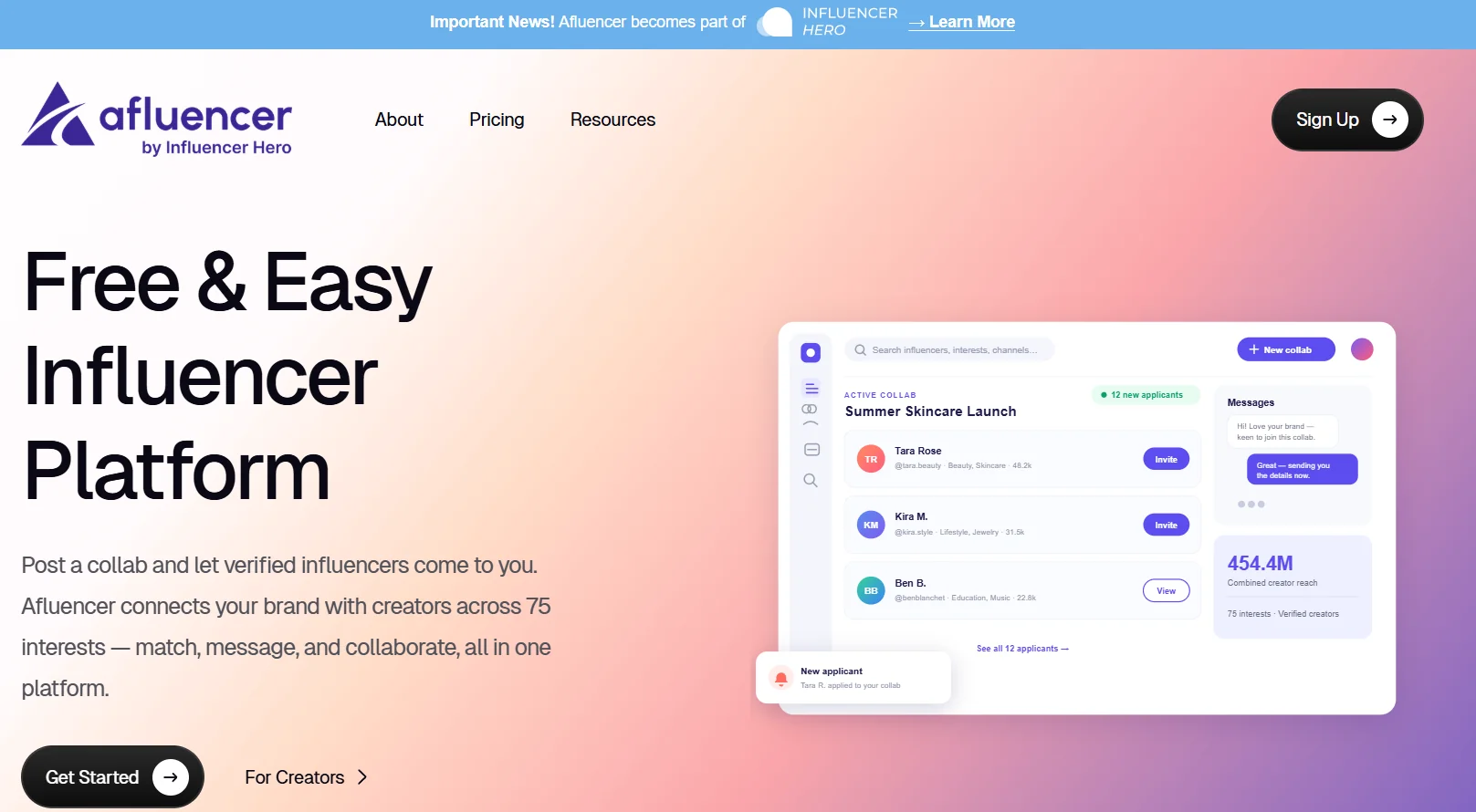
Afluencer flips the model Rakuten built its business on. Instead of recruiting from a publisher network of coupon sites, cashback apps and content partners, you post a Collab describing what you want, and verified creators apply to you. You review people who already raised their hand, which removes the slowest part of building a program from scratch.
That matters for anyone leaving Rakuten in 2026. The migration to impact.com means re-onboarding your program somewhere new anyway, so it is a natural moment to ask whether a publisher network is what you actually needed. If most of your revenue comes from creators posting on Instagram, TikTok and YouTube rather than from deal sites, Afluencer gets you to the same commission-based outcome without the enterprise contract wrapped around it.
Brands use it for gifting, affiliate deals, UGC and long-term ambassador setups, all inside the same Collab structure. You set the criteria creators must meet before they can apply, so you are not wading through a hundred mismatched pitches to find four good ones. Our guide to creator collaborations walks through how brands structure each of those deal types.
Afluencer also leans on AI to cut the manual work. You can chat with CreatorGPT for campaign strategy and outreach advice, and the Afluencer Collab Finder matches creators to your live opportunities so the right people see your offer first.
On pricing, brand plans start at $49 per month on the Marketplace tier, which covers full directory access, premium search filters, invitation credits and live support. Standard runs $649 per month and Pro is $1,049 per month as your outreach volume and payment needs grow. Compare that to Rakuten, where you cannot see a number at all until you have booked a call.
The honest caveat: Afluencer is a marketplace, not a global affiliate network. If your program depends on relationships with major cashback and loyalty publishers driving eight figures in tracked sales, that is genuinely Rakuten's lane and always was. Afluencer is the ideal option for brands that are just getting started with creator partnerships. Brands that want to scale and work with a lot of creators tend to need Influencer Hero.
Ready to try it? Sign up as a brand and post your first Collab this week.
2. Influencer Hero
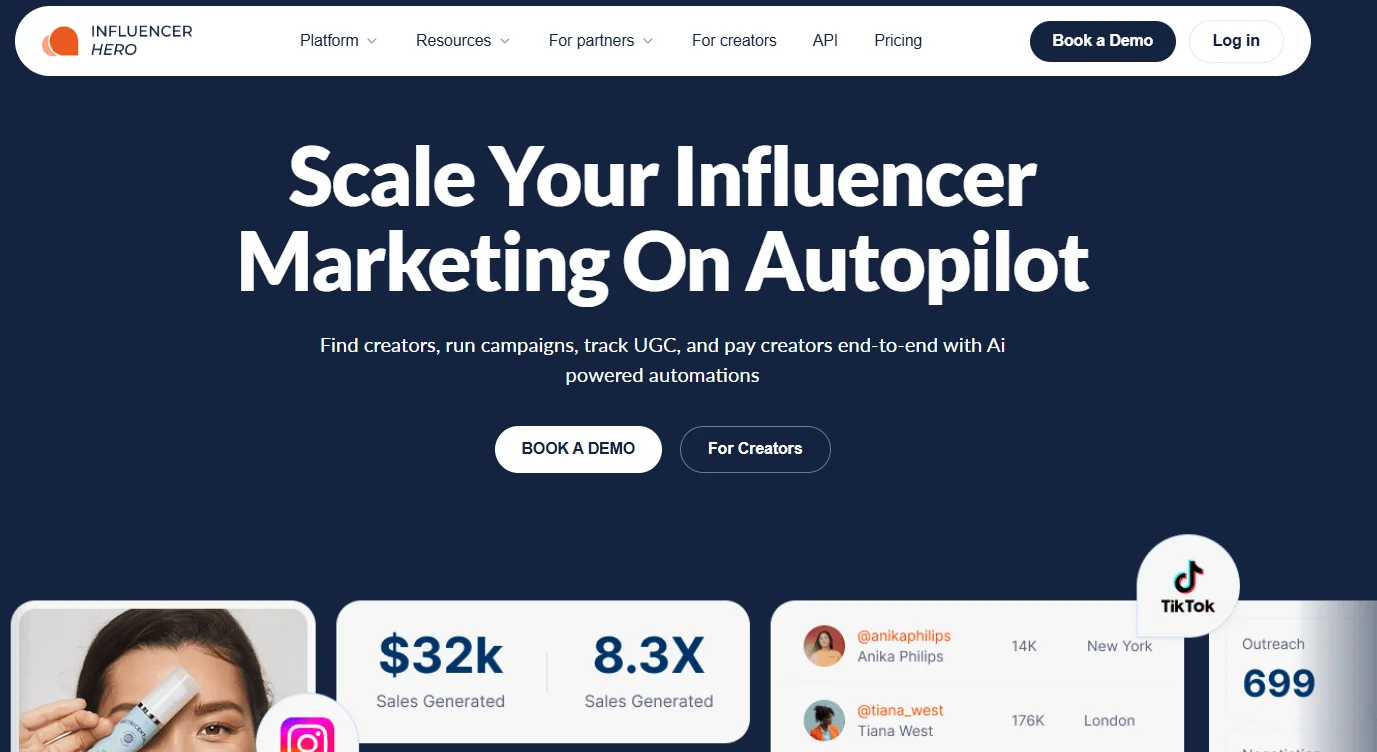
Influencer Hero is the closest thing on this list to a full replacement for what brands were trying to do with Rakuten plus a separate creator tool. It runs affiliate links, commission tracking, automated payouts and sales attribution in the same system that handles influencer discovery, outreach and CRM, so revenue attribution does not live in one platform while the creator relationship lives in another.
The affiliate side is where it competes with Rakuten directly. You generate unique affiliate links and discount codes per creator, track sales back to the individual who drove them, and pay everyone out from the platform. Payment fees run between 0.1% and 0.5%, which is a meaningful gap when most platforms and networks sit closer to 5% to 7%. On a program paying out six figures a year, that difference alone covers the software.
Discovery spans Instagram, TikTok and YouTube with fake-follower detection, lookalike search and AI matching, then outreach automation sends multi-step sequences from your own domain and stops the follow-ups the moment a creator replies. Gifting connects to Shopify and WooCommerce, and creator storefronts and application pages let partners sell without you building anything custom. It works well for mid-market DTC and ecommerce brands, and it scales to enterprise programs too.
Pricing is public, which is rare in this category. Standard is $649 per month for up to 1,000 creators, Pro is $1,049 per month for up to 5,000, and Business is $2,490 per month for up to 10,000, with custom and agency options above that.
The honest caveat: there is no free trial and the platform asks for a three-month commitment, so it expects you to arrive with a real program rather than an experiment. It is also more system than you need if all you want is link tracking on an existing publisher roster.
Want to see the affiliate and attribution side properly? Book a demo with the Influencer Hero team.
3. impact.com
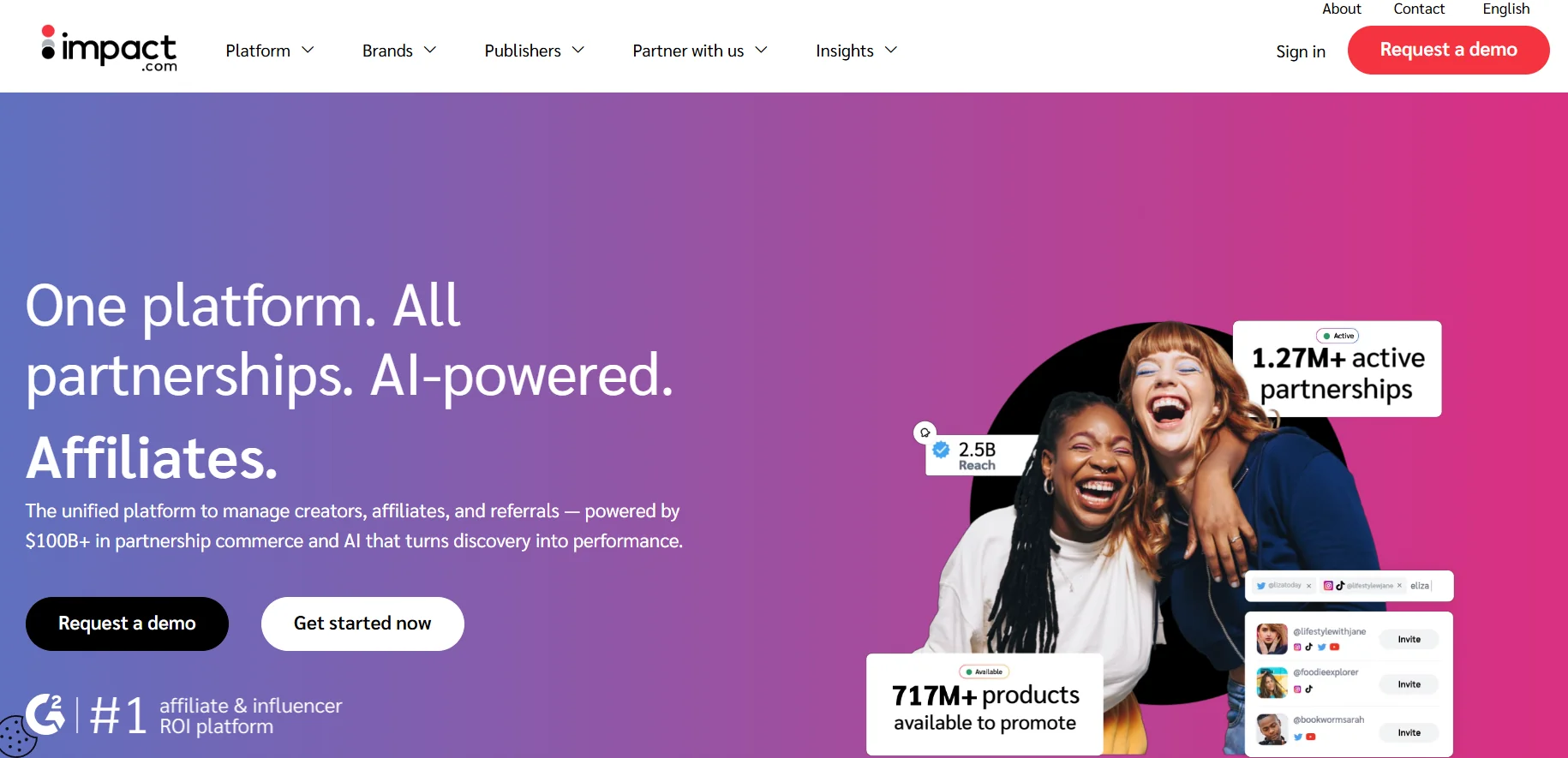
It feels strange listing impact.com as an alternative when it is also the destination Rakuten advertisers are being migrated to, but that is exactly why it belongs here. If you are moving anyway, you should evaluate it as a choice rather than accept it as a default.
impact.com is a partnership platform rather than a single affiliate network. It handles affiliates, influencers, referrals, B2B partners and commerce content under one contract, with cookieless first-party tracking, contract automation, fraud monitoring and a marketplace of vetted partners. It reported powering more than two million partnerships in 2026. For brands running several partner motions at once, the consolidation is the real product.
Pricing is tiered and unusually visible for the enterprise end of this market. Starter is $30 per month or 3% of monthly revenue generated through the platform, whichever is higher, with a 30-day trial. Essential is around $500 per month and Pro is around $2,500 per month, with Enterprise quoted individually. A network fee of roughly 2.5% applies on commissions across plans.
The honest caveat: the percentage fees compound as your program grows, so the entry price tells you very little about what you will actually pay at scale. Reviewers also consistently describe a steep learning curve, and support quality gets mixed marks from smaller brand accounts.
4. CJ Affiliate
CJ Affiliate, formerly Commission Junction, is the most direct like-for-like swap on this list. It has been running since 1998, it holds deep publisher relationships in consumer retail, travel and finance, and it does the same job Rakuten's network side used to do. If your program lived on major content and coupon publishers, CJ is where those same partners already are.
Its strength is reach and reporting depth. You get granular commissioning rules, so you can pay different rates by customer location, promotion type or new-versus-returning status, plus customer journey insight and competitor benchmarking. Brands running structured affiliate programs at real volume tend to rate the data highly.
CJ does not publish pricing. Expect a quote built from a setup or activation fee, a monthly network access fee and a percentage cut of the commissions you pay out. Industry estimates put network overrides across the big legacy networks somewhere in the 20% to 30% range on top of partner commissions, which is the number that actually decides whether the model works for you.
The honest caveat: onboarding is guided rather than self-serve and typically takes a week or more, the interface draws the same "dated" complaints Rakuten does, and account policies penalise inactivity. It is also worth knowing that CJ's parent Conversant completed a sale to Stagwell in late 2025, so it is not immune to the same ownership churn that pushed people off Rakuten.
5. Awin
Awin is the network that solved the "I want a real affiliate network without an enterprise contract" problem before anyone else did. It runs more than 9,500 advertisers and around a million publishers globally, and in 2026 it completed the absorption of ShareASale, folding both networks into a single platform.
The reason it lands high for brands leaving Rakuten is Awin Access. It starts at $49 per month with no long-term contract, and it gives you the full publisher network, tracking, an intuitive dashboard and unlimited team seats. You can launch a self-managed programme without a sales cycle, which is close to the opposite of the Rakuten buying experience. Larger programmes move to Accelerate or a custom enterprise agreement.
Coverage is genuinely global, which matters if the international side is what kept you on Rakuten in the first place. Ecommerce integrations for Shopify and the major carts are straightforward.
The honest caveat: the ShareASale migration was not universally loved, and plenty of long-time affiliates found the transition rough. There is a real irony in leaving one migration for a platform that just finished its own. Awin also charges a percentage override on transactions in addition to the plan fee, so model the total, not the sticker.
6. Partnerize

Partnerize sits in the enterprise partnership automation tier alongside impact.com, and it is the pick for brands that want network-grade infrastructure without joining a network. It covers partner discovery, recruitment, commission optimisation, brand safety, fraud prevention and payment in more than 200 markets and multiple currencies.
Where it earns its place as a Rakuten alternative is control. Rakuten's model routed your program through its own publisher relationships and managed services. Partnerize hands you the machinery and lets you decide who is in your program, how they are paid and what rules govern the payout. Retail, travel and financial services brands with in-house partnership teams are its natural fit.
Pricing is not published at all. The structure is typically a fixed license fee plus a percentage-based component, quoted after a sales process.
The honest caveat: no public pricing means no benchmarking before you enter a sales conversation, which is the exact complaint that sends people looking for Rakuten alternatives to begin with. It is also a lot of platform for a brand that has not yet proven the channel.
7. Everflow
Everflow is the tracking purist's option. It is a partner marketing platform built for teams that care about attribution precision above everything else, covering affiliates, influencers, referrals, media buying and in-app publishers in a single reporting layer.
The pull for former Rakuten advertisers is granularity. You can track unlimited events, break performance down by partner, placement, city and creative, and catch coupon or click spamming with click-to-conversion time alerts. It has a full two-way API, which makes it the strongest option here if you want your affiliate data flowing into your own warehouse rather than living inside a network's dashboard. It integrates with Shopify, BigCommerce, WooCommerce, Stripe, PayPal and Tipalti, and it is a common pick among agencies and networks as well as brands.
The Core plan starts at around $750 per month with a six-month minimum commitment, and it includes unlimited partners, conversions and clicks. Everflow+ adds white-glove migration, training and global payments, and is quoted individually. If you are weighing this against lighter options, our roundup of affiliate payment tools covers the cheaper end of the market.
The honest caveat: Everflow gives you tracking, not partners. There is no meaningful publisher network to recruit from, so if the reason you used Rakuten was access to its publishers, this solves the wrong half of the problem.
8. Levanta
Levanta is the newest name on this list and the most interesting one for brands selling on marketplaces. It runs a single creator and affiliate program across Amazon, Shopify and Walmart, which no legacy network does well. In March 2026 it unified creator and affiliate programs into one motion, so discovery, commissions and payouts all sit in the same place regardless of where the sale lands.
For Amazon sellers specifically, it does something Rakuten never could. Levanta tracks the Brand Referral Bonus, the credit Amazon returns for off-Amazon traffic that converts, which effectively offsets part of your creator commission cost. It also reports on Best Seller Rank movement and new-to-brand orders, so you can see whether creator traffic is doing anything beyond the immediate sale. An AI-powered creator marketplace handles recruitment, and automated 1099 filing handles the tax admin.
Pricing is public. The Gold plan is $750 per month plus 3.5% of affiliate-driven sales for marketplace programs, a Shopify-only plan runs $350 per month plus 4%, and Enterprise is custom. There is also a Launch plan for qualifying Amazon sellers under $3M in annual sales. Creators join free and Levanta takes no cut of their commissions.
The honest caveat: the percentage on affiliate-driven sales sits on top of the monthly fee, so a high-volume program pays real money. It is also narrow by design. If you do not sell on Amazon, Shopify or Walmart, most of what makes Levanta special does not apply to you.
9. ShopMy
ShopMy is where a lot of beauty, fashion and lifestyle brands ended up when they realised their affiliate revenue was coming from creators rather than publishers. Creators build storefronts of products they genuinely use, share those links with their audience, and brands get SKU-level attribution back.
The reason it works as a Rakuten alternative is cultural as much as technical. Rakuten's publisher mix skews toward deal, cashback and content sites, which convert on intent that already exists. ShopMy's creator commerce model builds the intent, which is a different growth motion entirely. It is strong for micro and nano creators, and brands running it alongside ambassador platforms tend to treat it as the storefront layer of a wider program.
Brand pricing starts at around $399 per month and climbs toward $2,799 and above on higher tiers, with GMV-based transaction fees layered on top. Its Opportunities feature, which lets you fund paid creator actions, takes 15% of whatever budget you deposit, billed on top of the subscription.
The honest caveat: ShopMy restructured its plans in 2026, and bulk gifting through Lookbooks is no longer the default step up from the affiliate tier. If gifting is your main use case, confirm the current plan structure before you commit. Category fit is also narrow, so it works far better for beauty and fashion than for most other verticals.
10. PartnerStack
PartnerStack closes the list for a specific reader: the B2B SaaS brand that ended up on Rakuten because it was the network everyone recommended, then discovered that a retail publisher network is a poor fit for software with trials, demos and recurring revenue.
PartnerStack is built for that world. It handles affiliates, referral partners and resellers, tracks deal registration, syncs referrals into your CRM, and runs partner onboarding and enablement paths. Its marketplace holds well over 100,000 active B2B partners, which is a recruitment pool no consumer affiliate network can match for software.
Pricing has become clearer recently. A free Spark tier costs nothing monthly but charges a 10% processing fee on commissions and excludes marketplace access and CRM integrations. Launch starts around $1,000 per month on annual billing, with Growth and Enterprise quoted individually. Historically the platform also charged a percentage on partner commissions, typically in the 3% to 15% band depending on volume.
The honest caveat: this is a B2B SaaS tool wearing affiliate clothing. Ecommerce, retail and DTC brands will not find the depth here that they get from any of the other nine options, and the fee on commissions punishes programs that scale faster than their budget.
Which Rakuten Advertising Alternative Should You Pick?
The 2026 shake-up did brands a favour, even if it did not feel like one. Being forced off a platform is the only time most teams actually re-examine whether the platform was right. Rakuten's network was built for a version of affiliate marketing that ran on publishers and deal sites, and plenty of programs have quietly stopped looking like that.
So pick by where your revenue actually comes from. If it comes from creators, a marketplace or an all-in-one creator platform will beat a network on both cost and speed. If it genuinely comes from large publishers, impact.com, CJ or Awin are the real swaps, and Awin Access is the only one of the three you can start on for $49 a month without a sales call. If you sell on Amazon or Walmart, Levanta is doing something none of the others are.
For brands earlier in the journey, Afluencer is the low-friction way to start. Post a Collab, let verified creators come to you, and build a commission program from people who already want to work with you. Sign up as a brand or chat with CreatorGPT to map out your first campaign.