.svg)
.png)
10 Best Refersion Alternatives in 2026
Most brands searching for Refersion alternatives in 2026 are doing the same piece of math. Refersion rebuilt its pricing this year, and every self-serve plan now stacks a percentage of your affiliate revenue on top of the subscription.
Launch runs $39/month plus 3% of affiliate-driven sales, Growth is $199/month plus 2%, and the flat-fee Scale plan only opens up once you pass $1M in annual GMV. At $20K a month in affiliate revenue, that 2% is another $400 leaving your account before you've paid a single creator.
To be fair, Refersion earns its reputation. However, the complaint that shows up again and again in reviews is not tracking, it's scope. Refersion manages affiliates you already have. It does not find them, and it has no creator search, so most brands end up bolting a second tool on top just to source the people who will promote them. That gap is exactly why affiliate influencer marketing has pushed brands toward platforms that handle discovery and commissions in one place.
The list below covers open creator marketplaces, Shopify-native apps, flat-fee trackers and full affiliate networks, and every one of them solves at least one thing Refersion doesn't. Let's get into them.
Top 10 Refersion Alternatives in 2026
1. Afluencer
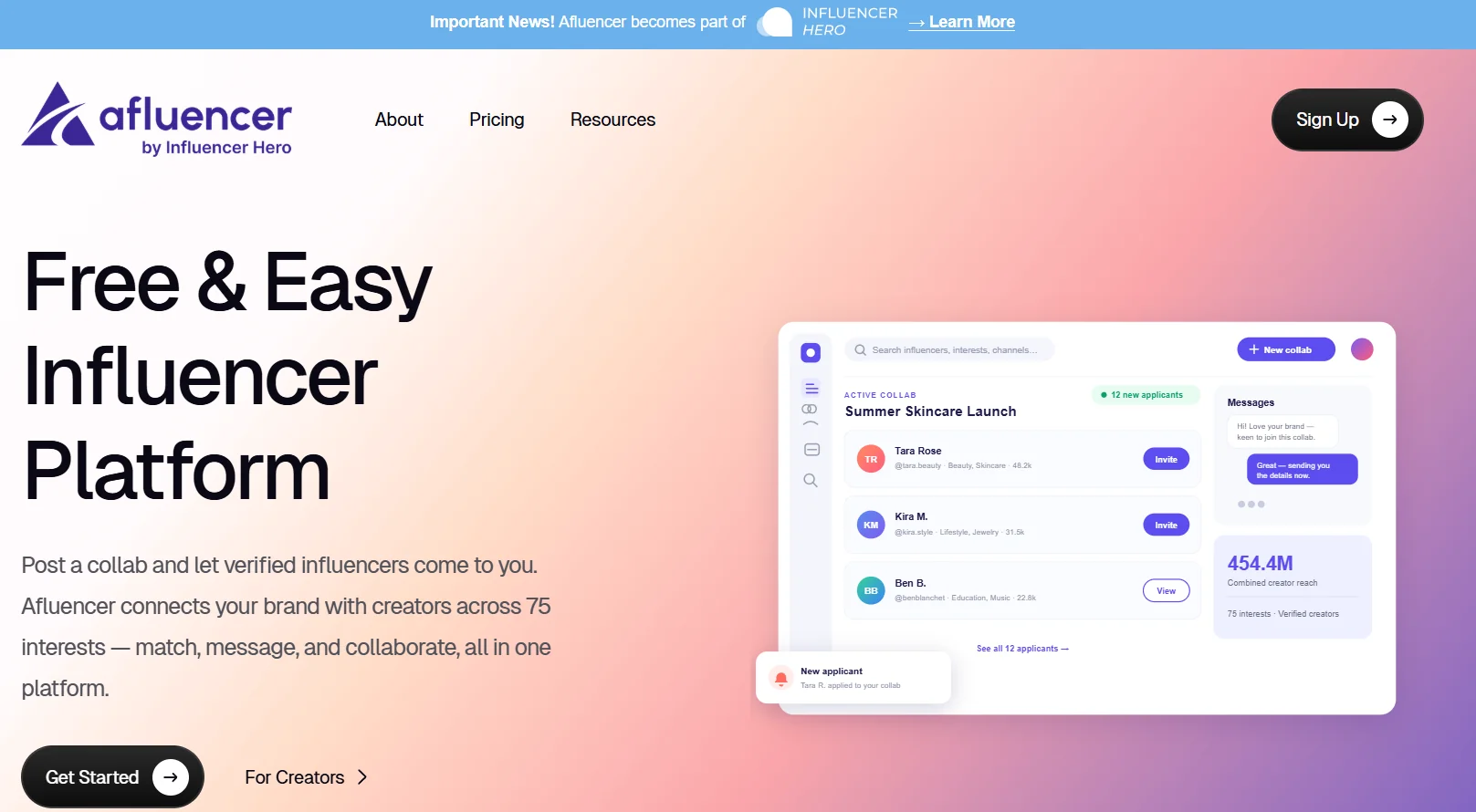
Afluencer flips the recruiting problem on its head. Instead of hunting for affiliates and hoping they answer, you post a Collab describing your offer, your commission and your product, and verified creators apply to you. For a brand replacing Refersion, that fills the biggest hole in the stack: you get a pipeline of people who want the partnership, not just software to track the ones you already found.
The platform is built around DTC and Shopify brands working with micro and nano creators, which is the same audience most affiliate programs recruit from anyway. You set your criteria before the Collab goes live, so applications arrive pre-filtered by niche, follower count, country and pay model. From there you message creators, ship product, and move the good ones into a longer-term arrangement.
That progression matters. A lot of affiliate revenue comes from a small group of repeat promoters, and Afluencer is a natural top of funnel for brand ambassador programs you build over months rather than one-off link drops.
Afluencer also leans on AI to cut the busywork. You can chat with CreatorGPT for campaign strategy, commission structures and outreach advice, and the Afluencer Collab Finder matches creators to your live opportunities so the right people see your offer instead of scrolling past it.
Brand pricing is public and starts at $49/month for the Marketplace tier, which gives you directory access, Collab posting and basic analytics. Standard is $649/month with 1,000 monthly reach-outs, product shipping and influencer payments, and Pro is $1,049/month with 5,000 reach-outs and a dedicated account manager. Compared to paying a percentage of every affiliate sale forever, a fixed $49 entry point is a very different cost curve.
Afluencer is a marketplace, not affiliate tracking software. It sources and manages the creator relationship brilliantly, but if you need SKU-level commission rules and first-party conversion tracking, pair it with a tool built for that. For brands just getting started that is the ideal setup, and brands that want to scale into a large, fully tracked program usually graduate to Influencer Hero.
Ready to test it? Post your first Collab and see who applies.
2. Influencer Hero
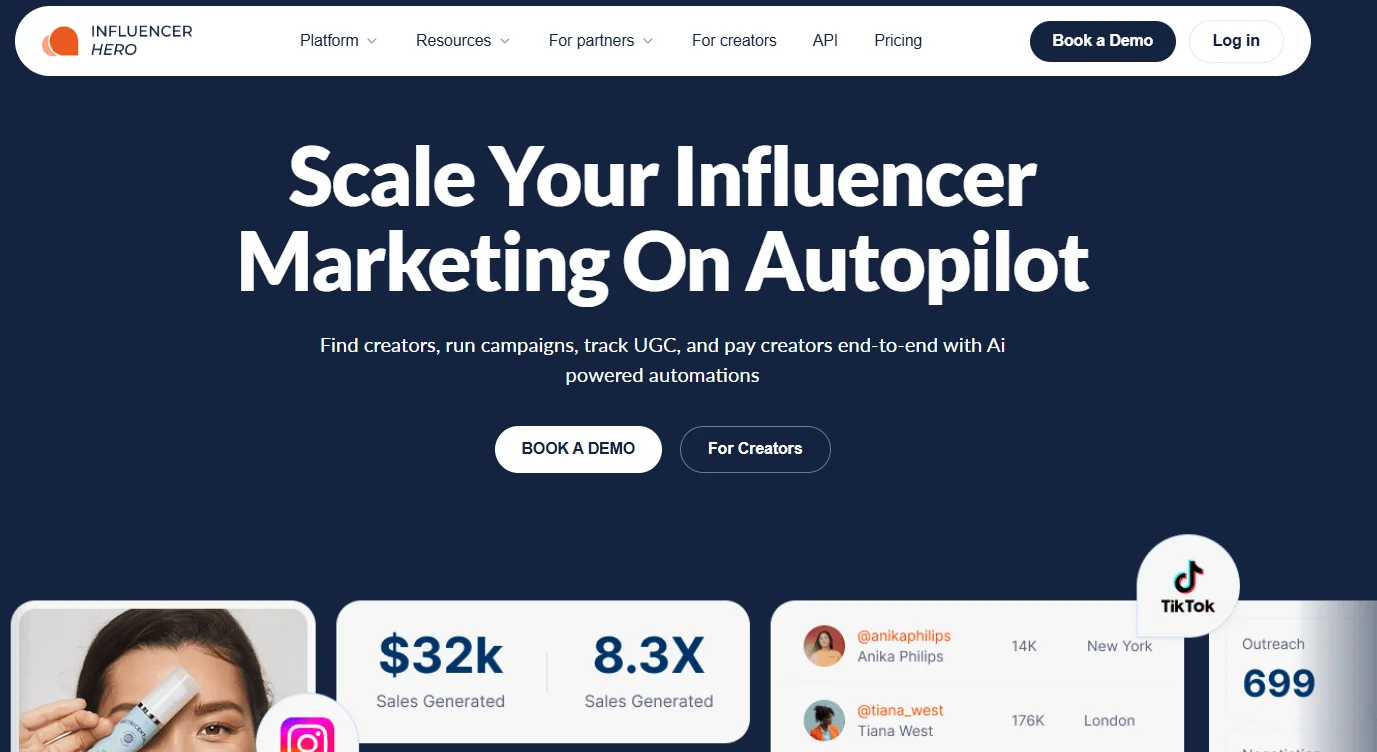
Influencer Hero is the closest thing on this list to a full replacement for Refersion plus the three tools brands usually run alongside it. Affiliate management sits at the centre: every creator gets a trackable affiliate link, a unique discount code and their own storefront, with sales attribution tied back to the person who drove them. Commissions calculate automatically, and payouts run through the platform with payment fees between 0.1% and 0.5%, well under the 5% to 7% most platforms charge.
Where it pulls ahead of Refersion is everything that happens before the first tracked sale. Discovery runs across a 450M+ creator database on Instagram, TikTok and YouTube, with lookalike search and brand-follower detection that surfaces creators already following you. Outreach is automated, the CRM keeps every deal in one pipeline, and ROI reporting ties content to revenue. The creator-facing side runs on Creator Hero, a separate product from the same company that powers the commission storefronts and payout experience.
Pricing is public: Standard is $649/month for up to 1,000 creators, Pro is $1,049/month for up to 5,000, and Business is $2,490/month for up to 10,000, with custom and agency plans above that.
One honest caveat: there is a three-month minimum commitment and no free trial, and $649 is a big jump from a $39 Refersion plan. If all you want is affiliate link tracking, this is more platform than you need. If you want discovery, outreach and affiliate revenue in one system, the math works quickly.
Book a demo to see the affiliate and attribution side in action.
3. Social Snowball
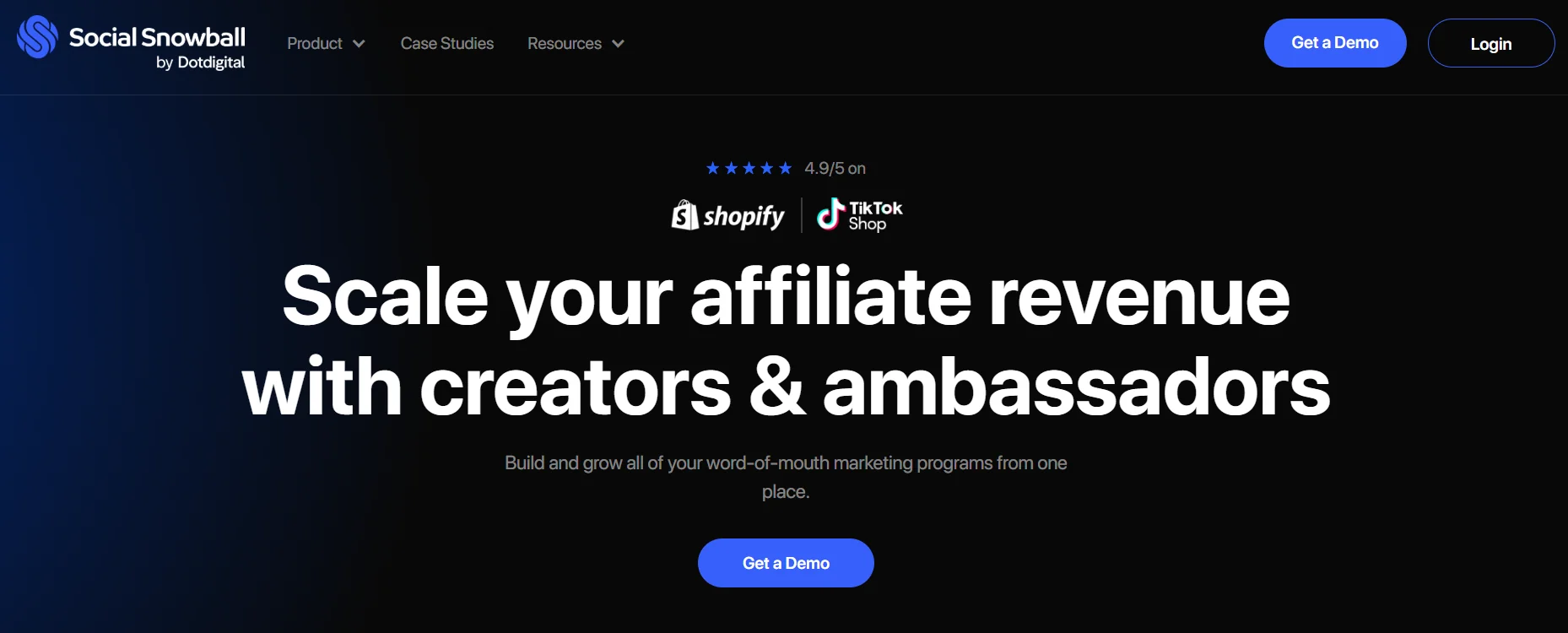
Social Snowball is the name that comes up most often when Shopify brands leave Refersion, mostly because of one feature: it turns customers into affiliates automatically at checkout. A post-purchase popup enrols buyers the moment they are happiest, which solves recruitment without any outreach at all. It also handles TikTok Shop affiliates, instant cash and gift card payouts, and Safelinks to stop discount code leaks.
The catch is that it copies the part of Refersion people are trying to escape. Snow Day starts at $249/month plus 3% of affiliate revenue, and Blizzard starts at $899/month with no commission fee. Both are quote-based, so those numbers are floors rather than fixed prices. The break-even sits around $22K in monthly affiliate revenue, which is worth calculating before you commit.
It's a strong pick if your program leans on customer advocacy and word of mouth, and it sits comfortably among the better ambassador platforms for Shopify brands. It is a weak pick if you are cost-sensitive at low volume, since $249 plus 3% is well above what Refersion charges to start.
4. UpPromote
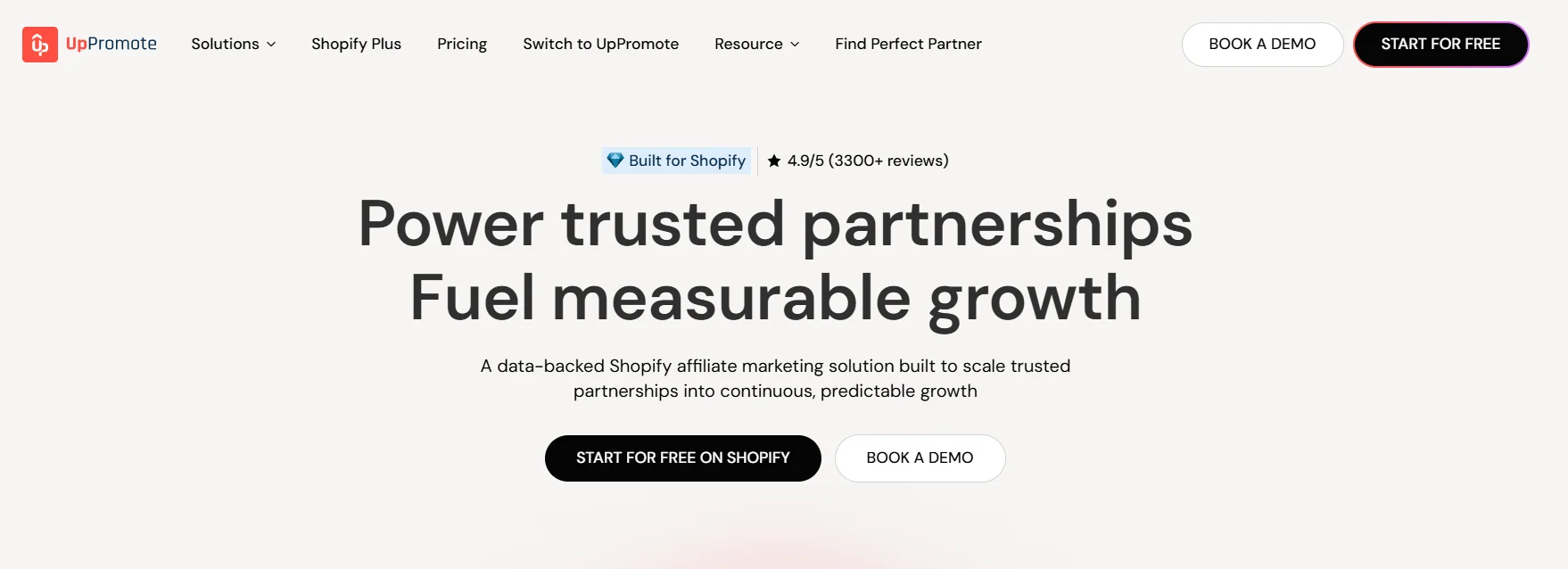
UpPromote is the highest-rated affiliate app on the Shopify App Store, holding 4.9 out of 5 across 3,200+ reviews and carrying the Built for Shopify badge. It covers the Refersion feature set closely: affiliate signup forms, links and coupons, commission rules, multi-level referrals, anti-leak discount links and 24/7 live chat. It also has a built-in marketplace where affiliates can find your program.
Pricing starts free, then moves to Growth at $29.99/month, Professional at $89.99 and Enterprise at $199.99, each with a 14-day trial. Every paid tier adds a performance fee on approved referral sales, 2%, 1.5% and 1% respectively, so the fee shrinks as you move up rather than staying flat like Refersion's.
It's cheaper than Refersion at almost every stage, and the free plan makes it easy to migrate and test before paying. Two honest limitations: it only works on Shopify, and creator discovery is a paid add-on billed separately at $39 or $79 a month on top of your plan.
5. GoAffPro
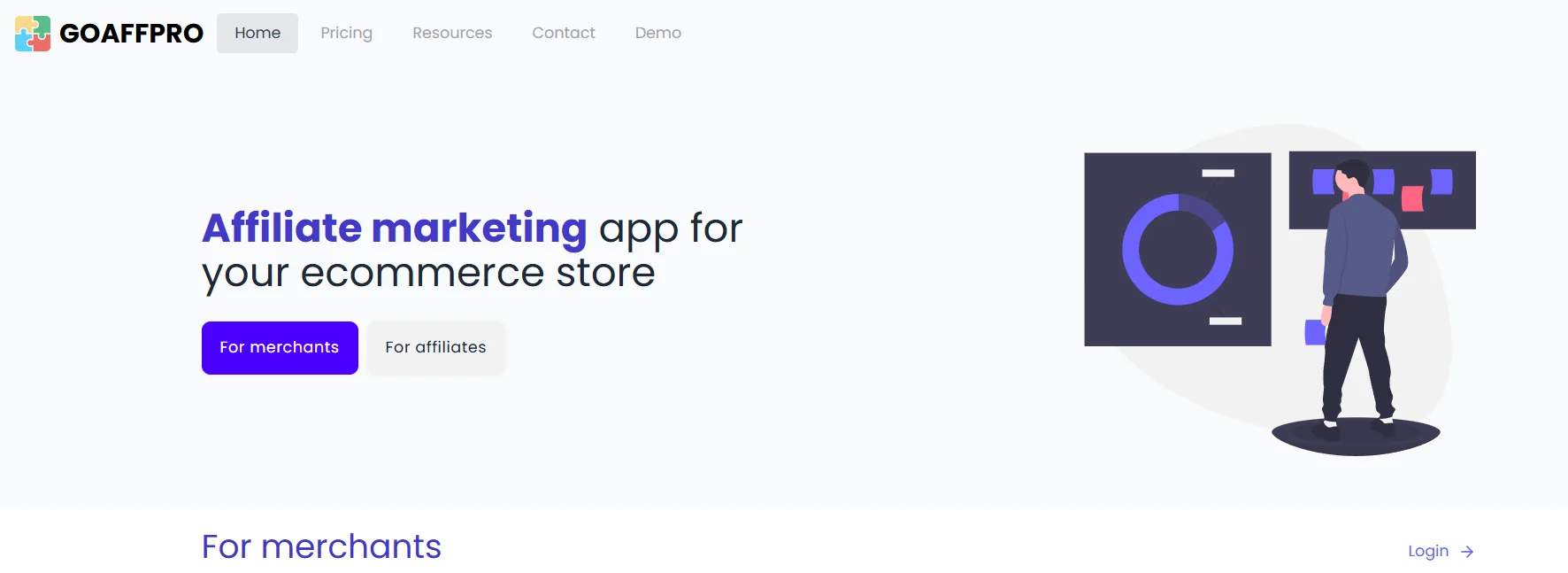
GoAffPro is the budget answer to Refersion, and it is not a stripped-down one. The free plan includes unlimited affiliates, unlimited clicks and unlimited referral orders, plus a branded affiliate portal on your own subdomain. More than 100,000 merchants use it, and unlike most apps on this list it runs on Shopify, WooCommerce, BigCommerce, Wix, Squarespace, Webflow and a dozen other platforms.
The premium tier is listed at $49/month in GoAffPro's own documentation and unlocks multi-level affiliate networks, tiered and target-based bonuses, bulk email campaigns, white-labelling and 1099 and W-9 generation. There is a Business plan above that for custom compensation plans, automations and dedicated support, and both paid tiers come with a 15-day trial.
The trade-off is depth. Reporting is basic next to Refersion's, integrations outside the core ecommerce stack are limited, and pricing listed across third-party sites varies enough that you should confirm your tier in-app. For a small program that just needs links, codes and payouts, it is hard to beat on cost.
6. Shopify Collabs
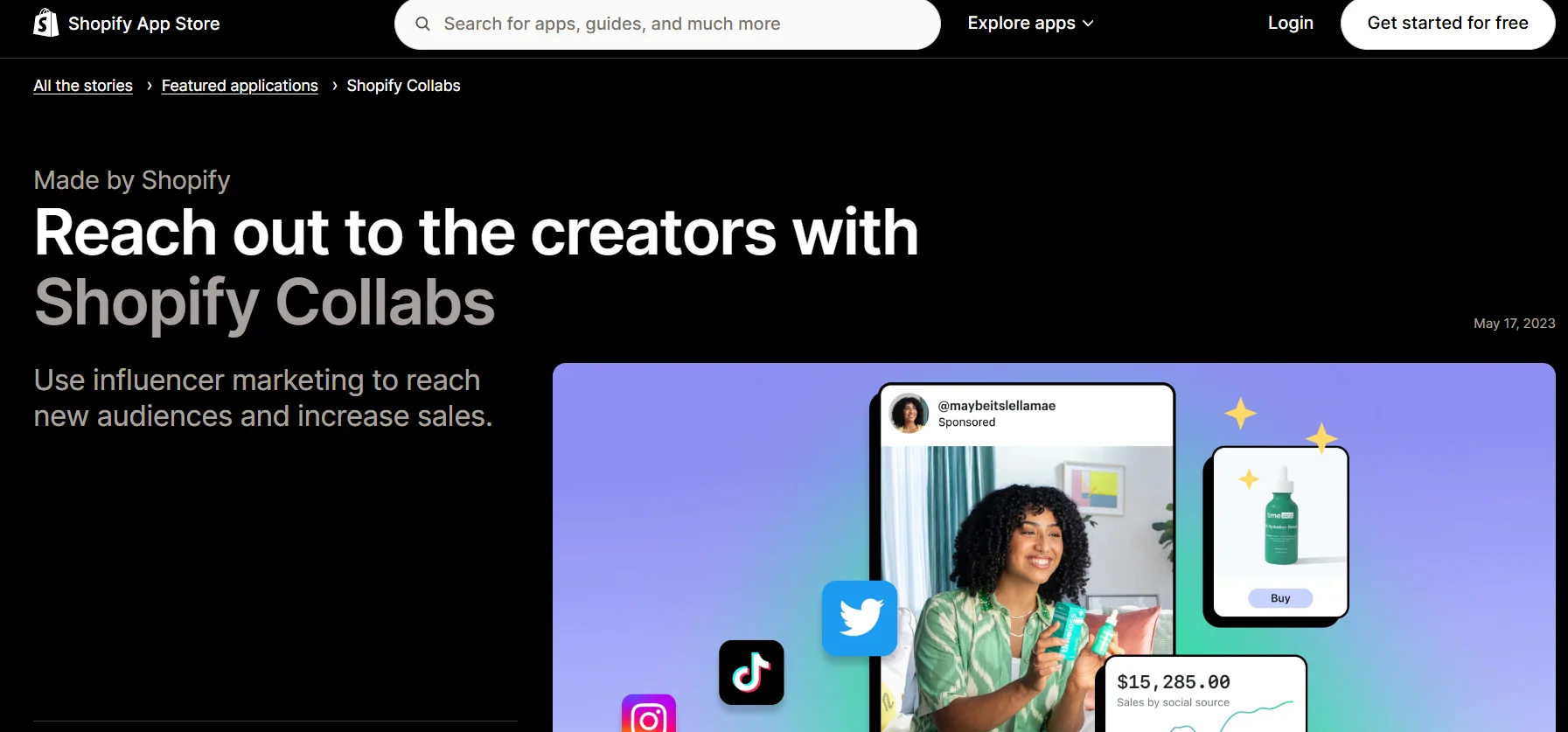
If your store already runs on Shopify, Collabs is the lowest-friction Refersion alternative available. It lives natively in your Shopify admin, generates affiliate links and discount codes per creator, handles product gifting, and pays commissions automatically. Attribution runs off your own store data, so there is no third-party tracking layer to configure or debug.
Cost is the headline. There is no subscription and no install fee, just a 2.9% processing fee on commission payouts. For a brand paying $39 plus 3% on Refersion, that is genuinely cheaper, and it removes a tool from the stack. It also gives you a gifting workflow, which puts it ahead of most single-purpose influencer marketing platforms at this price.
Two real limits. Creator signups to the Collabs network are paused, so you cannot count on inbound discovery, and you need at least $10,000 in sales over the past 12 months to appear in the discovery feed. There is also no creator vetting, so quality control is on you.
7. Tapfiliate
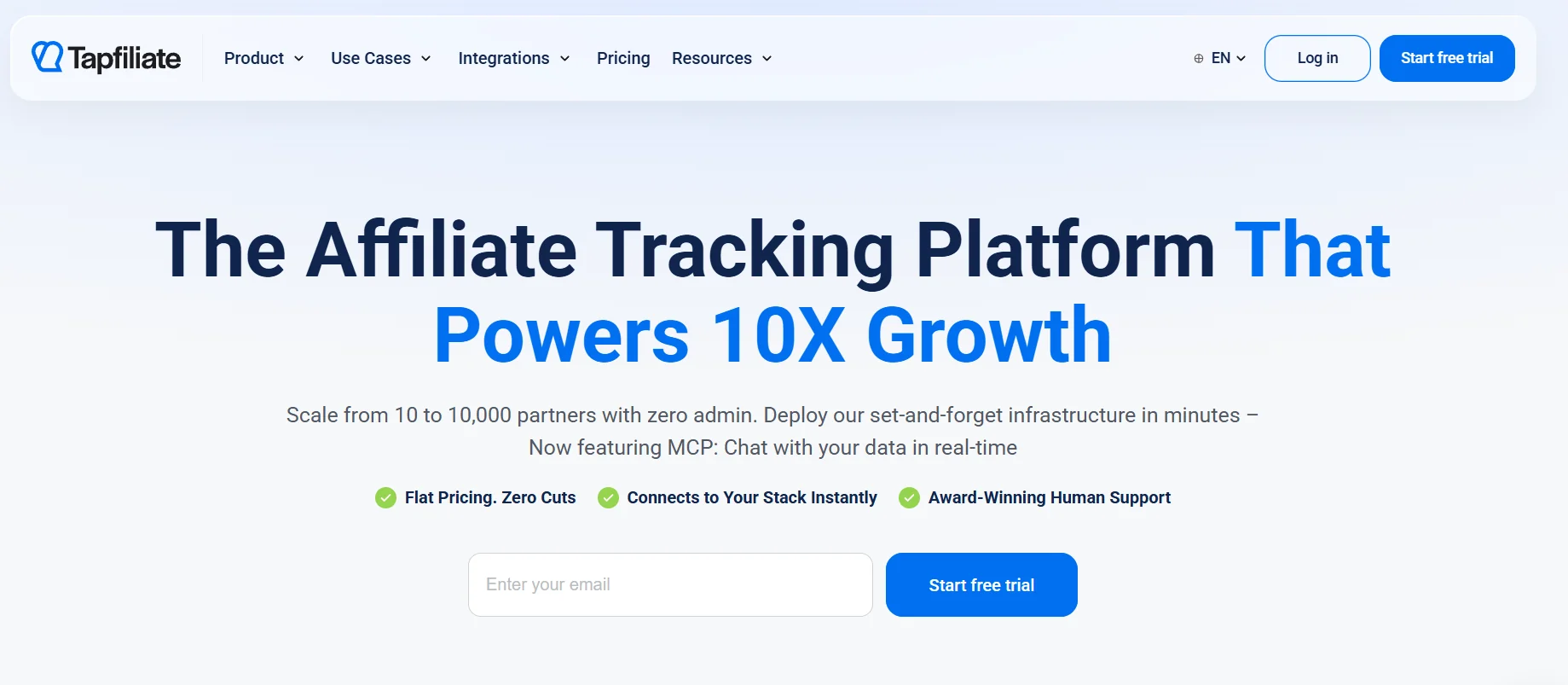
Tapfiliate exists for brands whose main objection to Refersion is the revenue share. It charges a flat monthly fee and takes 0% of your affiliate sales, so your cost stays predictable no matter how big the channel gets. That single difference gets more valuable every month your program grows.
The commission engine is the strongest part. You can run percentage, flat-rate, recurring, lifetime, group, product-level and category-level commissions, plus performance bonuses and full MLM structures, all without code. It supports six languages and multiple currencies, connects to 30+ integrations including Shopify, WooCommerce and Stripe, and works for ecommerce and subscription businesses alike.
Launch starts at $89/month and Scale is $149/month, with Enterprise quoted custom and a free trial on every tier. The honest caveat: Launch caps you at 50 affiliates with one seat, and entry plans carry monthly click and conversion limits with overage fees, so a fast-growing program lands on Scale sooner than the pricing page suggests.
8. LeadDyno
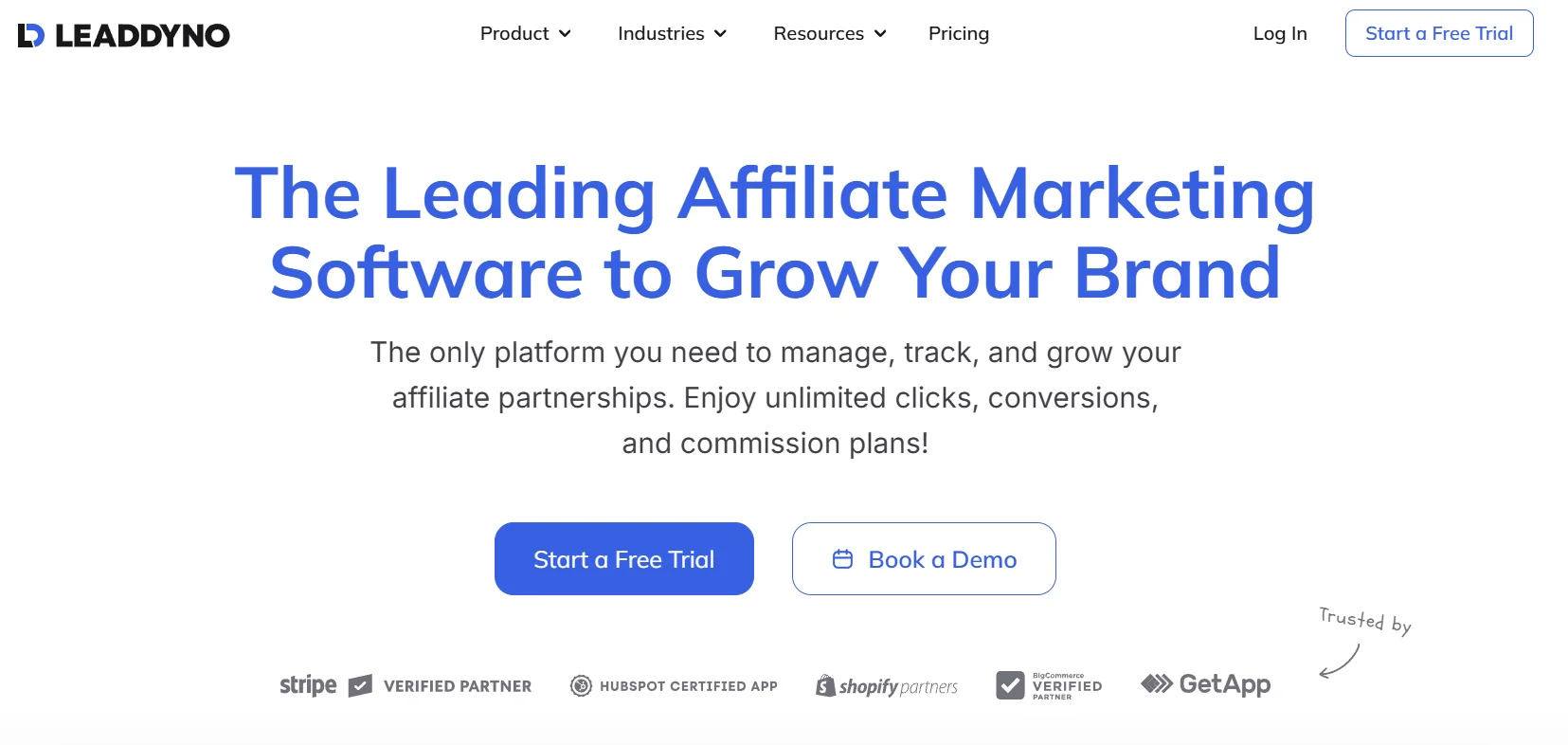
LeadDyno is the other flat-fee option worth shortlisting, and it is aimed squarely at brands that want affiliate onboarding to run itself. Affiliates get personalized dashboards, tracking links, brand assets and social templates the moment they join, and commission plans support tiered, flat, percentage and MLM structures with bonuses layered on top. Fraud prevention flags suspicious signups before they cost you.
Like Tapfiliate, it takes no percentage of affiliate revenue, and clicks and conversions are unlimited on every plan. Pricing runs $49/month for Lite, $129 for Essential, $349 for Advanced and $749 for Unlimited, all with a 30-day trial, which is the most generous window on this list.
The plans are gated by active affiliates rather than revenue, so Lite caps you at 50 affiliates and a single commission plan. Reviewers also note that reporting is lighter than what Refersion gives you, so if granular conversion analysis is central to how you optimize, test it properly before you migrate.
9. impact.com
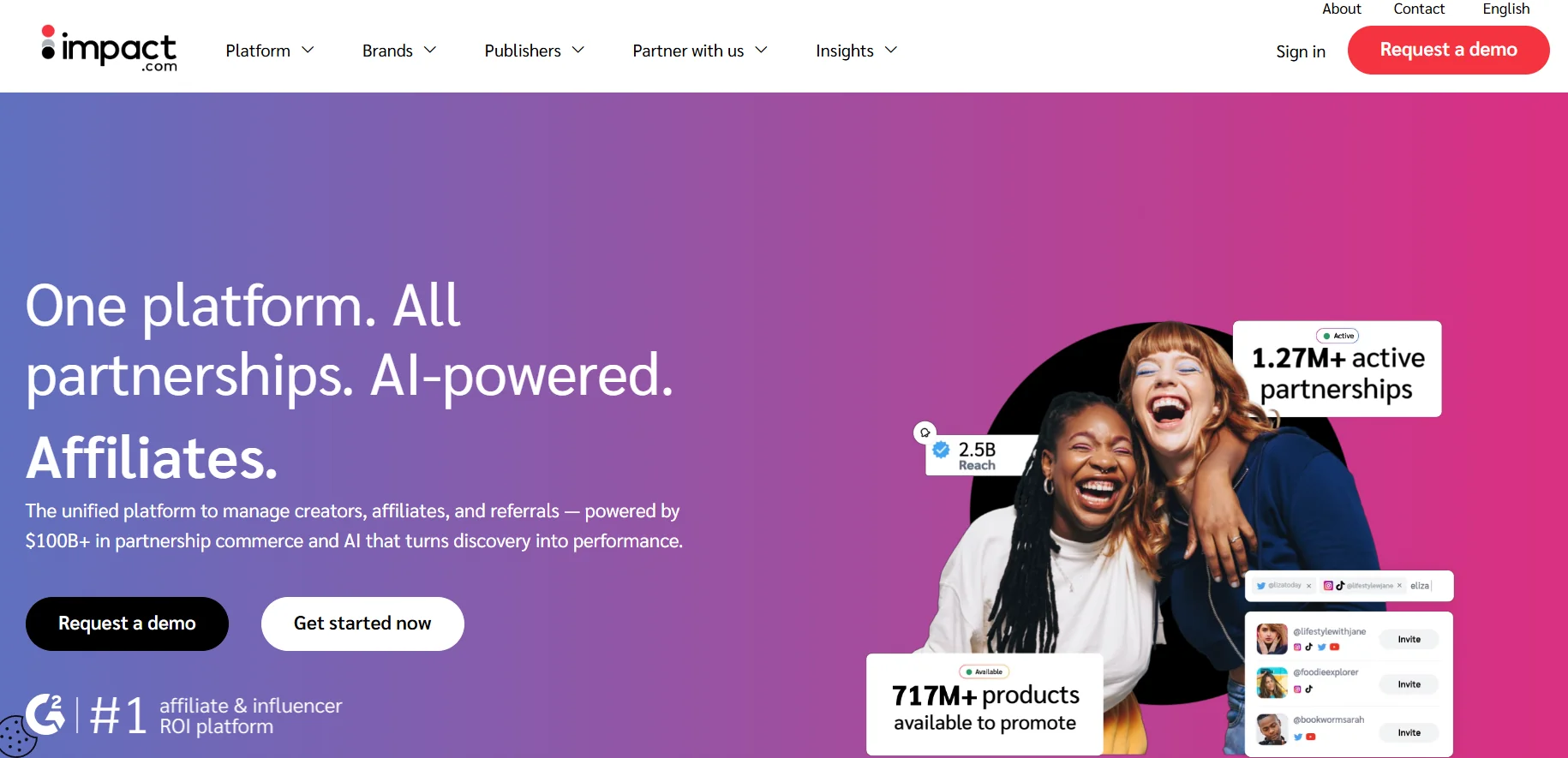
impact.com is where brands go when affiliates are only one of several partner types. It manages affiliate, influencer, customer referral and B2B partnerships in one system, with contracts, automated payouts, fraud detection and cross-device attribution that is genuinely best in class. Its marketplace is one of the deepest sources of vetted publishers and creators anywhere, which directly solves Refersion's recruitment gap.
Pricing is tiered and mostly quote-based. The Starter plan aimed at Shopify merchants is published around $30/month or 3% of monthly revenue, whichever is higher, with mid-tier plans commonly quoted from $500/month and enterprise contracts running far higher. Onboarding also carries a one-time technical fee.
It is overkill for a small program, and the setup curve is real. But if you are already thinking about how to structure commissions, tiers and affiliate perks across hundreds of partners, impact.com is built for that scale in a way Refersion is not.
10. Awin
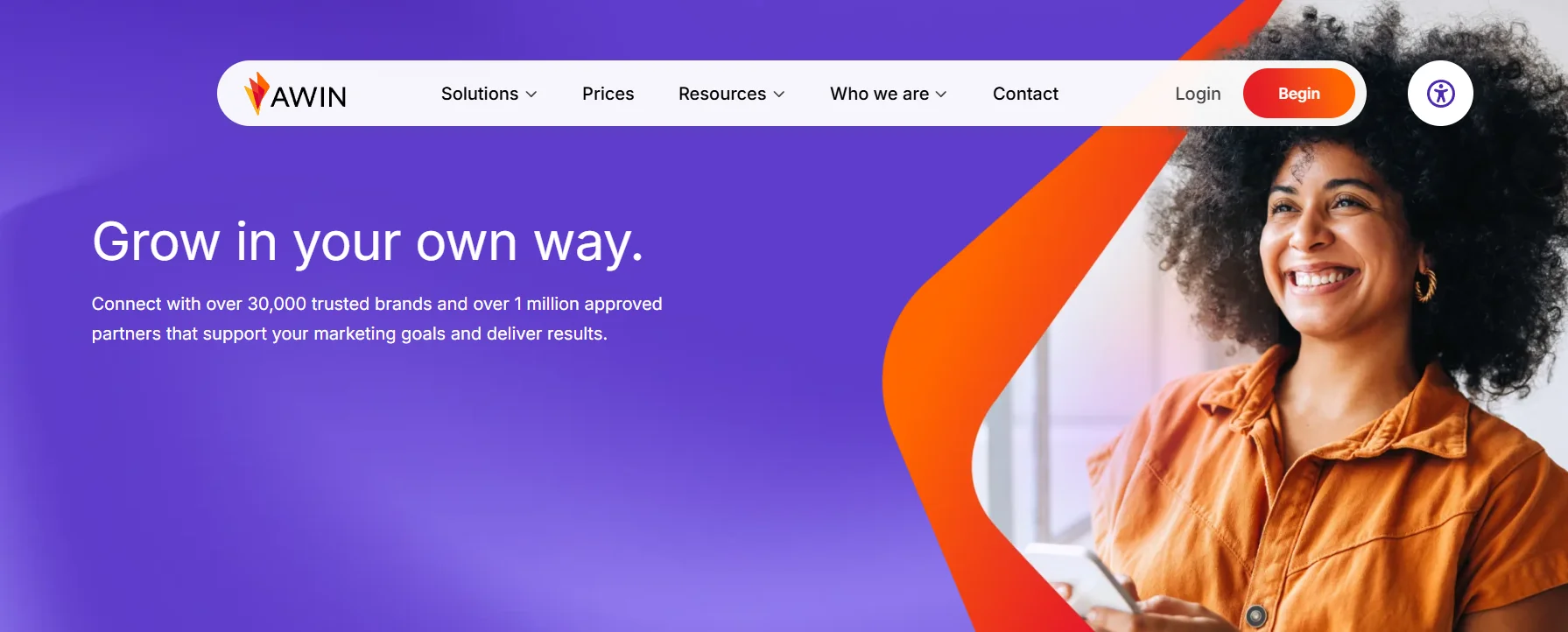
Awin is the one true network on this list, and that is the point. Refersion gives you software to run your own program, so you still have to find every affiliate yourself. Awin plugs you into an existing pool of more than a million publishers, including content creators, coupon sites, cashback sites and bloggers. In 2026 it completed the absorption of ShareASale, consolidating both publisher bases into one platform.
Awin Access is the self-managed entry plan, priced around $49 a month in the US with a one-time setup fee and no long contract, plus a 3.5% tracking fee on transactions. Accelerate and Advanced tiers are quoted custom and drop the tracking fee to 2.5%, adding automation and bespoke reporting.
Two honest caveats. Network fees mean you are paying a percentage again, which defeats the purpose if that was your reason for leaving. And the ShareASale migration was rough for plenty of affiliates, so expect some publisher-side friction if you inherit an older program.
Which Refersion Alternative Should You Pick?
The reason you left Refersion should decide where you land. If the percentage on affiliate sales was the problem, go flat-fee with Tapfiliate or LeadDyno. If the problem was that Refersion tracks affiliates but never helps you find them, you need a platform with discovery attached. And if you are on Shopify and want the cheapest working setup, Collabs at 2.9% on payouts is tough to argue with.
For most small and mid-sized brands, the real bottleneck is not tracking software, it's a shortage of creators who will actually promote the product. That is where Afluencer fits: post a Collab, let verified creators apply, and build your affiliate roster from people who raised their hand. Chat with CreatorGPT to shape your commission structure first, then browse live influencer programs to see how other brands are pitching creators before you write your own.