.svg)

.png)
10 Best Influencer Relationship Management (IRM) Tools in 2026
Most brands don't lose creators because the content flopped. They lose them because nobody followed up.
The rates sit in a spreadsheet. The contract lives in someone's inbox. The creator who drove your best month last year never got a second brief, because the person who ran that campaign left in March.
Influencer relationship management software exists to close that gap. An IRM tool is a CRM built for creators: contact records, agreed rates, past deliverables, performance history, and every message in one searchable place. Good discovery tools get you the shortlist. IRM is what keeps that list alive after the first campaign ends.
Most teams hit the wall around 15 to 20 active creators. Below that, a spreadsheet holds. Above it, you start double-paying people, missing renewals, and re-recruiting creators you already have.
Let's break them down one by one.
Quick Comparison: IRM Tools at a Glance
The Top 10 Influencer Relationship Management (IRM) Tools in 2026
1. Afluencer
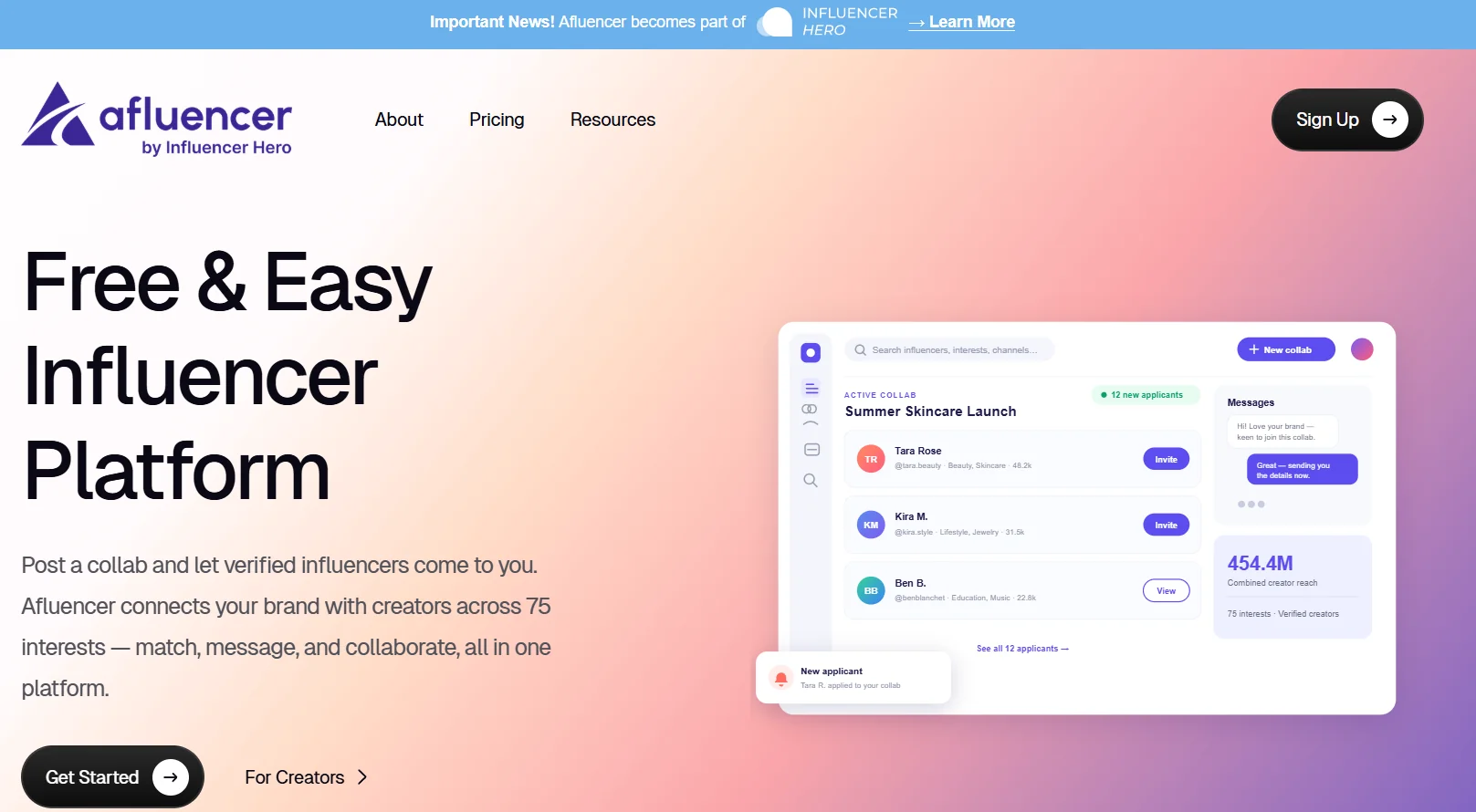
Afluencer flips the recruiting problem. Instead of scraping a database and cold emailing strangers, you post a Collab and verified creators apply to you. Every applicant lands in your account as a profile you can filter, message, and keep, which means your roster builds itself while you run campaigns.
That inbound model matters for relationship management specifically. The creators in your list already raised their hand for your brand, so second and third collabs are a much easier conversation than a cold restart.
The numbers: Brand plans start at $49/month on the Marketplace tier, which includes 60 invitation credits a month, premium influencer filters, and phone, email, and live chat support. Standard runs $649/month with 1,000 reach-outs, product sending, and influencer payments. Pro is $1,049/month with 5,000 reach-outs, a dedicated account manager, and 3+ seats. Billing is monthly, and full tiers sit on the Afluencer pricing page. Creators join free, which is why the supply side stays deep.
Afluencer pairs well with a gifting motion, since gifted collabs are the cheapest way to test a creator before you commit to a paid relationship. Here's the full gifting campaign walkthrough if that's your entry point.
Chat with CreatorGPT for campaign strategy, or try the Afluencer Collab Finder to get matched with live opportunities on Afluencer.
2. Influencer Hero
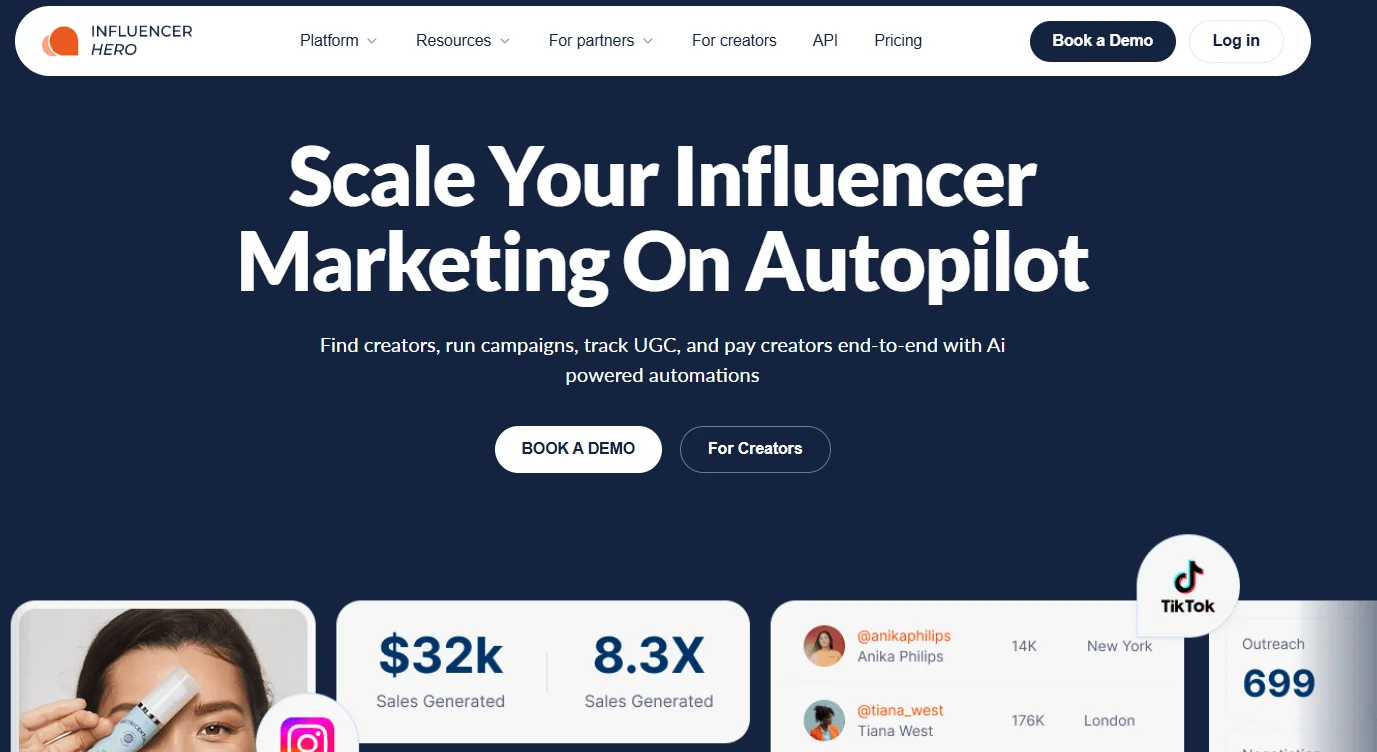
Influencer Hero is built around the creator record itself. Discovery, automated outreach, CRM, gifting, affiliate links, and ROI attribution all write back to the same profile, so the creator you emailed in January is the same record you attribute revenue to in June. That continuity is the whole point of IRM, and it's where stitched-together stacks usually break.
The CRM side goes deeper than most. You get custom fields on the deal page, automations that trigger off those fields, invoice workflows, and content review cycles with approve or reject comments. Coverage spans Instagram, TikTok, and YouTube, and Shopify or WooCommerce brands get gifting and affiliate tracking wired in natively.
The numbers: Pricing is publicly listed. Standard is $649/month for 1,000 monthly reach-outs and one seat. Pro is $1,049/month for 5,000 reach-outs, three seats, and a dedicated account manager. Business is $2,490/month for 10,000 reach-outs, eight seats, unlimited influencer payments, and UGC tracking. Plans carry a three-month minimum, and agencies get custom pricing.
One honest caveat: there's no free trial, and $649 is a real jump from discovery-only tools. If you only need search and vetting this quarter, it's more platform than you'll use.
Book a demo to see the CRM and attribution side in action.
3. Influencity
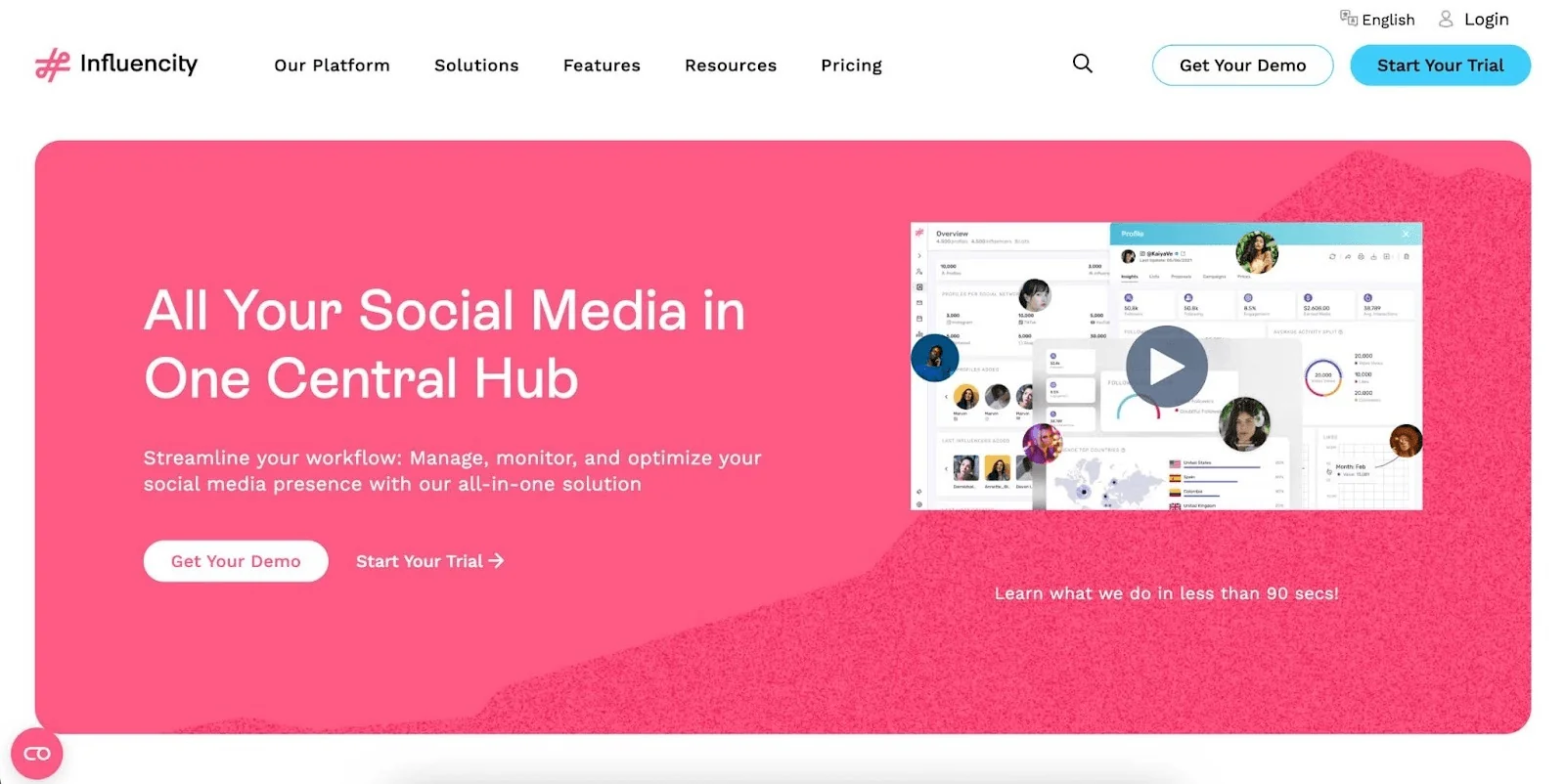
Influencity is one of the few platforms that names IRM as its own product, not a feature buried inside campaign management. You get creator lists, custom labels, communication history, and a shared database that multiple team members can work from, sitting on top of a 200M+ profile index across Instagram, TikTok, YouTube, and Twitch.
Agencies like it for a specific reason: you can keep separate client rosters clean inside one account, instead of running four spreadsheets.
The numbers: Influencity loads its prices dynamically, so confirm on the pricing page before you budget. Third-party sources through mid-2026 report a Basic tier around $168/month, a Professional tier around $348/month where the IRM module and unlimited analyses unlock, and a Business tier near $698/month. All plans come with a 7-day free trial and month-to-month billing is available, with no permanence clause.
Where it falls short is commerce. There's no native gifting logistics or affiliate attribution, so ecommerce brands usually pair it with another tool.
4. Modash

Modash earns its place on price transparency alone. It publishes every number, which is rare here. The platform covers a 350M+ creator database, audience quality checks, verified email outreach, campaign tracking that auto-collects posts and Stories, and creator payments across 180+ countries.
For relationship management, the tracked-creator list is the core object. Modash keeps watching the creators you've added, so you see who's still posting about you months after the campaign brief closed.
The numbers: Essentials is $299/month billed monthly, or $199/month on annual billing, and covers 2 seats, 100 tracked creators, 300 profile opens, and 150 email unlocks. Performance is $599/month monthly or $499/month annual, with 5 seats, 250 tracked creators, creator payments, and affiliate management. Enterprise starts around $14,700/year. There's a 14-day free trial with no card required.
Watch the caps rather than the headline price. Tracked creators and email unlocks are what push teams to the next tier, not seats.
5. GRIN

GRIN coined the "influencer relationship management" label, and in 2026 it rebuilt how you buy it. Pricing is now usage-based around Gia, its AI operator, and you pay for the work Gia does rather than per seat. The hands-on creator workspace, now called GRIN Classic, comes bundled from the mid tier up.
Classic is still the strongest part for relationship work: unlimited CRM contacts, email sequences, landing pages, partnerships, and native Shopify integration that ties creator activity to actual orders. Gia handles sourcing, shortlisting, outreach, and reporting on credits. If your bottleneck is outreach tools and follow-up volume, that's the trade GRIN is making for you.
The numbers: Free is $0 with 200 monthly credits and no card. Starter is $200/month with 2,000 credits. Growth is $500/month with 7,500 credits and GRIN Classic for up to 100 active creators. Scale is $1,000/month with 20,000 credits and 250 active creators. Complete is $1,500/month with 30,000 credits and 500 active creators. Every plan is month-to-month with no annual contract and no required sales call.
The catch is where Classic starts. The free and $200 tiers give you Gia, not the full relationship workspace, so real IRM begins at $500/month.
6. Upfluence

Upfluence has one trick nobody else does as well. It syncs with your store and surfaces creators already buying from you, then lets you gift, pay, or enroll them in an affiliate program without ever running a cold outreach sequence. Customers who already spend money with you are the warmest relationships in your database.
The platform is modular by design, split into Find Creators, Scale Programs, and an AI-driven Auto-pilot layer powered by Jaice. Integrations cover Shopify, WooCommerce, BigCommerce, and Amazon.
The numbers: There's no public rate card. G2 lists entry around $478/month for a single Search and Contact module, and additional seats are reported near $79/month each. A 12-month contract is standard, and reviewers put a realistic full-stack setup at roughly $14,000 to $16,000 per year once you add the modules most teams actually need.
That modular structure is the thing to interrogate on a sales call. Buying discovery alone means you can't run campaigns or process payments from it.
7. Club (formerly Brandbassador)
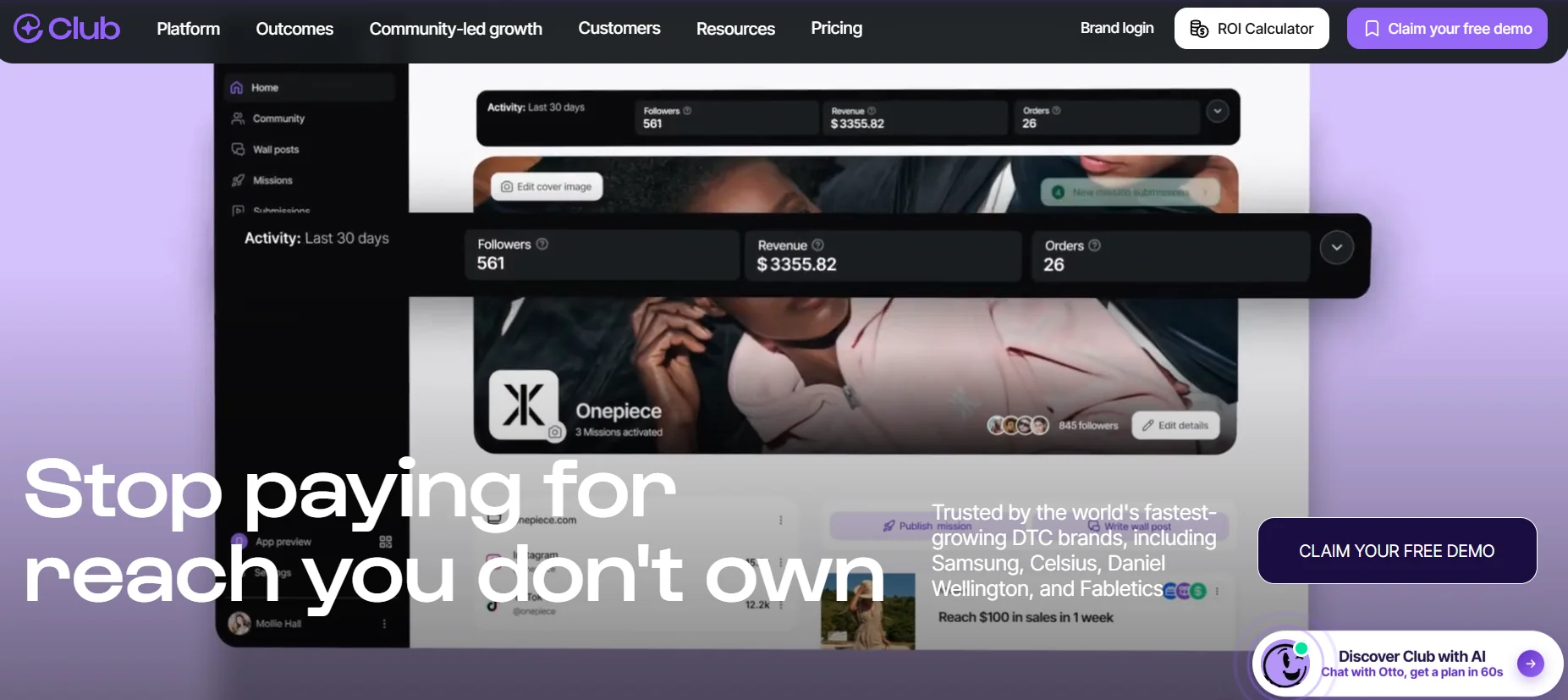
Club, which rebranded from Brandbassador, treats relationship management as community management. Instead of recruiting strangers, you activate customers and fans, then keep them engaged through gamified "missions" with points, rewards, and leaderboards. Ambassadors work from a mobile app, which keeps participation rates far higher than an email thread ever will.
It integrates with Shopify, WooCommerce, Magento, BigCommerce, and Salesforce, and rewards can pay out as cash, product, or discount codes. If ongoing advocacy is the goal rather than one-off posts, this is a different shape of tool from the rest of this list. Our roundup of ambassador platforms covers that category in more depth.
The numbers: Club doesn't publish pricing. Demo-sourced figures put the Growth plan near $2,000/month and Pro near $3,000/month, both sold on annual contracts with monthly payment options. Expect a one-time onboarding fee on top, commonly reported in the $1,000 to $5,000 range.
The trade-off is scope. It manages your community brilliantly and does very little for creator discovery outside it.
8. Aspire

Aspire sits between a marketplace and a management suite. Brands post opportunities, creators apply from a marketplace of over a million, and the platform then handles outreach, briefs, content approvals, affiliate programs, and payments. Reviewers consistently note Aspire runs more live campaigns than rival marketplaces, which keeps inbound flowing.
For long-term relationships, the ambassador workflow is the draw. Aspire is designed around ongoing creator communities rather than isolated activations, with strong Shopify support for gifting and tracking.
The numbers: Aspire doesn't publish rates. Third-party reports put entry around $2,300/month plus an onboarding fee on a 12-month contract, landing near $25,000 to $30,000 for the first year. Capterra lists a starting price of $2,499.
Budget for the commitment, not the month. Brands consistently flag the annual lock-in as the thing they wish they'd negotiated harder.
9. Traackr
Traackr is the analytics-first option, and it's built for teams who have to justify creator spend to a CFO. It keeps one creator record across markets and business units, tracks what every team has paid that creator, and benchmarks your program against competitors in the same category.
Beauty, fashion, and CPG teams running programs in multiple countries are its core audience. If two regional teams are quietly paying the same creator different rates, Traackr is the tool that surfaces it.
The numbers: Pricing is quote-only with annual contracts and no monthly billing. Third-party sources report a Growth tier around $25,000/year with a roughly 3-user minimum, Standard near $32,500/year, and Plus near $55,000/year, with custom Enterprise above that. Treat those as reported figures, since Traackr quotes by seats, markets, and integrations.
There's no self-serve path and no public trial, so evaluation runs through sales either way.
10. CreatorIQ
CreatorIQ is the enterprise end of the category. Direct API integrations with the social platforms mean the performance data is first-party rather than scraped, and the platform adds white-labeling, compliance workflows, and reporting built for organizations running creator programs across dozens of teams. Disney, Unilever, Sephora, and LVMH are on the client roster.
As an IRM system it's genuinely deep. Creator records carry full history, rights, payment status, and cross-campaign performance, with permissions that let big teams work in the same database without stepping on each other.
The numbers: CreatorIQ publishes nothing publicly. Procurement data reported through 2026 puts entry contracts around $30,000/year, with a median closer to $39,250 and larger deals at $59,500 and up. That works out to roughly $2,350/month, annual commitment only, with no month-to-month option.
Onboarding is a project, not a signup. Reviewers report 6 to 8 weeks before a program is fully running, which prices out most mid-market teams on time as much as money.
How to Choose the Right IRM Tool in 2026
The best IRM tool is the one that matches the size of your roster and the way you already work. Run your shortlist through these five filters.
- How many creators you actually manage. Under 15, a spreadsheet still works. Between 15 and 100, Afluencer, Influencity, or Modash cover it. Past 250 active creators, you need something with real capacity like Influencer Hero, GRIN Scale, or an enterprise contract.
- Whether discovery lives in the same tool. Some platforms manage relationships but don't help you find anyone new. If you're building a roster from scratch, buy discovery and IRM together instead of paying twice.
- Contract length. This is the biggest hidden cost in the category. GRIN, Modash, Influencity, and Afluencer all offer monthly billing. Aspire, Upfluence, Traackr, and CreatorIQ want a year up front, before you know whether the tool fits.
- Where money moves. Rates, payouts, affiliate commissions, and invoices belong in the same system as the relationship, or your finance team ends up as the actual CRM. Getting the commercial side right starts with knowing current influencer rates so you're not negotiating blind.
- Who needs access. Seat limits bite fast. Modash Essentials caps you at two people, and several entry tiers assume a single operator. Count everyone who touches creator comms, including agency partners.
There's no single best IRM platform, and any list claiming otherwise is guessing at your budget. A three-person DTC team and a global beauty group need genuinely different software. Pick for the roster you'll have in six months, not the one you have today.
Turning One-Off Collabs Into Real Relationships
Creator programs compound. The tenth campaign with a creator who knows your product costs less, ships faster, and converts better than the first one with a stranger. Every tool on this list exists to make that repeat business possible instead of accidental.
You don't need all ten. You need one system where creator history lives, plus the discipline to actually log things in it. Start with the cheapest tool that covers your roster size and contract tolerance, then upgrade when the caps start hurting.
If you're still building the roster itself, that's the place to begin. Our roundup of marketing platforms breaks down the wider category.
Post your first Collab on Afluencer to start getting verified creators applying to you, and chat with CreatorGPT for campaign strategy while you build the program.