
.svg)

.png)
10 Best Julius Alternatives in 2026
Most brands searching for Julius alternatives are not unhappy with the data. They are unhappy with the deal. Julius, now owned by Triller, built its reputation on quality control: every creator profile gets manually vetted before it enters the database, and you get more than 50 filters to work it. Julius sells on annual contracts only, with no monthly option and no public pricing, and third-party software listings put the entry point somewhere around $24,000 a year.
There are other reasons people shop around in 2026. Julius rates 4.5 on Capterra across 107 reviews, and the recurring complaints in those reviews are consistent: profiles that go stale, a thin pool of micro and niche creators, and patchy coverage outside English-speaking markets. It is also discovery-first by design. Outreach at scale, affiliate links, creator payouts and sales attribution usually end up in a second tool, which means a second bill.
The good news is that this category has split into clear lanes. Some of the best influencer marketing platforms now publish real prices, so you can compare without a sales call. Others fold discovery, outreach and payments into one workflow instead of three.
Here are the 10 best Julius alternatives worth a look in 2026, ordered from the most accessible to the most enterprise.
Top 10 Julius Alternatives
1. Afluencer
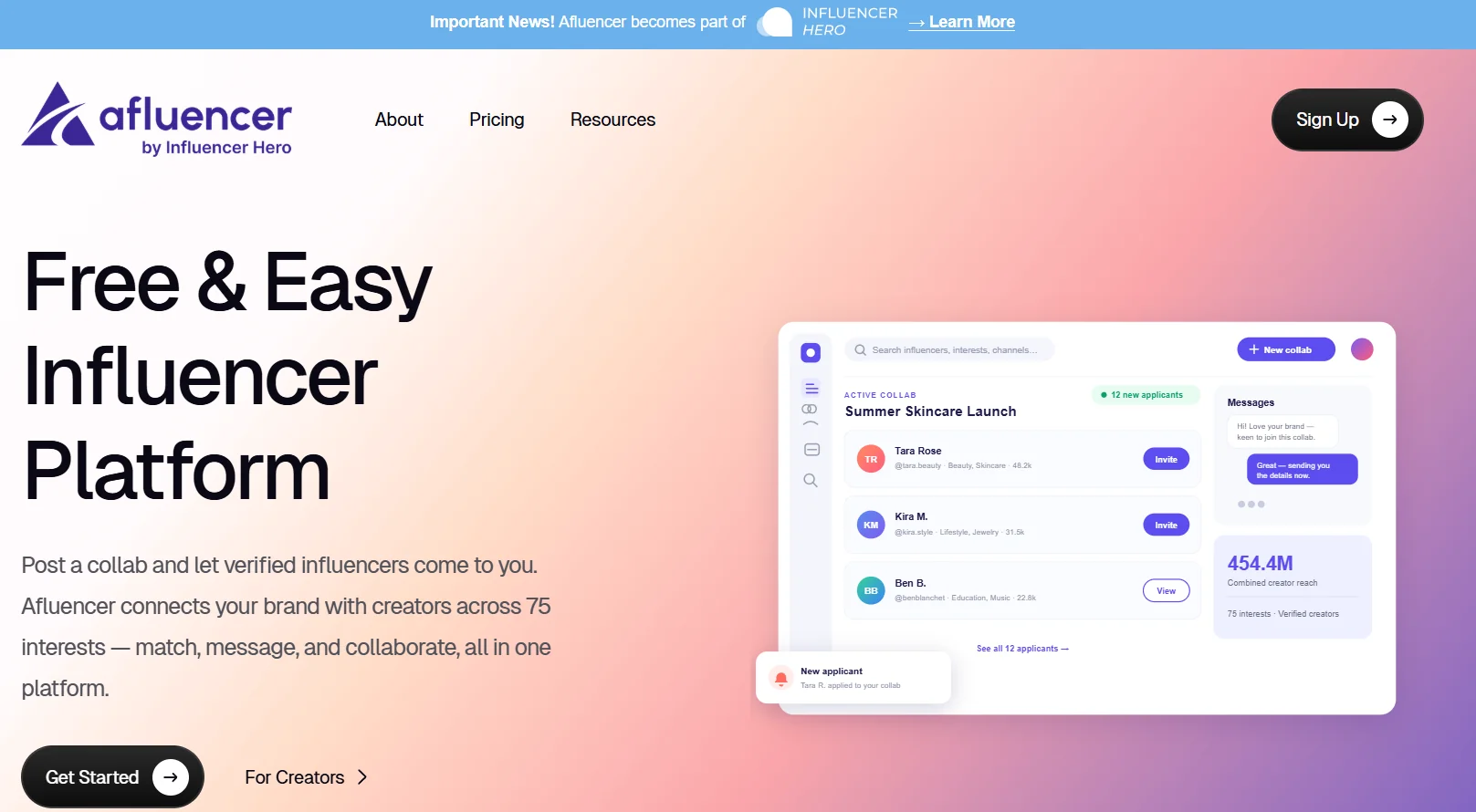
Afluencer flips the model Julius runs on. Instead of licensing a database and cold-pitching strangers, you post a Collab describing what you want, and verified creators apply to you. You review people who already raised their hand, which cuts the vetting work that makes enterprise discovery tools expensive in the first place.
That inbound approach is the reason it works as a Julius alternative for small and mid-sized brands. Julius is built for teams with an analyst mindset and a budget to match. Afluencer is built for a marketing team of one or two who need creators posting this month. You filter by category, location, follower count and engagement, message creators directly, and manage applications in one place.
It also covers the practical side of a campaign. Brands run gifting collabs, paid posts, affiliate deals and ambassador programs through the platform, and the same Collab can pull in creators across Instagram, TikTok and YouTube. If you are sending free samples, our guide to product gifting covers how to set that up without losing track of shipments.
The AI layer is where it gets genuinely useful in 2026. CreatorGPT handles strategy questions, offer structure and campaign planning, while the Afluencer Collab Finder matches creators to live opportunities so you are not filtering manually.
Brand plans start at $49 a month for the Marketplace tier, which includes 60 invitation credits a month, premium influencer filters and phone, email and live chat support. Those credits matter: they let you push your Collab to specific creators instead of only waiting for applications. Standard is $649 a month and Pro is $1,049 a month as your reach outs and payment needs grow.
One honest limit: it is a marketplace, not an enterprise measurement suite. You will not get the audience-analysis depth or the compliance reporting that a Fortune 500 team expects from Julius. If you are scaling to thousands of reach outs a month, look at the full stack platforms further down this list.
2. Influencer Hero

Influencer Hero is the best influencer marketing software for brands that want the whole program in one system instead of a discovery tool plus four workarounds. It combines creator discovery, an influencer CRM, automated outreach, gifting, affiliate management, creator payments and ROI attribution in a single workflow across Instagram, TikTok and YouTube.
That end-to-end coverage is exactly where Julius stops. With Julius you find and vet the creator, then move to another tool to run the outreach sequence, another to send product, and a spreadsheet to work out what any of it earned. Influencer Hero keeps that in one place, and its Shopify integration attributes revenue down to the individual order, which is the number most marketing directors actually get asked about.
The outreach automation is the standout. You can run personalized email sequences with follow-ups at volume, track every reply in the CRM, and trigger next steps automatically as creators move through the pipeline. It is a strong fit for mid-market DTC and ecommerce brands running ongoing programs rather than one-off campaigns.
Pricing is published, which is rare at this level. Standard is $649 a month for one seat and up to 1,000 monthly reach outs, Pro is $1,049 a month for 5,000 reach outs, three seats and a dedicated account manager, and Business is $2,490 a month for 10,000 reach outs, unlimited creator payments and UGC tracking.
Book a demo with Influencer Hero to learn more about it today. Worth doing if you are weighing it against Julius, since the comparison is really workflow coverage versus database curation, and that is easier to judge on a live screen than a feature list.
2. Modash

Modash is the transparency play. Where Julius quotes you after a call, Modash publishes its prices on the site and lets you start a 14-day trial without talking to anyone. For a lot of teams evaluating in 2026, that alone shortens the process by weeks.
The database is the other argument. Modash indexes more than 350 million creator profiles across Instagram, TikTok and YouTube, which is a very different philosophy from Julius. Julius curates a smaller, hand-checked pool. Modash indexes everyone with 1,000+ followers and gives you audience analysis and fake-follower detection to sort them yourself. If Julius kept returning the same familiar names, this is the swap that fixes it.
Beyond search, you get verified creator emails, outreach, campaign tracking and a native Shopify integration that ties creator activity to actual orders. That covers more of the workflow than Julius does, and it pairs well with the tools on our roundup of gifting platforms if seeding is your main play.
Essentials runs $199 a month on annual billing or $299 monthly. Performance is $499 annually or $599 monthly, and Enterprise is custom-quoted starting around $14,700 a year.
The catch is the usage caps. Essentials gives you 300 profile opens and 150 email unlocks a month across two seats, so heavy research teams burn through it fast. Coverage is also limited to three platforms, so Julius still wins if you need Twitch, Pinterest or LinkedIn creators.
4. HypeAuditor
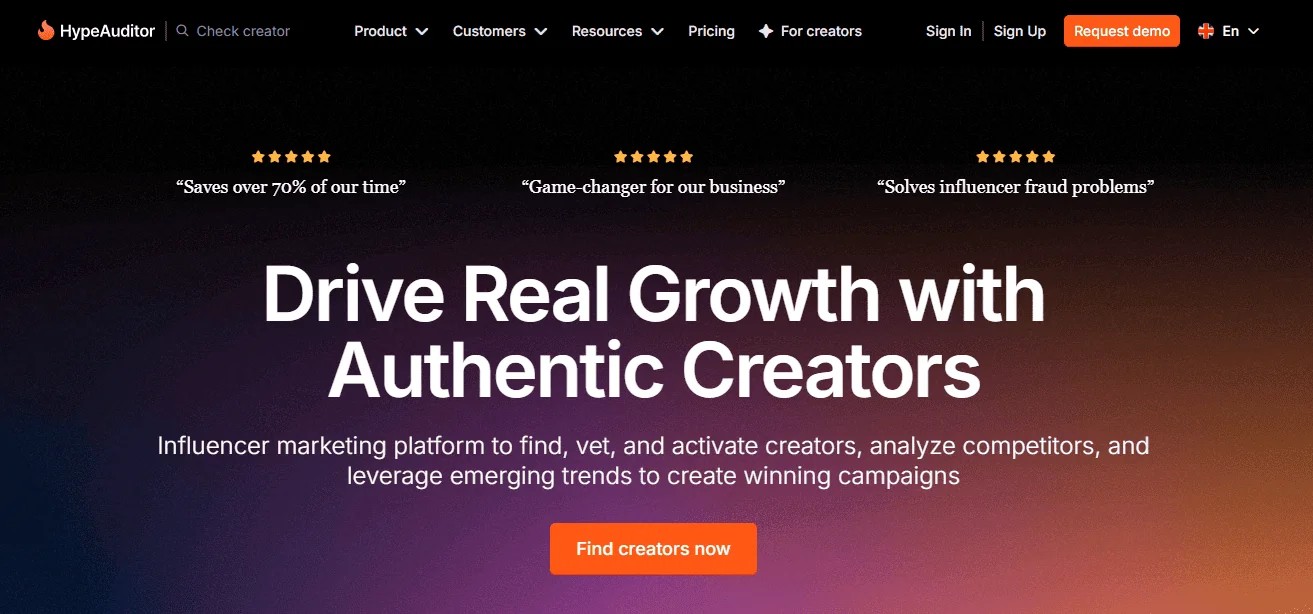
If what you value in Julius is the vetting, HypeAuditor is the closest swap at a fraction of the contract. It built its name on fraud detection, scoring audience quality and flagging bought followers before you spend budget, and it now covers a database of more than 227 million creators.
The difference is scale versus curation. Julius hand-checks a smaller pool. HypeAuditor runs automated authenticity analysis across a much larger one, which gives you both reach and a fraud filter. For agencies that have to justify creator picks to a client, the reports export cleanly and carry weight in a deck.
It also handles discovery, a creator CRM, campaign management and competitor monitoring, so it works as a research hub rather than a single-purpose checker. Teams that pair it with dedicated outreach tools get most of what Julius offers without the annual lock-in.
The Basic plan starts at $299 a month billed annually, Pro sits around $499 a month, and enterprise tiers are quote-only.
The model is the thing to watch. Every plan includes the same modules and then meters them by limits, so the tier you actually need is usually not the entry one. Budget for the real usage rather than the headline number.
5. Heepsy
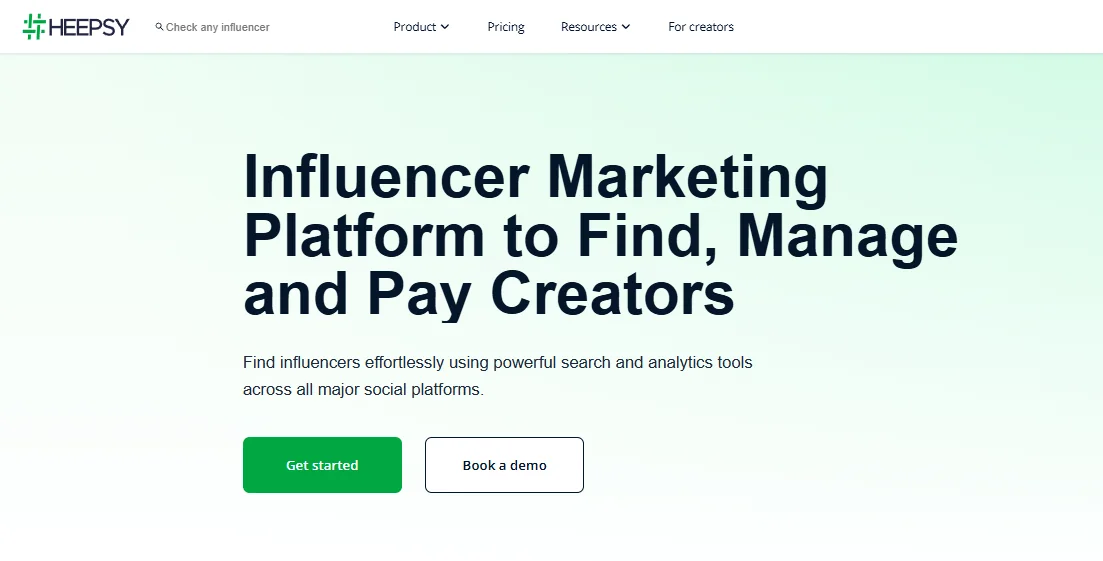
Heepsy is the budget end of the discovery market, and it earns a spot here because it solves one specific Julius complaint: cost per search. If you only need to find and check creators a few times a quarter, five figures a year is impossible to justify. Heepsy starts at roughly $89 a month.
It gives you a searchable database of 11 million-plus profiles across Instagram, TikTok and YouTube, with filters for location, category, follower count, engagement rate and audience demographics. It is particularly strong in Spanish and wider European markets, which is where Julius reviewers most often report gaps.
The Spanish company also added Shopify and WooCommerce connections for affiliate links and sales tracking, so small ecommerce teams can close the loop on what a creator drove.
Plans run from a limited free tier to Starter at about $89 a month, Plus at $249 and Advanced at $369.
Be clear-eyed about the gating. Several filters and the ecommerce integration only unlock on the $369 Advanced plan, and an 11 million profile database is small next to what Julius or Modash index. It is a starting point, not a scaling tool.
6. Upfluence

Upfluence is the ecommerce-native alternative. Its signature feature is customer-to-creator discovery: it connects to your Shopify, WooCommerce or Amazon store and surfaces the customers who already buy from you and happen to have an audience. Those creators convert better than cold picks, and Julius has no equivalent.
From there it works as a full stack. You get discovery across a large multi-platform database, AI matching through its Jaice assistant, outreach with email integration, campaign workflows, one-click product seeding, affiliate links and creator payments. For brands running affiliate programs alongside gifting, that single pipeline saves a lot of manual reconciliation.
Pricing is modular and quote-based. The Search and Contact module reportedly starts around $478 a month, and a typical full setup with workflow and payments lands near $1,276 a month, or roughly $16,000 a year billed monthly.
Two caveats. The minimum contract is 12 months, so you are trading one annual commitment for another, and onboarding fees are quoted separately. Reviewers also flag a steep learning curve in the first few weeks.
7. Aspire

Aspire, formerly AspireIQ, is built around long-term creator relationships rather than one-off campaigns. It covers discovery, an inbound creator marketplace, outreach, contracts, content approval, payments and affiliate tracking, and brands like HelloFresh, Dyson and Samsung use it for large ambassador and seeding programs.
As a Julius alternative it makes sense for teams that want the enterprise polish without the discovery-only ceiling. Julius tells you who to work with. Aspire runs the relationship after that: briefs, approvals, renewals and payouts all live in the platform. Its own creator marketplace also brings applications inbound, which is closer to how the better ambassador platforms work in 2026.
Pricing is custom and not published. Third-party sources put entry around $2,000 to $2,500 a month with a 12-month commitment, and Capterra lists a starting figure of $2,499 a month. There is no free trial.
The common complaint is that the workflow still goes manual at scale. Once you are managing hundreds of creators, outreach follow-ups and approvals start to pile up, and onboarding fees can be layered on top of the license.
8. Sprout Social
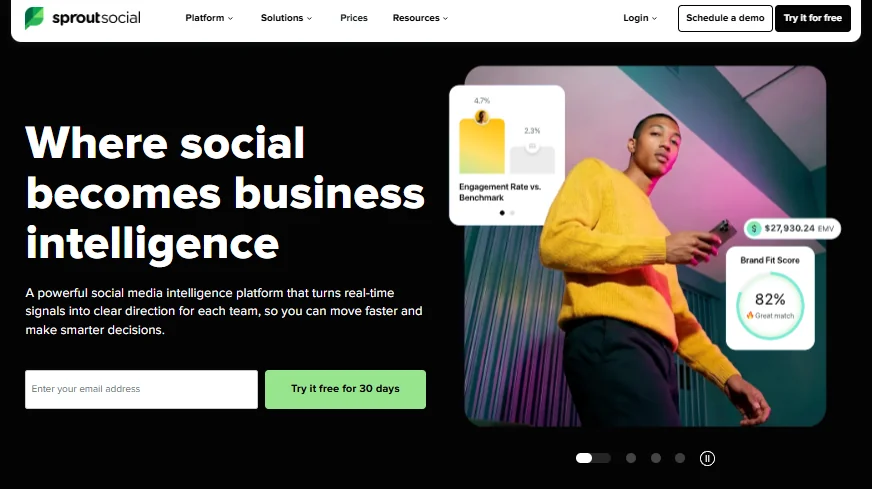
Formerly Tagger, this became Sprout Social's influencer product after the 2023 acquisition, and it is the strongest option if social listening matters as much as creator search. Its Affinity Engine profiles audience interests and affinities, so you can match creators on what their followers actually care about rather than on follower count alone.
For teams already running Sprout for publishing and reporting, the case is simple: influencer data sits in the same environment as the rest of your social program, with one login and one reporting layer. Julius has no comparable social intelligence layer, so this is the swap for brands that treat influencer marketing as part of social rather than a separate channel.
Pricing is not published for the influencer module. Enterprise buyers report figures starting around $3,000 a month on annual contracts, and bundling it with the wider Sprout suite pushes that higher.
There is no free trial for the influencer product, so you cannot test it before signing, and reviewers rate it lower than CreatorIQ on ease of use. If you are not already a Sprout customer, a lot of the value disappears.
9. CreatorIQ
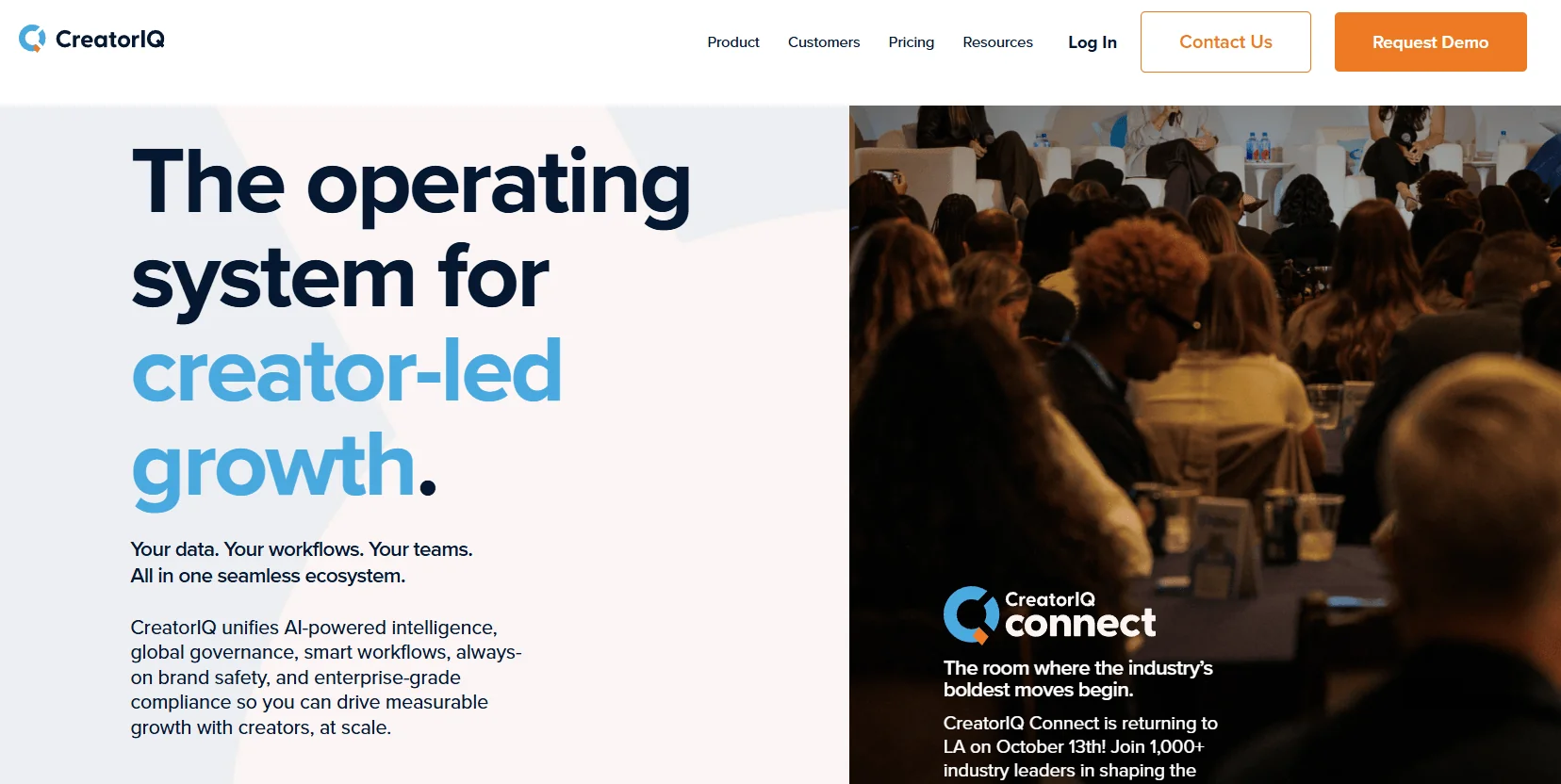
CreatorIQ is the like-for-like enterprise swap. If you are leaving Julius because the data was not deep enough rather than because it was expensive, this is the upgrade. It runs direct API integrations with the social platforms, which gives it verified first-party metrics instead of scraped estimates, and it is used by Disney, Sephora, Unilever and more than 1,300 global brands.
It covers discovery across 20 million-plus indexed creators, campaign management, content approvals, compliance workflows, creator payments and the deepest analytics in the category. For regulated industries and global programs running across several markets, that governance layer is the reason to buy.
Pricing starts around $30,000 a year based on procurement data, with a median closer to $39,250 and larger deals reaching $59,500 or more. Every contract is annual and quote-only.
So the honest read is this: CreatorIQ costs more than Julius, not less. It also needs a dedicated team to run properly, plus configuration time before you see value. Mid-market brands almost always overbuy here.
10. Traackr
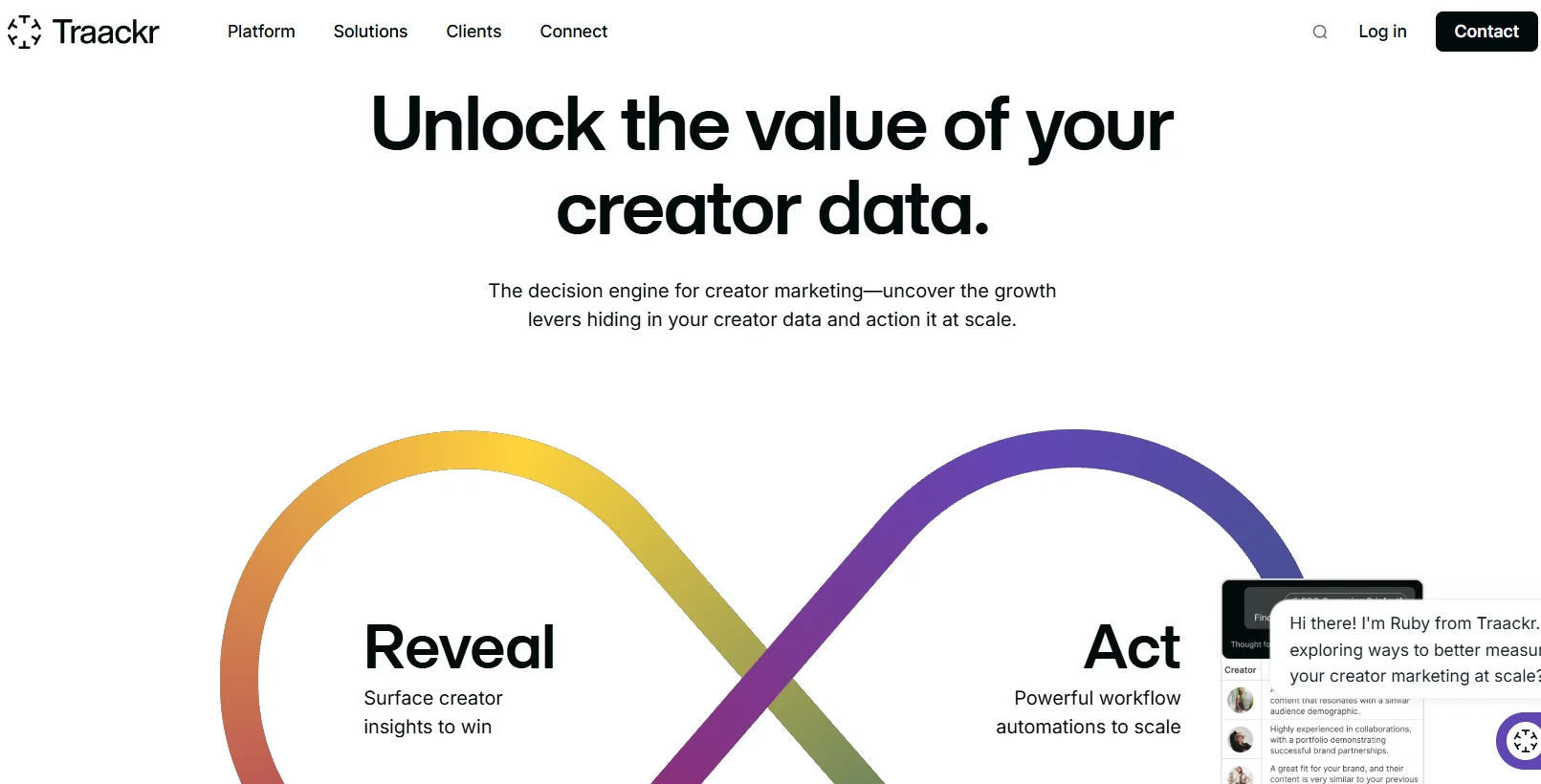
Traackr is the measurement specialist, and it appeals to the same buyer Julius targets: brands that need to defend creator decisions with data. Founded in 2008, it positions itself as a system of record, covering discovery across 13 million-plus creators on Instagram, TikTok, YouTube, Facebook, X, Twitch and Snapchat, plus influencer relationship management and competitive benchmarking.
Its Brand Vitality Score is the differentiator. It measures your brand's influencer impact against competitors across earned, owned and paid content, which is the kind of number a CMO can act on. Beauty, luxury and CPG enterprises like L'Oréal, Shiseido and Coach are the core customer base.
Pricing is annual and quote-based. Reported tiers run from about $25,000 a year for Growth with a three-user minimum, around $32,500 for Standard with five users, and $55,000-plus for Plus with a ten-user minimum. Industry benchmarking is an add-on of roughly $8,000 a year.
Those user minimums are hard floors, so a three-person team still pays for five seats. API access is gated to the Plus tier, and there is no monthly billing at any level. It solves the Julius data problem, not the Julius contract problem.
Which Julius Alternative Should You Pick?
The reason to leave Julius is rarely the platform itself. It is the mismatch between a five-figure annual commitment and the size of the program you are actually running. Once you name your real constraint, the shortlist gets short fast.
For brands earlier in the journey, or any team that would rather have creators apply than chase them, Afluencer is the lowest-friction way to start in 2026. Post a Collab, review the creators who raise their hand, and run gifting, paid and affiliate deals from $49 a month.
Chat with CreatorGPT to shape the offer first, then post your Collab and see who applies. Weighing up other enterprise tools too? Our roundup of Influential alternatives covers the managed-service side of the market.