.svg)
.png)
- Traackr vs Afluencer: A Detailed Comparison
- Quick Comparison: Traackr vs Afluencer at a Glance
- What Is Traackr?
- What Is Afluencer?
- Traackr vs Afluencer: Feature-by-Feature Breakdown
- Pricing: What You'll Actually Pay
- Scaling Beyond the Marketplace: Where Influencer Hero Fits
- Which Platform Is Right for You?
- The Bottom Line
Traackr vs Afluencer: A Detailed Comparison
Traackr and Afluencer both get filed under "influencer marketing platform." That label hides a gap the size of a budget cycle.
Traackr is an enterprise system of record. It sells annual contracts that reportedly start around $25,000 a year, it serves brands like L'Oréal and Shiseido, and it exists to prove influencer performance to a board. Afluencer runs a marketplace where creators apply to your campaigns, with brand plans starting at $49 a month.
So the real question isn't which one is better. It's which one matches what your program looks like right now. If you're still figuring out which category of tool you need, our breakdown of discovery tools is a useful starting point before you compare specific vendors.
Below you'll get the pricing reality for both, an honest read on where each one struggles, and a clear answer on what to do if you outgrow the marketplace model but aren't ready to sign a five-figure enterprise contract.
Quick Comparison: Traackr vs Afluencer at a Glance
What Is Traackr?
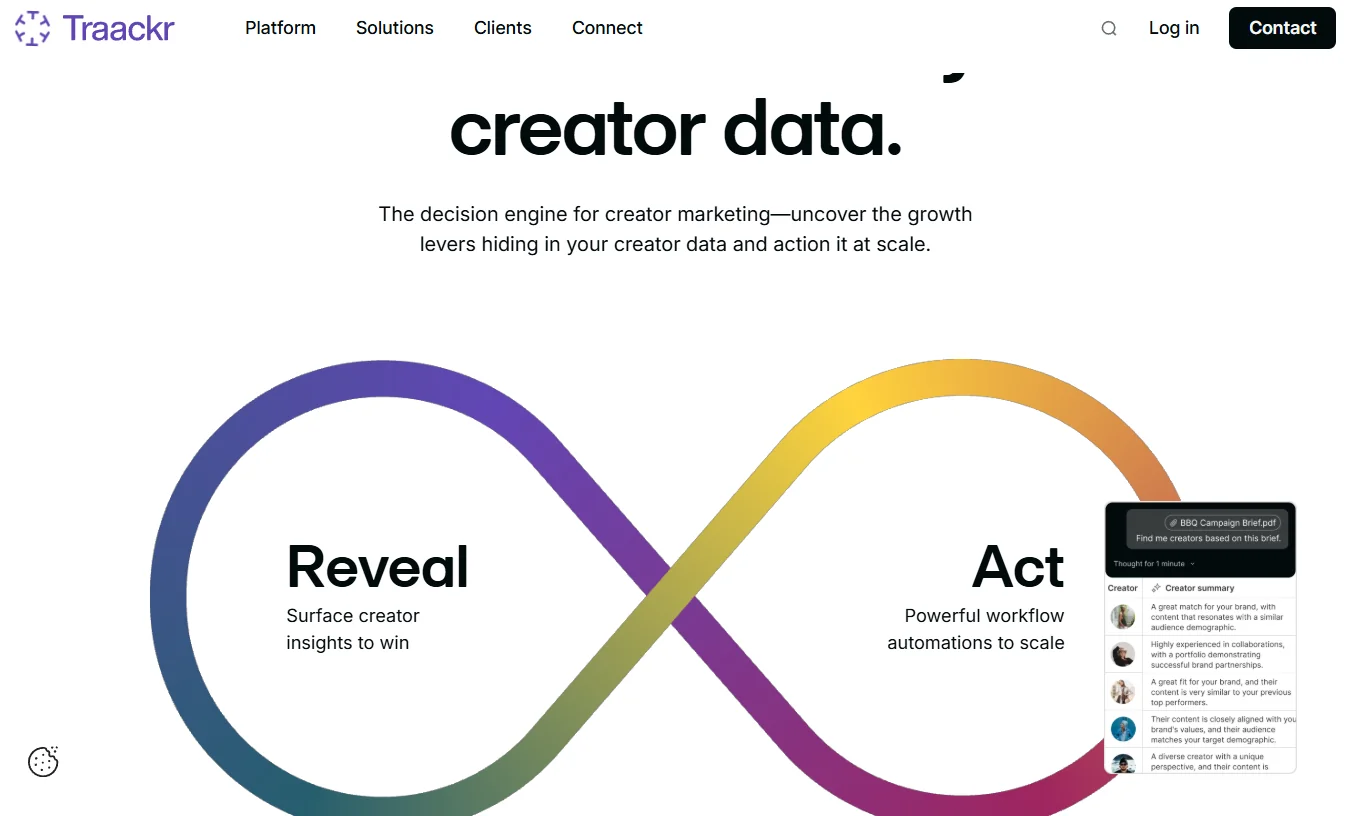
Traackr has been around since 2008, which makes it one of the oldest names in the category. It positions itself as an Influencer Relationship Management platform, or IRM, and the framing matters. Traackr isn't trying to be the place where you launch your first gifting campaign. It's trying to be the single system of record for a global program that spans markets, currencies and dozens of internal stakeholders.
The client list tells you the same story. L'Oréal, Shiseido, Colgate-Palmolive and Samsung all run programs on it, and the platform leans heavily into beauty, luxury, fashion and CPG. Roughly 110 employees across San Francisco, New York, Boston, London and Paris support that kind of account.
Day to day, a Traackr user searches a database of millions of creator profiles across 13 platforms, saves them into shared lists with ownership assigned across the team, logs every interaction, then measures what came out of it against a set of standardized KPIs.
Enterprise Measurement and EMV
This is Traackr's real product. Earned Media Value calculations, cross-market reporting, custom dashboards and exportable live links for stakeholders. If you need to walk into a quarterly review and show what influencer marketing returned against a consistent methodology, few platforms in the category do it with this much rigor.
Competitive Benchmarking
Traackr lets you compare your program's performance against named competitor brands in your category. You can see which creators your rivals work with, what their share of voice looks like, and where you sit against a category baseline. It's an add-on that pushes the price up, and it's genuinely hard to replicate elsewhere.
Audience Quality and Brand Safety
Reviewers consistently call out the vetting depth. Fake follower analysis, audience demographics, authenticity scoring and ongoing content monitoring all sit in the platform. For regulated categories like beauty and food, that compliance layer does real work. The trade-off is that this level of vetting is aimed at long-term partnerships rather than the volume-driven micro-influencer campaigns most smaller brands run.
Relationship Management at Scale
Every creator gets a profile that merges contact details, collaboration history, performance data and internal notes. Teams assign relationship owners, add custom fields, and keep a shared history so nothing gets lost when someone leaves the company.
Where Traackr Falls Short
The cost and the commitment. Traackr sells annual contracts with no monthly billing, the entry tier reportedly requires a three-user minimum, and implementation can take around two months before you see anything. Add-ons for extra markets, API access or additional seats are quoted separately and stack on top. There's no self-serve trial either, so evaluating it means booking a sales call. For a brand that wants to run five gifting campaigns and see what happens, that's a lot of friction before the first product ships.
What Is Afluencer?
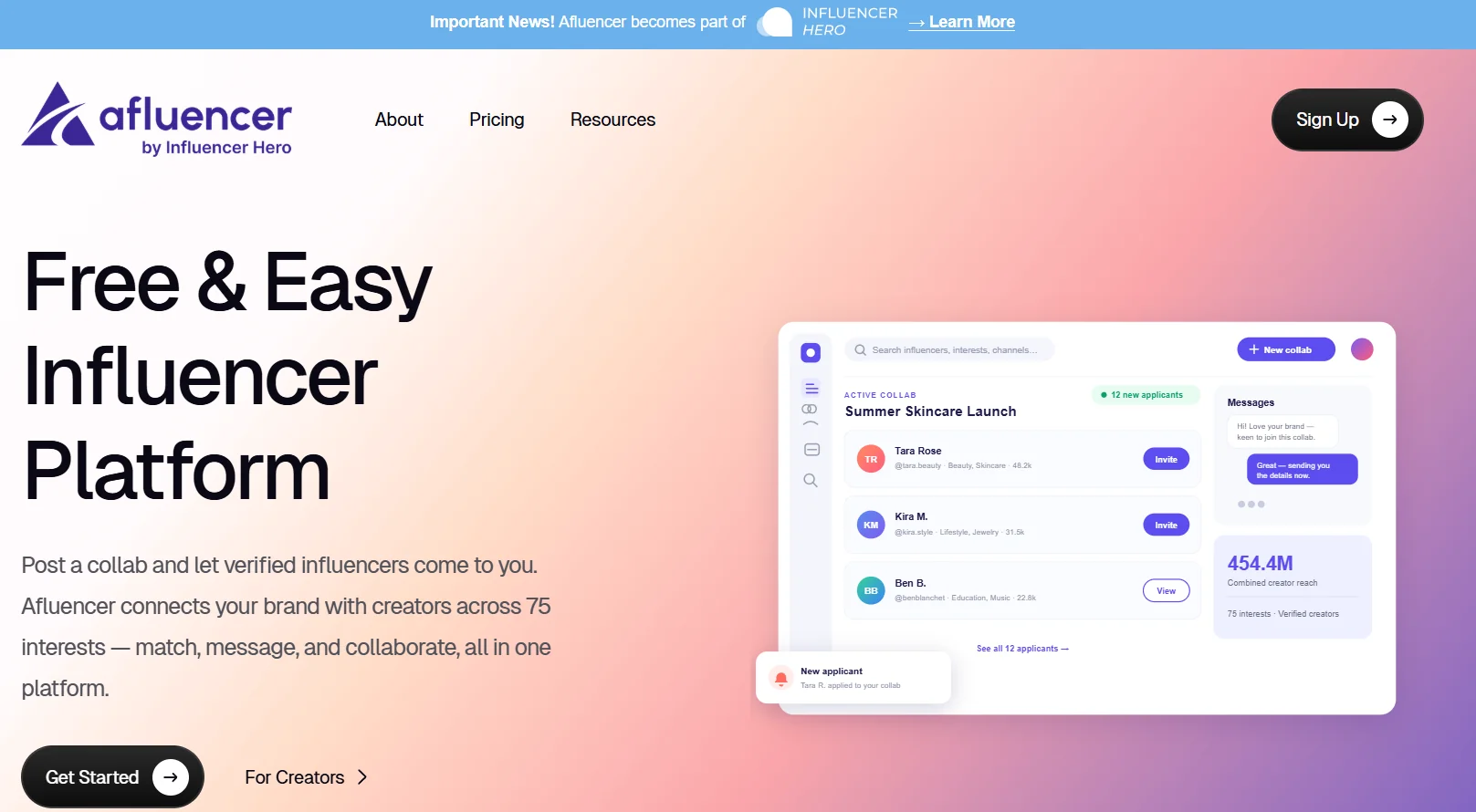
Afluencer works in the opposite direction. Instead of paying for a database and going hunting, you post a Collab describing what you need, and verified creators apply to it. Your inbox fills with people who already want to work with you, which flips the entire response-rate problem.
The creator base sits at 20K+ verified, active profiles across Instagram, TikTok, YouTube and Facebook. Smaller than an enterprise index by design, because these are creators who signed up specifically to find brand deals rather than names scraped into a database. You can also search the directory directly by niche, platform, location and follower size when you'd rather go outbound.
Afluencer is built for brands with small teams and tight budgets, which is exactly who struggles most with enterprise tooling. Brand plans start at $49 a month on the Marketplace tier.
Inbound Creator Applications
Posting a Collab and reviewing applications removes the single most expensive part of influencer marketing, which is cold outreach that goes nowhere. Everyone who applies has read your brief and opted in. You can see how matching works in more detail, but the short version is that fit gets sorted before you ever send a message.
Speed to First Campaign
There's no implementation project, no onboarding call and no annual contract. You create a brand profile, post a Collab and start getting applications. For a team testing whether influencer marketing works for their product at all, going live in an afternoon beats a two-month rollout.
Accessible Pricing for Smaller Teams
At $49 a month, the entry tier costs less than most brands spend on a single gifted product run. That price point is why Afluencer works so well for small brands that can't justify a five-figure software line item before they've proven the channel.
CreatorGPT for Strategy and Matching
CreatorGPT is Afluencer's AI assistant, trained on real influencer marketing workflows rather than general marketing advice. Ask it to find micro creators in a specific niche and city and it returns a shortlist with reasoning, instead of a raw filtered list you still have to evaluate yourself.
Where Afluencer Falls Short
Reporting stays basic. There's no EMV modeling, no competitive benchmarking, and no affiliate link attribution tying creator content to revenue. The database is intentionally smaller than an enterprise index, so if you need a specific creator in a specific market who hasn't joined the marketplace, you won't find them there.
Influencer Hero exists precisely for brands that hit these limits, and it's the upgrade path from Afluencer. Affiliate links with real sales attribution, ROI reporting tied to revenue instead of estimated media value, outbound discovery across Instagram, TikTok and YouTube, plus automated outreach to creators who never applied to your Collab.
Afluencer solves the getting-started problem well. When your program outgrows it, the answer sits one tier up in the same family, and the section below breaks down exactly what that looks like.
Traackr vs Afluencer: Feature-by-Feature Breakdown
Influencer Discovery
Traackr indexes millions of profiles across 13 platforms with 15+ filter criteria, plus a scoring algorithm designed to surface genuine influence rather than follower count. Afluencer covers four platforms with a directory you can filter, but its real discovery mechanism is inbound applications. One gives you scale and control. The other gives you creators who already raised their hand.
Outreach and Communication
Neither platform automates outreach at volume. Traackr manages conversations inside its IRM workspace, so a team can see who owns which relationship and what was last said, but the sending is manual. Afluencer keeps everything in direct in-app messaging with creators who applied to your Collab. If you're running cold outreach at scale, both leave you doing the work yourself, and it's worth reviewing solid outreach techniques before you commit to either workflow.
CRM and Campaign Management
This is Traackr's strongest gap over Afluencer. Shared creator profiles, assigned owners, custom fields, collaboration history, briefs and deliverable tracking, all built for multiple teams working across multiple markets. Afluencer's campaign management covers what a small team needs, which is applications, approvals, messaging and shipping details, without the collaboration layer a global org requires.
Tracking and Analytics
Traackr wins on depth by a wide margin. Real-time content monitoring, hashtag and keyword tracking, EMV, share of voice and data lake integration for combining influencer data with internal sources. Afluencer gives you basic campaign visibility. Neither one, and this catches brands out, does affiliate link attribution tying a creator's post to a specific order.
Integrations and Ecommerce
Traackr tracks influencer fees, payments and budgets in-platform, and has an AI feature that suggests appropriate creator fees based on engagement rate. What it doesn't do is plug into your store to automate product gifting or commission payouts the way a DTC-focused tool does. Afluencer handles product shipping through direct creator communication and includes influencer payments from its Standard plan.
Pricing: What You'll Actually Pay
Traackr doesn't publish pricing. Third-party sources report the Growth plan starting around $25,000 a year for a three-user minimum, climbing to roughly $33,000 a year once you add competitive benchmarking, with higher tiers reaching $55,000 and beyond. Everything is annual. There's no monthly option, no self-serve trial, and API access sits behind the top tier.
Afluencer publishes its numbers. Marketplace is $49 a month and includes 60 invitation credits, premium influencer filters and support by phone, email and live chat. The Standard plan is $649 a month and adds 1,000 reach outs monthly, product shipping and influencer payments. Pro runs $1,049 a month with 5,000 reach outs, a dedicated account manager and 3+ seats. You can see the full breakdown on the Afluencer pricing page.
Here's the practical math. Traackr's entry point works out to roughly $2,000 a month before add-ons, locked for twelve months. If your total influencer budget for the year is under $50,000, you'd be spending half of it on software before a single creator gets paid. That's the reason brands validating the channel start on a monthly plan and scale the tooling once the program earns it.
Scaling Beyond the Marketplace: Where Influencer Hero Fits
There's a real gap between these two. Afluencer gets you creators. Traackr gets you enterprise measurement. Neither one runs the full operational workflow a growing DTC brand needs, which is discovery, automated outreach, CRM, affiliate tracking, creator payouts and store integration in one system.
That's the job Influencer Hero does, and it's the natural next step once Afluencer has proven the channel works for you. The two products are connected: Afluencer's Standard plan and above unlock access to the Influencer Hero platform, so upgrading is a step up rather than a migration.
Influencer Hero covers discovery across Instagram, TikTok and YouTube with fake follower detection and lookalike search, then automates the outreach sequences that both Traackr and Afluencer leave manual.
From there it handles the parts that actually decide whether influencer marketing turns a profit: affiliate links with real sales attribution, automated creator payouts, product gifting through Shopify and WooCommerce, UGC collection, and ROI reporting that ties content to revenue instead of estimated media value.
Pricing is public, which matters when you're comparing against a quote-gated enterprise tool. Standard is $649 a month for up to 1,000 creators, Pro is $1,049 for up to 5,000, and Business is $2,490 for up to 10,000. That's roughly a third of Traackr's reported entry cost, with a shorter commitment and an end-to-end workflow instead of a measurement layer.
If your program has outgrown the marketplace and you want to see what running it end to end looks like, book a demo with Influencer Hero.
Which Platform Is Right for You?
Traackr earns its position with global brands for a specific reason. If you run influencer programs across a dozen markets, need standardized KPIs your CFO will accept, and want to benchmark your share of voice against named competitors, Traackr is built precisely for that job. The measurement depth and the compliance tooling are the product, and they're serious.
Afluencer makes sense at the other end. You're testing the channel, you want creators who actually respond, and you need to launch this month rather than next quarter. Posting a Collab and reviewing applications gets you there for $49 a month, and it's the fastest way to find out whether influencer marketing works for your product before you commit real budget to software.
If you're weighing several options at once, our guide on choosing a platform covers the questions worth asking first. Influencer Hero fits the stage in between, which is where most growing DTC brands actually sit. You've validated the channel, you're working with more creators than a spreadsheet can hold, and the bottleneck has shifted from finding people to running the operation.
When you need outreach automation, affiliate attribution and creator payments in the same place your discovery lives, that full workflow works better as one system than as three.
The Bottom Line
Traackr answers "what did our influencer program return across every market?" Afluencer answers "how do I get good creators to work with us this month?" Those are different problems, and picking the wrong one costs you either budget or momentum.
Most brands hit the second problem first, then grow into needing more than a marketplace can offer. That's the point where Influencer Hero takes over, with the outreach automation, affiliate tracking and payouts that turn a set of collabs into a program.
Not there yet? Start where the risk is lowest. Post your first Collab on Afluencer from $49 a month and let creators come to you.
Frequently Asked Questions
<details class="ih-faq"><summary>What's the main difference between Traackr and Afluencer?</summary><div class="ih-faq-a">Traackr is an enterprise measurement platform where you search a database and prove program ROI across markets. Afluencer is a marketplace where verified creators apply to your campaigns. One is built for global brands with dedicated influencer teams, the other for brands getting started.</div></details><details class="ih-faq"><summary>How much does Traackr cost per year?</summary><div class="ih-faq-a">Traackr doesn't publish pricing. Third-party sources report the entry Growth plan starting around $25,000 a year with a three-user minimum, rising to roughly $33,000 with competitive benchmarking and $55,000+ for higher tiers. All plans are annual, with no monthly billing option.</div></details><details class="ih-faq"><summary>Does Traackr track affiliate sales?</summary><div class="ih-faq-a">No. Traackr tracks influencer fees, campaign budgets and Earned Media Value, but it doesn't attribute individual sales to creator affiliate links. If you need commission tracking tied to real orders, that sits with platforms built around ecommerce, like Influencer Hero.</div></details><details class="ih-faq"><summary>Can I use Afluencer and Influencer Hero together?</summary><div class="ih-faq-a">Yes. They're two connected products from the same family. Afluencer's Standard plan and above unlock access to the Influencer Hero platform, so brands typically start on Afluencer to find creators, then move up to Influencer Hero once they need automation, affiliate tracking and payouts.</div></details><details class="ih-faq"><summary>Which platform works better for a brand with under $5,000 a month in influencer budget?</summary><div class="ih-faq-a">Afluencer, comfortably. At $49 a month, software takes a tiny slice of your budget and the rest goes to creators and product. Traackr's roughly $2,000 a month entry point would eat close to half your spend before a single campaign runs.</div></details><details class="ih-faq"><summary>Tagged In:</summary><div class="ih-faq-a">blog, influencer marketing platforms, comparison, finding an influencer, influencer marketing</div></details><script type="application/ld+json">{"@context":"https://schema.org","@type":"FAQPage","mainEntity":[{"@type":"Question","name":"What's the main difference between Traackr and Afluencer?","acceptedAnswer":{"@type":"Answer","text":"Traackr is an enterprise measurement platform where you search a database and prove program ROI across markets. Afluencer is a marketplace where verified creators apply to your campaigns. One is built for global brands with dedicated influencer teams, the other for brands getting started."}},{"@type":"Question","name":"How much does Traackr cost per year?","acceptedAnswer":{"@type":"Answer","text":"Traackr doesn't publish pricing. Third-party sources report the entry Growth plan starting around $25,000 a year with a three-user minimum, rising to roughly $33,000 with competitive benchmarking and $55,000+ for higher tiers. All plans are annual, with no monthly billing option."}},{"@type":"Question","name":"Does Traackr track affiliate sales?","acceptedAnswer":{"@type":"Answer","text":"No. Traackr tracks influencer fees, campaign budgets and Earned Media Value, but it doesn't attribute individual sales to creator affiliate links. If you need commission tracking tied to real orders, that sits with platforms built around ecommerce, like Influencer Hero."}},{"@type":"Question","name":"Can I use Afluencer and Influencer Hero together?","acceptedAnswer":{"@type":"Answer","text":"Yes. They're two connected products from the same family. Afluencer's Standard plan and above unlock access to the Influencer Hero platform, so brands typically start on Afluencer to find creators, then move up to Influencer Hero once they need automation, affiliate tracking and payouts."}},{"@type":"Question","name":"Which platform works better for a brand with under $5,000 a month in influencer budget?","acceptedAnswer":{"@type":"Answer","text":"Afluencer, comfortably. At $49 a month, software takes a tiny slice of your budget and the rest goes to creators and product. Traackr's roughly $2,000 a month entry point would eat close to half your spend before a single campaign runs."}},{"@type":"Question","name":"Tagged In:","acceptedAnswer":{"@type":"Answer","text":"blog, influencer marketing platforms, comparison, finding an influencer, influencer marketing"}}]}</script>